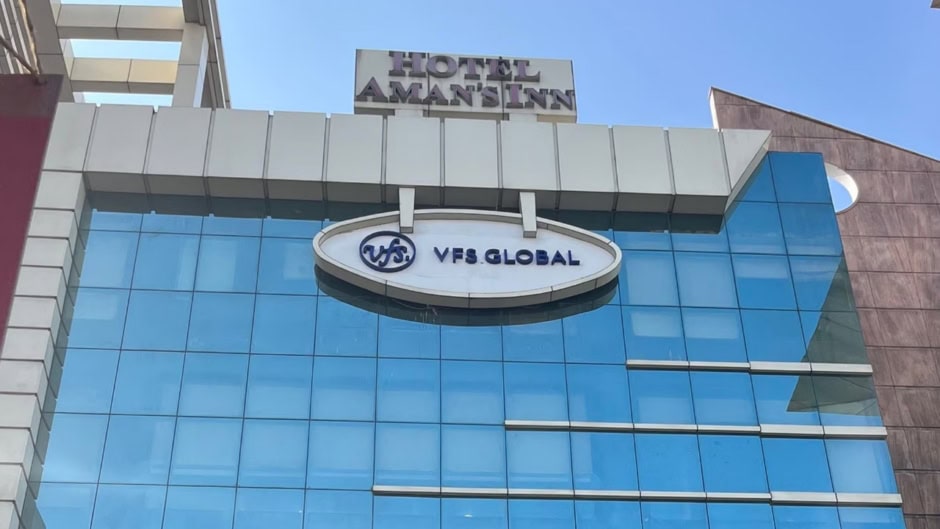
Applying for an international visa is already an expensive and stressful ordeal. However, a massive new international investigation reveals that private outsourcing giant VFS Global may be making that process significantly harder, and much more costly.
An extensive, year-long probe by Lighthouse Reports and 14 media partners has pulled back the curtain on the world’s largest visa outsourcing company. The findings paint a troubling picture. The investigation alleges that VFS Global routinely pressures, misleads, and forces visa applicants into buying paid add-on services that are officially entirely optional.
Turning Borders into a Billion-Dollar Business
VFS Global was founded in 2001. Today, it has grown into a multi-billion-dollar empire. Its owners include Dubai’s ruling family and a major donor to Donald Trump. The company currently holds lucrative visa outsourcing contracts with 71 governments worldwide.
While applicants must pay a mandatory service fee to process their applications, VFS Global has built a massive adjacent business around selling premium add-ons. These value-added services (VAS) include:
- SMS tracking updates
- Courier passport return services
- Document scanning
- Premium lounge access
Between 2017 and 2024, VFS Global’s profits increased fourfold. According to consolidated financial statements in Luxembourg, the company’s revenue grew completely out of proportion to the actual number of visas it processed. VFS itself consistently attributes this immense growth to its value-added services. For instance, financial accounts from a subsidiary in India show that its premium services business achieved pre-tax profit margins of up to 70%.
Furthermore, investigators analyzed more than 2,000 application receipts obtained through Freedom of Information (FOI) requests from Swedish embassies across 16 Asian and African countries. Using machine reading, they established that these optional, value-added services account for a staggering 30% of VFS Global’s total revenue in that sample.
Low Pay & High Pressure: Inside the Sales Machine
Why are these optional services pushed so aggressively? Current and former VFS employees reveal that the company’s internal system creates perverse incentives.
Staff are typically paid low base salaries. However, management ties their financial bonuses directly to meeting monthly sales targets for optional add-ons. In Nigeria, a current visa officer noted that contractors make up the majority of the workforce. They earn a base salary of just €126 a month. Crucially, the bonuses for selling premium services can amount to almost twice their base salary. Consequently, staff face relentless workplace pressure to sell.
Former employees confessed that this pressure led to dishonest tactics. An ex-employee who worked in Kenya until 2024 revealed that staff routinely added paid services directly to customers’ bills without their explicit consent.
Similarly, Rohit Taneja, a former visa operations officer in Delhi (2016–2017), explained that staff had strict targets for SMS and courier sign-ups. He stated that employees had to persistently pitch and convince applicants, even after they explicitly said no. Because many first-time travelers mistake VFS staff for actual embassy officials, they rarely deny the requests.
VFS Global Exploiting a Captive Market
This aggressive upselling disproportionately targets applicants from Asia, Africa, and the Middle East. These individuals hold “weak” passports and already face strict visa regimes. Because they have no alternative route to travel, they become a captive market.
Applicants frequently report immense confusion. Many are unsure which services are legally required and which are optional. In many cases, travelers feel they have no practical choice but to pay extra to keep their applications moving forward.
For example, last June, a 71-year-old applicant named Vrinda traveled through torrential rain and heavy traffic to reach the VFS office in Pune, India. She was applying for a visa to visit her son and new granddaughter in Belgium. Because of the weather, she arrived 15 minutes late. Instead of accommodating her, a VFS officer gave her a harsh ultimatum: go home and book a completely new appointment, or immediately pay €35 for the “premium service.” Vrinda, who uses a walking stick and suffers from back problems, felt shocked but complied. The forced fee equaled her entire monthly grocery budget.
Data Violations, Bribery & Government Negligence
The investigation’s findings extend far beyond aggressive sales tactics. Data experts reviewed VFS Global’s handling of personal information and discovered repeated mishandling. They described these actions as “manifestly serious violations of the GDPR”.
Additionally, the report highlights severe corruption risks. Applicants in some countries face bribery from external agents and VFS staff. In fact, undercover footage obtained in the Democratic Republic of Congo (DRC) caught a VFS staff member claiming they could guarantee a visa in exchange for an illicit, higher payment.
Despite these rampant issues, contracting governments rarely take robust action. Investigators reviewed internal EU documents from 22 Schengen zone countries and leaked reports from the European Commission’s diplomatic service. The documents prove that European governments are fully aware of these consistent service deficiencies and data violations. However, outsourcing allows these governments to offload a core state function onto a private entity, shifting the financial burden entirely onto vulnerable applicants.
Public backlash is growing. An online petition launched by Joyce José, an Angolan-British national, demands a permanent systemic fix. She states that VFS has built a “digital wall” and operates as an unaccountable monopoly service provider with zero incentive to fix its broken systems.
VFS Global Denies All Allegations
VFS Global strongly rejects the investigation’s findings. The company told Lighthouse Reports that any suggestion its financial growth stems from improper conduct is completely false.
The company maintains that its optional services are clearly presented to applicants. It stresses that these services are never mandatory for a visa decision. Furthermore, VFS emphasizes that embassies and governments hold the sole authority to approve or reject visa applications, not the outsourcing provider.
For millions of global travelers, the takeaway from this investigation is clear. Before paying anything extra at a visa center, carefully check and verify exactly which services are legally mandatory and which are strictly optional.