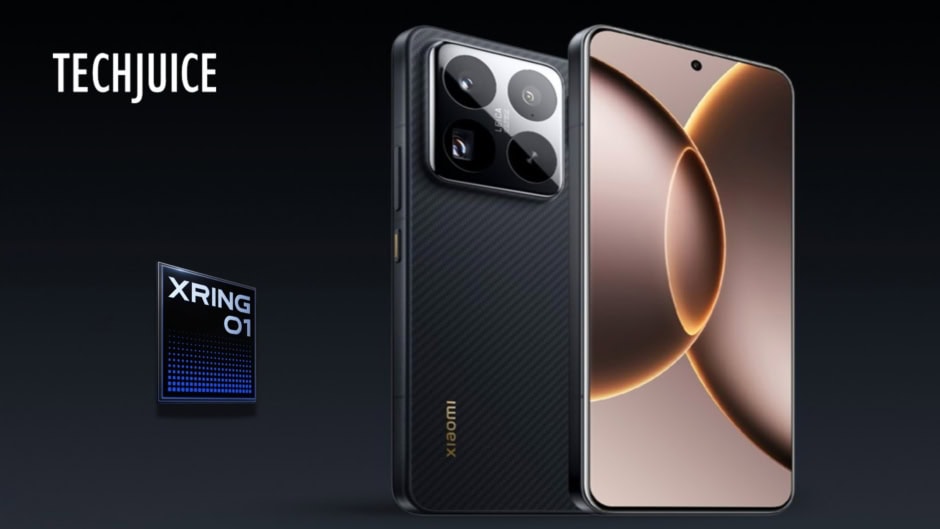
Xiaomi just threw down the gauntlet. With the launch of its 15S Pro smartphone powered by its first-ever in-house flagship chip, the Xring O1, the tech giant isn’t just making phones anymore; it’s rewriting the rules of the mobile game.
This strategic leap signals a bold break from third-party chipmakers and cements Xiaomi’s ambition to dominate not just devices, but the silicon that fuels them.
Xring O1: A Leap in Processing Power
Xiaomi’s Xring O1 chipset is built using TSMC’s cutting-edge 3nm technology. It compresses nineteen billion transistors into a small 109mm² chip. That represents significant density for significant power.
Inside the chip are ten-core CPUs. Running at 3.9GHz, it comprises two high-performance Cortex-X925S. Four Cortex-A725 clocks at 3.4GHz, and the other two Cortex-A725 efficiency cores run at 1.9GHz. The rest Cortex-A520 cores run at 1.8GHz.
The Xring O1 doesn’t hold back on visuals and artificial intelligence. Its graphics are housed on a 16-core Immortalis-G925 GPU. Along with it is a 6-core NPU designed especially for artificial intelligence tasks. They provide an efficiency trifecta with smart on-device experiences, rapid multitasking, and smooth gameplay.
Benchmark data give an interesting tale. On several tests, Apple’s A18 Pro is either matched or even surpassed by Xring O1. That’s a bold claim—and evidence of Xiaomi’s growing influence in bespoke chip creation.
Xiaomi 15S Pro: Flagship Features
The 15S Pro keeps the sleek and modern design of its predecessor. It sports a 6.73-inch LTPO AMOLED display with a 3200×1440 resolution, 120Hz refresh rate, and a stunning peak brightness of 3,200 nits. It’s protected by Dragon Crystal Glass 2.0 and includes an ultrasonic fingerprint scanner under the screen.
Under the hood, the device boasts 16GB of LPDDR5T RAM and offers up to 1TB of UFS 4.1 storage. Its 6,100mAh battery supports 90W wired and 50W wireless charging, ensuring users get back to full power in no time.
Photography enthusiasts will enjoy its triple camera setup, led by a 50MP main sensor. It also includes an ultra-wide lens and a 5x periscope telephoto camera. The phone runs on Xiaomi’s latest HyperOS 2, based on Android 15.
Strategic Implications
The Xring O1 didn’t happen overnight. It’s the result of a four-year development cycle and over 13.5 billion yuan (around $1.87 billion) in investment. Xiaomi aims to pour another $7 billion into chip design and development over the next decade.
Even though Xiaomi will continue using Qualcomm’s Snapdragon 8-series chips in select future models, the introduction of Xring O1 marks a major step toward greater control over its hardware ecosystem.
Global Availability
While the phone launched first in China, the Xiaomi 15S Pro is now available worldwide through platforms like Geekwills. The base model with 16GB RAM and 512GB storage is priced at $949. Buyers can choose between elegant Black and Blue color options.
Xiaomi’s launch of the 15S Pro and its in-house Xring O1 chip signals a transformative shift in its ambitions. It’s not just about powerful phones anymore—it’s about controlling the future of its technology from the inside out.