On March 10, 2026, Pakistan will hold the most consequential technology auction in its history. The Pakistan Telecommunication Authority has confirmed the Spectrum Auction for Next Generation Mobile Services and 5G will be conducted on March 10, 2026, following constructive regulatory coordination and extensive stakeholder consultations aimed at ensuring a smooth, transparent, and well-participated process.
The auction has been years in the making, repeatedly delayed, and repeatedly promised. This time, the financial guarantees are in place, the bidders are qualified, and the spectrum is ready to be assigned. What happens next will shape Pakistan’s digital economy for the next decade. This analysis examines what the 5G auction actually delivers, what it does not, and what it means for every major stakeholder from the average mobile user to the startup founder in a Lahore co-working space.
What Is Actually Being Auctioned
The auction will cover around 597.2 MHz of spectrum across low, mid, and high bands, including 700 MHz, 1800 MHz, 2100 MHz, 2300 MHz, 2600 MHz, and the globally preferred 3500 MHz band, ensuring nationwide 5G coverage and capacity.
Base prices have been set in US dollars, with the 700 MHz band priced at $6.5 million per MHz, the 1800 MHz and 2100 MHz bands at $14 million per MHz each, the 2300 MHz band at $1 million per MHz, the 2600 MHz band at $1.25 million per MHz, and the 3500 MHz band at $0.65 million per MHz. Payments will be made in Pakistani rupees at the State Bank’s prevailing exchange rate, with operators given the flexibility to pay the full license fee by the first anniversary of issuance or opt for deferred payments with at least 50 percent payable in year one.
Three major telecom operators have submitted applications: Pak Telecom Mobile Limited (Ufone), Pakistan Mobile Communications Limited (Jazz), and CMPak Limited (Zong). The auction is projected to generate up to $700 million in revenue for the national exchequer, and major telecom operators have already deposited multi-million dollar guarantees.
What Happens to Internet Speeds: The Honest Answer
The first question most Pakistanis have is the simplest one: will my phone get faster? The answer is yes, but the timeline and geography of that improvement matters enormously.
PTA sources indicate that after the release of additional spectrum, average 4G speeds could increase from around 4 Mbps to 20 to 25 Mbps in urban areas. For most users, this improvement will be immediately noticeable. Faster loading times, smoother video streaming, and more reliable calls are benefits that will reach users even before full 5G rollout.
This is perhaps the most underappreciated aspect of the auction. Because the spectrum being released includes bands already used for 4G, the congestion relief will benefit the hundreds of millions of Pakistanis who will not have 5G-capable handsets for years. The person using a mid-range smartphone bought in 2023 will experience meaningfully faster internet simply because existing networks will no longer be as overcrowded.
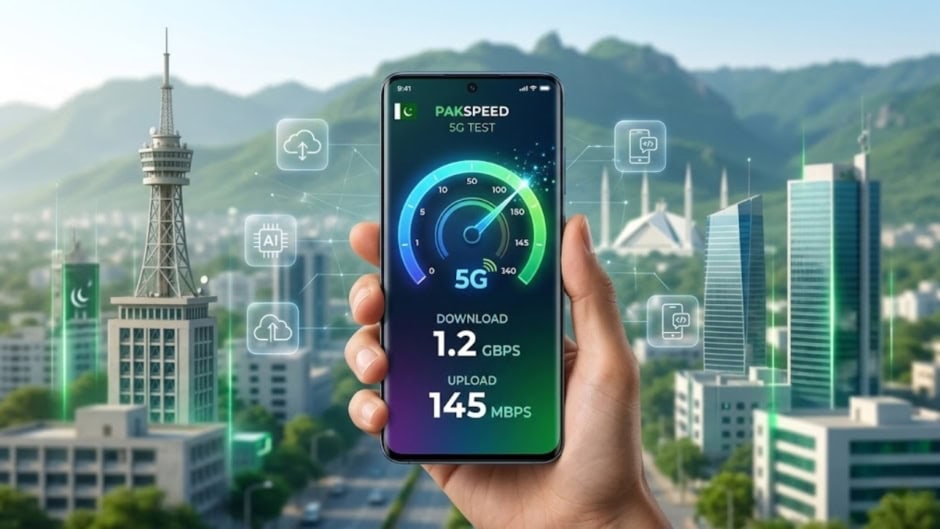
For 5G services, PTA has set a minimum downlink speed of 50 Mbps as part of mandatory Quality of Service requirements, ensuring that 5G delivers a meaningful upgrade rather than just a marketing label. In real-world conditions, with mature network deployment, speeds of 200 to 500 Mbps are achievable in dense urban areas, with peak theoretical speeds reaching into the gigabit range. Latency, which measures the delay between sending and receiving data, is expected to drop from the current 40 to 60 milliseconds on 4G to under 10 milliseconds on 5G. That reduction is invisible when you are scrolling social media but transformative for applications involving real-time machine communication.
Commercial rollout of 5G services is expected within six to seven months after license issuance, subject to regulatory approvals and network readiness. Initial rollout will be concentrated in Islamabad, Karachi, Lahore, Peshawar, and Quetta, with secondary cities following in subsequent phases. Pakistan’s rural majority should expect to wait considerably longer, a structural issue the auction’s design addresses partially through mandatory deployment obligations that stretch into the early 2030s.
Are Most Phones Already Ready?
One of the most positive and least discussed facts about Pakistan’s 5G transition is that the handset compatibility problem is largely already solved. Approximately 80 percent of mobile phones currently in circulation in Pakistan are said to support the key frequency bands required for 5G. This is a direct consequence of the global smartphone industry standardising on 5G chipsets across mid-range and premium devices, meaning that the millions of Pakistanis who bought a reasonably modern phone in the last two or three years are holding a device that can take advantage of 5G networks the moment they are switched on.
Affordable 5G-capable handsets have also begun entering the local market, with domestic assembly operations increasingly focused on sub-$150 5G devices. The constraint is not hardware. It is network infrastructure, which the auction now begins to resolve.
Impact on the Tech Sector and IT Exports
Pakistan’s IT export trajectory is the most compelling argument for why 5G matters beyond consumer convenience. The initial six months of FY26 recorded IT exports of USD 2.23 billion, a record growth of 19.5 percent over the same period last year, with December alone contributing USD 437 million. The country’s IT exports have grown from under a billion dollars in the late 2010s to over three billion in 2024, driven by software houses, freelancers, and increasingly sophisticated digital service firms.
The constraint that 5G directly addresses for this sector is connectivity reliability. Pakistani software houses working on international contracts frequently struggle with video conferencing quality, large file transfers, and real-time collaboration tools. When a team in Lahore is trying to run a standups call with a client in Toronto, a 4 Mbps connection with 50ms latency and regular packet loss is not merely inconvenient. It is a competitive disadvantage that makes Pakistan-based teams appear less professional and less reliable than peers in India, the Philippines, or Eastern Europe, countries where broadband infrastructure has long been superior.
5G’s impact here operates on two levels. At the individual level, remote workers and freelancers gain access to stable, high-speed mobile internet that can substitute for or supplement fixed-line broadband, particularly in areas where fibre has not yet penetrated. At the sector level, reliable connectivity makes Pakistan a more attractive destination for nearshore and offshore digital services contracts, gradually improving the country’s reputation as a delivery location.
Freelancers working with international clients could see productivity gains. Startups experimenting with immersive technologies, augmented reality, or advanced gaming platforms may find 5G infrastructure essential to scaling their ideas.
What 5G Means for Pakistan’s Startup Ecosystem
Pakistan’s startup ecosystem raised approximately $350 million in 2022 before a global funding drought hit hard in 2023 and 2024. The recovery has been cautious. Investor confidence has been tied closely to macroeconomic stability and the quality of digital infrastructure, both of which the 5G auction improves in measurable ways.
The most immediate beneficiaries are startups in sectors where connectivity is the limiting technical factor. Healthtech companies building telemedicine platforms have long been hamstrung by the reality that a remote consultation requires consistent video quality that Pakistan’s current mobile networks cannot reliably provide. With 5G, a specialist in Shaukat Khanum could guide a procedure in a remote Gilgit clinic in real-time, revolutionising healthtech in Pakistan.
Edtech startups face the same constraint. Live interactive online learning requires latency low enough that the experience does not feel like talking to someone on a delay. The current mobile internet quality in Pakistan makes truly synchronous online education difficult to deliver at scale outside the largest cities. 5G changes that calculation for urban areas immediately and sets the infrastructure foundation for eventual rural expansion.
E-commerce is another sector with direct 5G dependencies. E-commerce startups can offer better customer experiences with faster loading, high-quality product videos, and AR try-before-you-buy features. Delivery logistics improve with real-time tracking and route optimisation. Pakistan’s e-commerce market, already projected to exceed $14 billion in value, has been operating with a mobile web experience that lags significantly behind regional peers. Faster, more reliable mobile internet closes that gap.
Fintech, already one of Pakistan’s most active startup sectors, stands to benefit from 5G’s capacity to support real-time financial processing, instant transaction verification, and the kind of always-on connectivity that digital banking requires. Pakistan’s aim is to have 15 billion digital transactions by June 2026 and full digitisation of government payments. Achieving that target is significantly easier when the underlying mobile network can handle high transaction volumes without congestion-driven failures.
The longer-term and more transformative opportunity lies in IoT and industrial applications. Smart cities: intelligent traffic systems that adapt in real-time could reduce Karachi or Lahore’s infamous traffic jams. Industrial IoT: factories will become smarter with connected machinery, enabling predictive maintenance and boosting Pakistan’s manufacturing output. Pakistan has a large manufacturing base in textiles, food processing, and light industry. Connecting that base to 5G-enabled IoT platforms could improve productivity, reduce waste, and make Pakistani factories more competitive in a global market that is rapidly moving toward automation.
The Structural Challenges That 5G Does Not Solve
Intellectual honesty requires acknowledging what the 5G auction cannot fix. The sector’s long-term health hinges not just on releasing more spectrum but on aligning auction policy with sustainable deployment models that address both urban data demand and rural connectivity gaps.
The first is infrastructure cost. Building out 5G requires far denser tower networks than 4G because high-frequency 5G signals do not travel as far and are blocked more easily by buildings. Pakistani operators are already financially stretched. The capital required to deploy 5G meaningfully across a country of 240 million people spread across varied geography is immense, and license fees paid in the auction come directly out of the capital available for network build-out.
The startup ecosystem faces the same problem as always: limited funding, small addressable market, and infrastructure that is not quite good enough yet. 5G helps, but it is not a magic solution to Pakistan’s startup challenges.
The second is the urban-rural divide. 5G will launch in five major cities and will remain a largely urban technology for years. Pakistan’s rural population, which accounts for roughly 60 percent of the total, will continue to experience connectivity as a limiting factor on economic participation for the foreseeable future.
The third is complementary infrastructure. 5G backhaul requires fibre. Pakistan’s fibre penetration outside major urban centres remains limited. Without fibre connecting towers to the internet backbone, 5G towers cannot deliver their theoretical speeds regardless of how much spectrum operators hold.
The Geopolitical and Investment Context
The 5G auction does not happen in a vacuum. It occurs at a moment when Pakistan is actively competing with India, Bangladesh, and Vietnam for a share of the global digital services market, and when international investors are watching whether Pakistan can execute on infrastructure promises after years of delays.
While the delay pushes back immediate 5G deployment, the additional preparation period ensures smoother implementation and fair competition among telecom operators. The fact that the auction has moved forward with financial guarantees deposited and qualified bidders named suggests a level of institutional follow-through that previous Pakistani telecom policy milestones have not always demonstrated.
The $700 million in expected auction revenue also provides the government with fiscal breathing room and signals to the IMF and bilateral creditors that Pakistan’s reform trajectory includes genuine infrastructure investment rather than purely austerity-driven adjustments.
The Bottom Line
Pakistan’s 5G auction is a genuine inflection point, not a silver bullet. For the average mobile user in a major city, the most meaningful near-term change will be relief from congestion on existing 4G networks, with speeds rising from roughly 4 Mbps toward 20 Mbps or more even before 5G services formally launch. For the tech sector and IT exporters, improved connectivity reliability makes Pakistan a more credible delivery location for international contracts. For startups, 5G opens product categories in healthtech, edtech, IoT, and industrial automation that have been structurally inaccessible on current infrastructure. For investors, the auction’s execution signals that Pakistan is moving from planning to implementation on digital infrastructure.
The arrival of 5G in Pakistan will not instantly solve economic challenges or eliminate structural gaps. But it marks a significant step in the country’s evolving digital narrative. For businesses, startups, and young professionals, it represents expanded possibility. For policymakers, it presents a responsibility to ensure equitable access and sustainable growth.
The auction on March 10 is day one of a build-out that will take years to mature. Whether Pakistan captures the full economic value of 5G depends on what operators do with the spectrum they win, what the government does to accelerate fibre deployment alongside wireless rollout, and whether the startup ecosystem can attract the capital needed to build the applications that make 5G genuinely transformative. The infrastructure is arriving. The opportunity is real. Executing on it is the harder part.