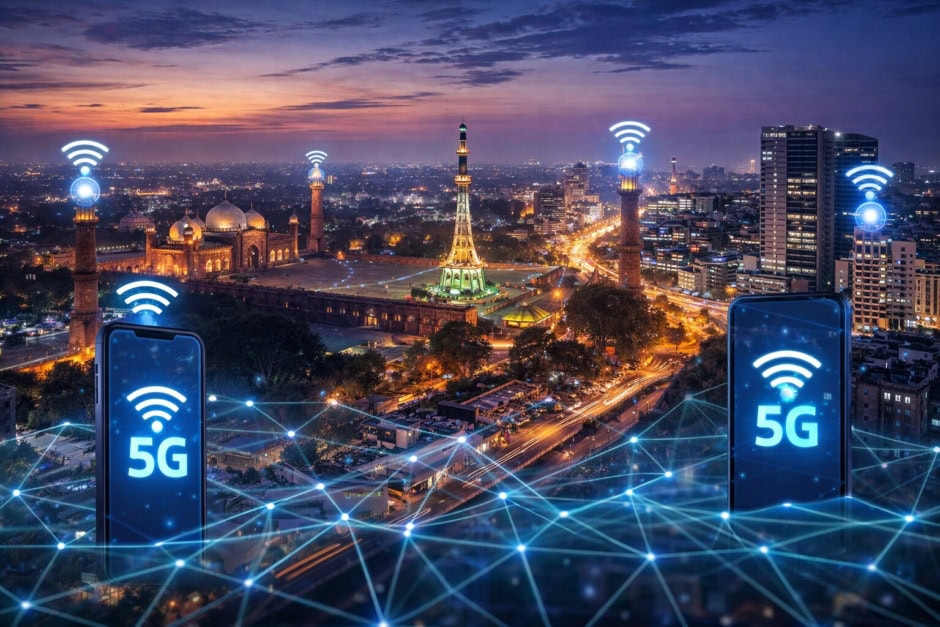
Pakistan has officially begun testing 5G networks in selected parts of Lahore, and early speed results are already drawing attention. Initial trials are delivering download speeds between 150 and 200 Mbps. However, industry experts believe telecom operators have deliberately capped performance for now to protect network stability during this early phase.
At this stage, testing remains limited to specific high-traffic zones. Users who own 5G-supported smartphones can check network speeds in the following areas:
- Garden Town
- Main Boulevard
- Main Market, Gulberg
- Lahore Airport
- Defence Club, DHA
- Hafeez Centre
- PC Hotel
- Aiwan-e-Iqbal
- PIC Hospital
- DHA Y Block, Phase 3
- G1 Johar Town, Jinnah Hospital
- MM Alam Road
- Barkat Market
- Fortress Stadium
- LCCI
- DHA Raya
- Model Town Link Road
- LSE
- Johar Town H1 Block
- CM Office
Telecom analysts expect network performance to improve as trials continue. Speeds will likely rise once operators adjust spectrum allocation and optimize equipment. In addition, coverage will expand to more neighborhoods after technical benchmarks are met. For now, users in these zones can test 5G and experience the difference compared to standard 4G speeds.
The broader picture shows a much larger digital push. IT Minister Shaza Fatima recently confirmed a major expansion of 4G services alongside 5G pilot launches in major cities next week. The government has released 480 MHz of additional spectrum, effectively tripling the country’s overall network capacity. As a result, operators like Jazz, Ufone, and Zong have already started testing next-generation services.
At the same time, policymakers are shaping the ecosystem around connectivity. The government plans to establish a national AI council to guide responsible innovation. New financing policies will also make smartphones more affordable through installment plans, which could increase 5G adoption.
Meanwhile, local mobile manufacturing continues to grow. Three submarine internet cables have recently landed in Pakistan, strengthening international bandwidth. The latest spectrum auction generated $510 million, adding financial momentum to telecom expansion.