LinkedIn has launched Crosscheck, a new tool enabling Premium members in the United States to test and compare outputs from multiple artificial intelligence models in a single interface. The platform provides insights to help users identify the best AI tools for their professional needs.
Crosscheck allows users to submit any prompt and receive responses from various AI tools without initially revealing which models generated each response. The platform currently supports models from OpenAI, Anthropic, Google, Microsoft and other providers, creating what LinkedIn describes as a taste-testing experience for AI capabilities.
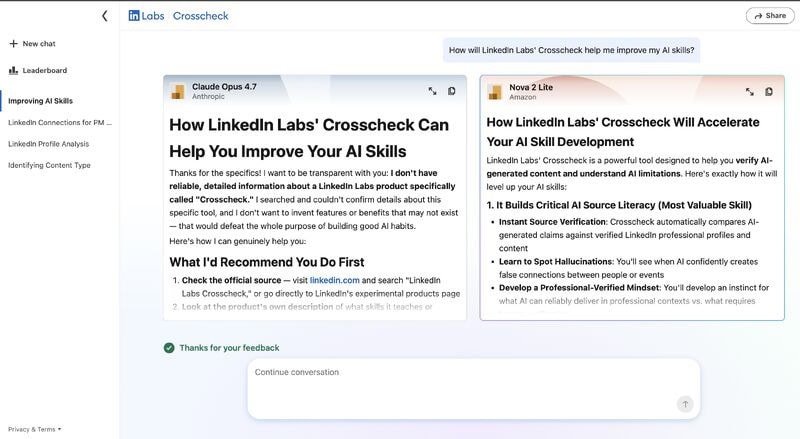
Within Crosscheck, Premium users enter prompts, and the system matches them with AI tools it can access. The platform then generates two responses from different models without identifying them, and users rate the responses for quality. LinkedIn uses these ratings to improve AI models and shares user conversations and feedback with AI developers.
The tool includes leaderboards showing top-performing AI models for Crosscheck queries across different professional verticals, providing sector-specific insight into which models perform best for particular types of work. This approach aims to offer more precise evaluation of each AI tool’s value for professional users compared to general benchmarks.LinkedIn’s parent company Microsoft has invested billions of dollars into OpenAI to secure access to its tools within Microsoft’s program suite, while simultaneously developing its own AI models to reduce reliance on OpenAI’s systems.
Despite potential conflicts of interest, the Crosscheck leaderboards display diverse rankings reflecting a broad range of AI models rather than favoring Microsoft-affiliated systems.
The launch represents another example of LinkedIn embracing the AI shift, which has become a central focus for the platform as it helps members navigate professional transitions. Posts about AI usage and adoption dominate LinkedIn feeds, with recurring themes emphasizing that while AI may not replace workers, those who use AI will replace those who do not.
However, actual business data on AI productivity gains tells a different story. A recent study published by the National Bureau of Economic Research surveyed 6,000 business executives across the United States, United Kingdom, Germany and Australia, finding that 89% reported seeing virtually no change in labor productivity over the last three years despite widespread AI adoption. While modest gains are expected in future, the projected benefits and actual reality have not aligned.
LinkedIn is, in fact, passing along data to the AI companies involved, who will likely use insights from LinkedIn activity to enhance their products. The company clarifies:
Anonymized data is shared with model builders to help them understand how their models are performing across various occupations… No personally identifiable information is shared with model builders.
Crosscheck specifically targets workplace applications including content creation, data analysis, coding assistance and professional communications. These are areas where LinkedIn members actively use AI daily. By collecting user ratings and feedback from its professional community, LinkedIn creates a feedback loop where real-world professional usage data helps improve AI models. This approach benefits AI developers seeking to understand how their models perform on professional tasks. It also helps LinkedIn members searching for the most effective tools.
The tool’s blind testing methodology, where users rate responses without knowing which model generated them, aims to reduce bias in evaluations. This approach mirrors scientific testing protocols and could provide more objective assessments than comparisons where users know which AI system they are evaluating.
Crosscheck currently remains limited to LinkedIn Premium members in the United States, though the company has not announced whether it plans broader rollout to international markets or free-tier users.