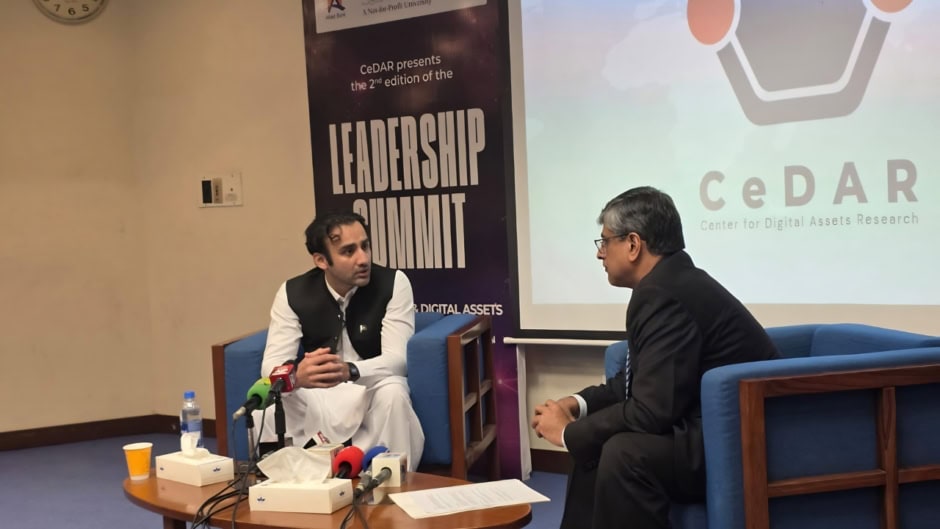
Pakistan is finally moving to address the massive, unregulated digital asset market. Policymakers and experts gathered in Lahore for the Leadership Summit on Blockchain and Digital Assets. The LUMS Centre for Digital Assets Research (CeDAR) hosted the event. During the summit, officials emphasized that rapid blockchain adoption, with approximately 40 million digital asset users, requires immediate policy intervention.
Bringing 40 Million Digital Asset Users into the Formal Economy
Currently, an estimated 40 million Pakistanis engage with digital assets. Most of these users operate through informal platforms. These platforms lack regulatory oversight, which creates high risks for consumers. Consequently, the government aims to bring these users into a formal financial system.
Minister of State Bilal Bin Saqib stated that the government must act decisively. He noted that “the universe rewards action, not intelligence.” Therefore, timely execution is the priority. Proper regulation will protect users while encouraging local innovation.
Securing $38 Billion in Remittances
The economic implications of this shift are massive. Pakistan receives approximately $38 billion in annual remittances. Blockchain-based settlement systems could make these inflows significantly more efficient. Furthermore, the freelance economy needs regulatory clarity to stay competitive.
The government has developed this regulatory approach in a short timeframe. Strong institutional support drives this progress. As a result, Pakistan now has a chance to shape global digital finance discussions. Waiting longer would only increase the country’s reliance on risky, unregulated systems.
The “Sandbox” Strategy & the Talent Gap
Pakistan will follow a risk-mitigated model for digital finance. The framework includes “sandbox” environments. These environments allow the government to test emerging technologies safely. Initially, the focus will remain on asset-backed tokenization. This strategy enables smaller investors to access real estate and financial instruments.
However, a major obstacle remains. Saqib identified talent as the “biggest gap” in the current ecosystem. He urged banks, technology firms, and academia to collaborate. Continuous learning is essential for long-term progress. The summit will continue to explore the integration of AI and regulated digital finance.