This Pakistani Startup Has Marked A Major Harvard Milestone
By Abdul Wasay|5 months ago |
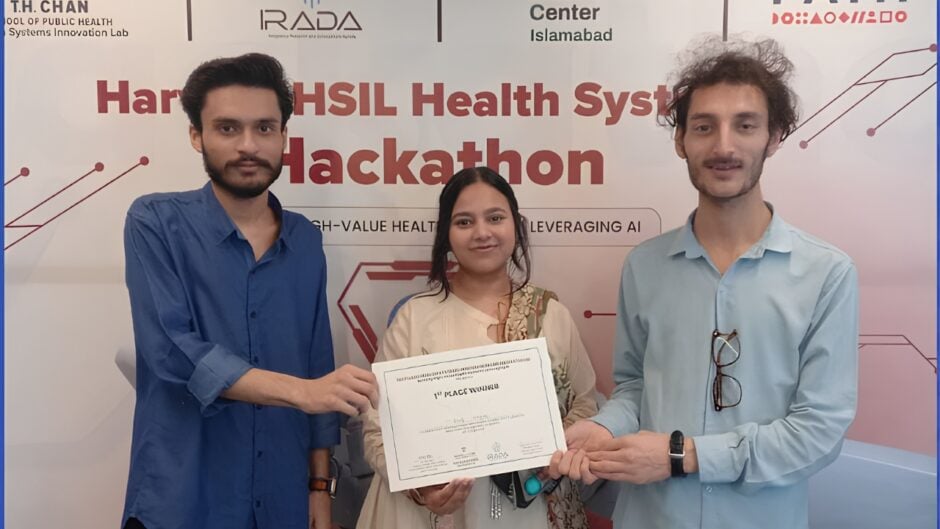
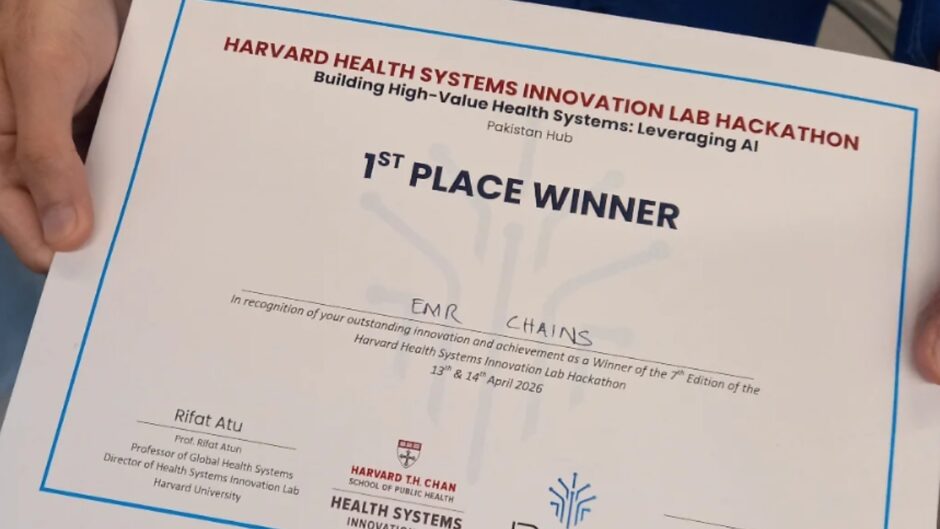
EMRChains, a Pakistani AI-powered healthcare startup incubated at National Incubation Center Islamabad, qualified among top 50 globally at Harvard Health Systems Innovation Lab Hackathon 2026. The team representing Pakistan IslamabadHub advanced from more than 1,800 applications worldwide with only 100 teams reaching the program marking a 7.2% selection ratio.
Following two weeks of intensive venture development and refinement during Bootcamp I at Harvard University, the team continues to showcase Pakistan’s growing potential in innovation and healthcare technology on the international stage.
In an exclusive conversation with TechJuice, team EMRChains shared their complete journey from observing Pakistan’s fragmented healthcare systems to competing at Harvard.
The Origin Story: From Fragmented Healthcare to AI-Powered Solutions
The idea behind EMRChains emerged from observing how fragmented and inefficient healthcare systems remain across Pakistan. Patients move between hospitals carrying paper files, prescriptions get misplaced, and doctors struggle to access complete medical histories. Healthcare facilities spend enormous time handling records and appointments manually creating operational bottlenecks.
The turning point came from witnessing how delays in accessing patient information directly affected quality of care and decision-making. Patients had to repeat tests or explain their medical history multiple times simply because records were unavailable or disconnected between healthcare providers. That experience highlighted a much larger issue beyond simple digitization needs.
“Healthcare systems did not just need digitization, they needed intelligent, connected infrastructure capable of supporting both patients and healthcare professionals efficiently,” they explained. “This became the foundation of EMRChains: building an AI-powered healthcare ecosystem focused on improving accessibility, simplifying healthcare operations, and creating smarter patient experiences.”
Understanding EMRChains: Beyond Traditional Electronic Medical Records
EMRChains is an AI-powered healthcare ecosystem designed to simplify how hospitals, doctors, and patients interact with healthcare services. For patients, the platform means easier appointment booking, smoother communication, faster access to healthcare information, and a more organized healthcare journey. For doctors and hospitals, it helps reduce paperwork, automate administrative tasks, improve patient management, and support smarter decision-making through AI-powered tools.
One of the key innovations within the ecosystem is SANA AI, the AI healthcare assistant developed by EMRChains. SANA AI is designed to support patients while reducing operational pressure on healthcare facilities and improving patient engagement. Most conventional electronic medical record systems mainly focus on digital documentation while EMRChains focuses on building an intelligent healthcare infrastructure that combines AI, automation, patient engagement, and operational efficiency into one connected platform.
“What makes EMRChains different from traditional electronic medical record systems is that it goes beyond simply storing patient data,” the team stated. “The goal is not just to digitize healthcare systems, but to make them smarter, more accessible, scalable, and patient-centered.”
The Harvard Journey: Standing Out Among 1,800 Global Applications
EMRChains discovered Harvard’s HSIL Health Systems Innovation Lab Hackathon through startup and innovation networks. These were connected with National Incubation Center Islamabad and IRADA Pakistan. Before Harvard, EMRChains was also selected through Clear Islamabad among leading startups in the first phase out of nearly 100 startups. They proudly qualified among the top 50 globally at the Harvard Health Systems Innovation Lab & Hackathon 2026.
Out of more than 1,800 applications received worldwide, only 100 teams advanced to the program making this achievement a significant milestone. Following two weeks of intensive venture development and refinement during Bootcamp I at Harvard University, the team continues to showcase Pakistan’s growing potential in innovation and healthcare technology on the international stage. The pitch stood out because it focused on solving real healthcare challenges through practical AI-driven solutions with strong global scalability and impact.
National Incubation Center’s Critical Role
National Incubation Center Islamabad played an important role in helping EMRChains strengthen both its business strategy and long-term vision. One of the most valuable aspects of the incubation experience was mentorship. The team received guidance on business development, startup positioning, investor communication, and international pitching standards. These insights helped shape EMRChains into a startup capable of competing beyond local markets.
“Being surrounded by ambitious founders, experienced mentors, and innovation-driven programs encouraged continuous growth and pushed the team to think globally,” EMRChains explained.
Overcoming Challenges: Building Trust in Healthcare Technology
One of the biggest challenges involved building trust within a healthcare environment naturally cautious about adopting new technologies. Since healthcare directly affects patient safety and operational continuity, introducing AI-driven systems often comes with hesitation and resistance. In the early stages, significant skepticism existed around digital transformation and AI-powered healthcare workflows. Many stakeholders understood the need for modernization, but large-scale adoption remained difficult because of traditional systems and operational habits.
Like many startups, EMRChains also faced challenges related to limited resources, operational pressure, and the complexity of building healthcare technology from the ground up. There were moments where progress felt slow and the pressure became overwhelming. What kept the team moving forward was the belief that the problem being solved was larger than the obstacles being faced.
“Every conversation with doctors, hospitals, and patients reinforced the urgent need for smarter, more connected healthcare systems,” they shared. “Instead of treating setbacks as failures, the team used them as opportunities to improve the product, strengthen the vision, and build resilience together.”
Next Steps and Advice for Pakistani Founders
Completing Bootcamp I and reaching the global top 50 is a major milestone for EMRChains. However, the team views it as only the beginning of a much larger journey. The next stages involve deeper mentorship, further evaluations, strategic refinement, and continued engagement with global healthcare innovation leaders. The team continues to strengthen its AI healthcare ecosystem, expand capabilities, and build partnerships that can accelerate healthcare transformation both nationally and internationally.
EMRChains is currently working with Sidra Medical and Research Center, reflecting the growing international recognition and potential of healthcare innovation emerging from Pakistan. This partnership demonstrates how Pakistani startups can compete and collaborate on the global stage with leading healthcare institutions.
Offering advice to fellow Pakistani founders, the team emphasized a crucial lesson often overlooked in the startup ecosystem.
“Before focusing only on the problem being solved, first focus on building the right team,” they stated. “Strong startups are built by strong teams that genuinely believe in the mission together. Creating a culture where people grow together, support each other, and celebrate small wins together, those ‘choti choti khushiyaan‘ become extremely important during difficult startup journeys.”
Many founders become completely focused on the product while overlooking the people building it. In reality, the team becomes the biggest strength during failures, uncertainty, and pressure. Another important lesson involves focusing on solving real problems instead of chasing trends or buzzwords. International platforms look for clarity, execution, resilience, and measurable impact.
“When a startup genuinely improves lives and remains committed to its mission, global opportunities naturally follow,” the team concluded.
Sports recruiters easily measure concrete physical stats like sprint speed and throwing velocity. However, mental toughness remains a mystery. NTangible wants to change that. Co-founder.
WindBorne Systems has won a contract worth up to $49 million from the US Air Force. The government awarded this deal without competitive bidding because.
A Santa Monica startup called Blueprints AI claims it can generate permit-ready construction documents in minutes. The company just unveiled Version 2 of its platform.
Singapore-based startup Greenairy builds smart plant towers that clean office air using plants and microbes. The company targets volatile organic compounds, or VOCs, that build.