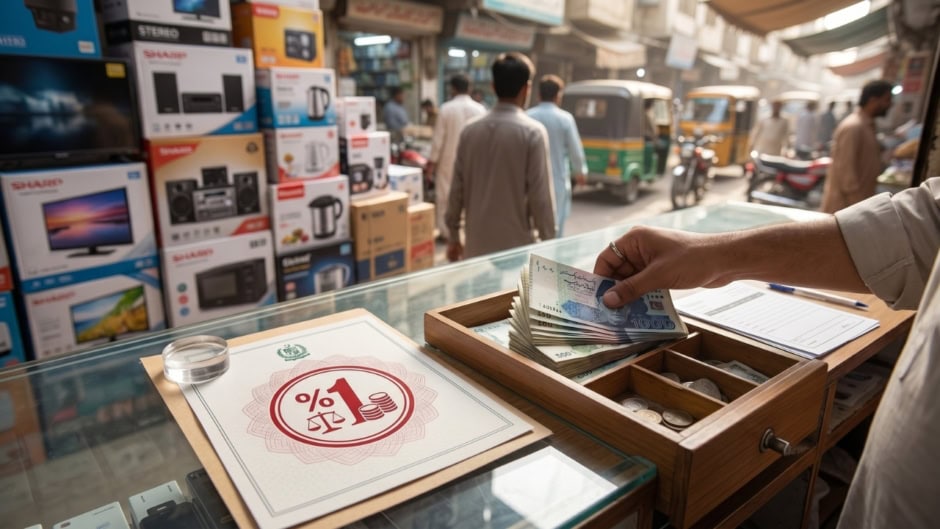
The federal government has officially unveiled the finer details of its turnover tax policy for retail business owners. This move follows TechJuice’s earlier coverage of the government’s introduction of a fixed tax scheme for small retailers to expand the tax net. Now, Federal Ministers have explicitly clarified the structural tiers of the plan during a formal press conference.
While the policy aims to streamline compliance, the real test lies in its execution. Below is the comprehensive breakdown of how the scheme works, its overall potential, and the serious reservations voiced by the business community.
Detailed Structure: How Does the Scheme Work?
Who qualifies for this specific tax policy? The new turnover tax scheme strictly applies to small traders and shopkeepers who generate an annual sales turnover of up to PKR 200 million (20 crores) or less.
Here are the exact payment requirements for shopkeepers
- Qualifying shopkeepers must deposit a minimum base amount of PKR 25,000 in cash.
- For traders with higher revenues within the PKR 200 million threshold, the government will calculate their liability at a flat 1% rate.
Karachi’s business community is supporting the announcement. Rizwan Irfan, the President of the Karachi Electronics Dealers Association (KEDA), has openly endorsed the scheme. He states that the policy focuses entirely on simplifying a historically convoluted tax system. Consequently, this simple 1% rule is rapidly winning over local business groups by stripping away standard administrative headaches.
The Reservations: What is Holding Traders Back?
Before this announcement, some historical barriers made traders avoid the tax net. Previously, undocumented traders completely avoided registering due to highly complicated documentation demands. The old structure created persistent fear and anxiety among small business owners.
Additionally, there are some specific complaints business groups have against tax enforcement. According to trade representatives, registered merchants consistently faced systemic harassment. The Federal Board of Revenue (FBR) frequently subjected them to aggressive audits and sudden official notices. Furthermore, tax authorities were forcibly registering small-scale retail shops into the Point of Sale (POS) system, even when those businesses did not legally fall under that category.
Traders demand strict transparency and absolute accountability. Rizwan Irfan emphasizes that the state must build a rigorous check-and-balance system to police its own departments. Specifically, the government must resolve existing loopholes in the policy framework. Most importantly, authorities must take severe action against officials who misuse their power, misinterpret the rules, or corruptly target newly registered tax filers.
The Potential: What Can the Fixed Tax Scheme Achieve?
This policy is going to have a very positive impact on Pakistan’s undocumented economy. If the government implements the policy with complete transparency, it holds the potential to bring massive numbers of undocumented traders into the formal tax net. KEDA and other trade associations are actively motivating merchants to register to ensure widespread market participation.
Will this initiative successfully boost national revenue? Yes. By replacing aggressive enforcement with a clear, simplified system, the state can simultaneously expand its revenue collection and protect small businesses. The policy effectively removes the core hurdles to compliance, creating a mutually beneficial framework for both the state and the trader community.