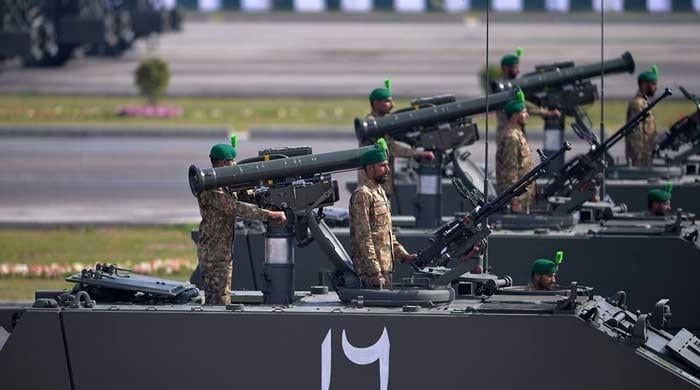
Pakistan has emerged as one of the world’s largest arms importers, according to the latest Stockholm International Peace Research Institute (SIPRI) Yearbook 2026. The report also confirms Pakistan remains among the nine nuclear-armed countries as global military spending and geopolitical tensions continue to rise.
SIPRI describes a world where security conditions are becoming more unstable. It highlights stronger rivalry between major powers, rising conflicts between states, and growing military budgets across many regions.
India-Pakistan Clash Highlighted Among Rising Global Conflicts
The report refers to the military confrontation between Pakistan and India in May 2025. SIPRI counts it among six interstate armed conflicts recorded in 2025.
It notes that such crises in Asia remain dangerous. They can quickly escalate into larger wars if tensions are not managed.
Globally, the number of interstate conflicts doubled from three in 2024 to six in 2025. Other conflicts included Russia and Ukraine, Iran and Israel, Afghanistan and Pakistan, Cambodia and Thailand, and the Democratic Republic of Congo and Rwanda.
Pakistan Ranked Fifth in Global Arms Imports
SIPRI places Pakistan as the fifth-largest importer of major conventional weapons during 2021–2025. It accounted for 4.2 percent of global arms imports. Only Ukraine, India, Saudi Arabia, and Qatar imported more weapons during this period.
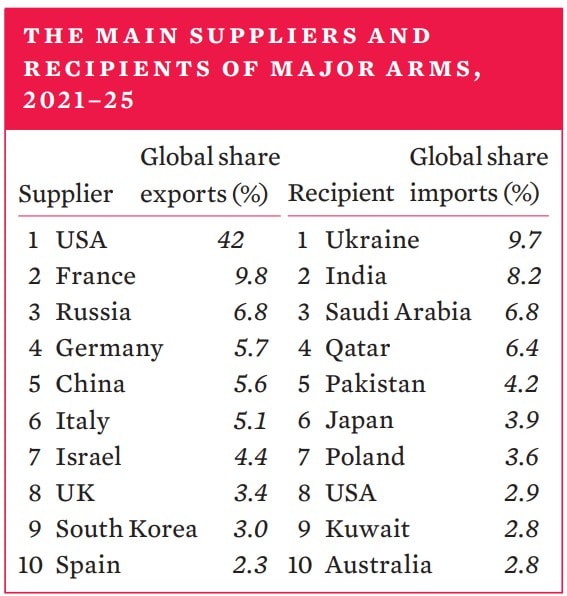
Together, these five countries made up 35 percent of global arms imports. This shows how concentrated global weapons demand has become.
The report also states that international arms transfers reached their highest level since the Cold War. They increased by 9.2 percent compared to the previous five years.
Nuclear Arsenal Estimated at 170 Warheads
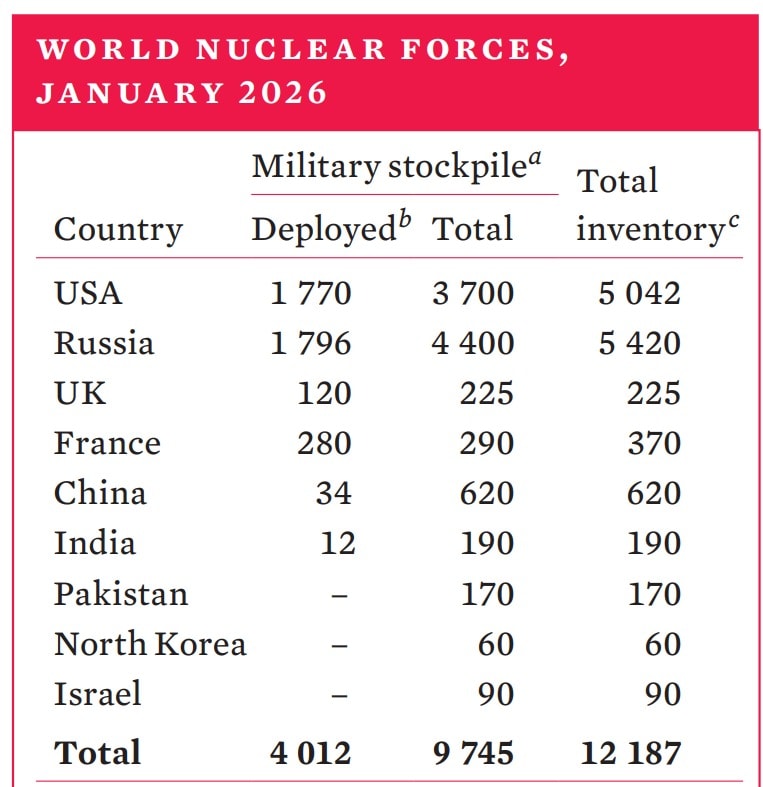
SIPRI estimates that Pakistan holds around 170 nuclear warheads. This places the country among nine nuclear-armed states worldwide.
The report notes that Pakistan continued developing delivery systems in 2025. It also points to the ongoing accumulation of fissile material. This suggests that Pakistan’s nuclear capability may expand in the coming years.
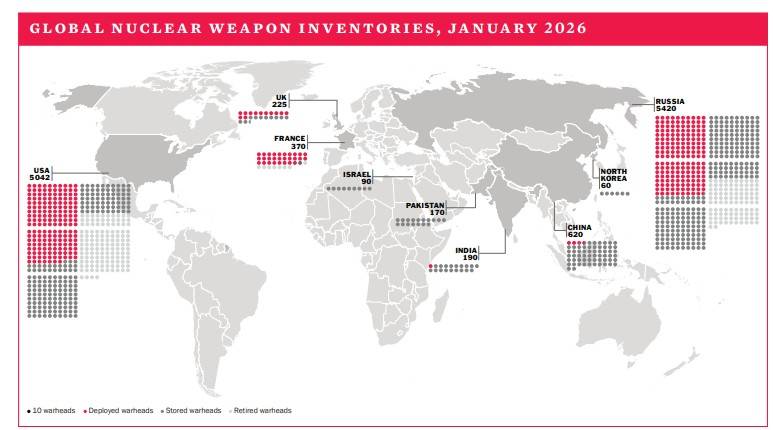
Across the world, SIPRI estimates that about 12,187 nuclear weapons exist. Around 9,745 are in military stockpiles. Nearly 4,012 warheads are deployed with operational forces. More than 2,000 remain on high alert status.
The report says Russia and the United States still hold about 83 percent of global stockpiled warheads. However, this share is slowly declining as other countries expand their arsenals.
China Expands Nuclear Capability Rapidly
China now holds around 620 nuclear warheads, according to SIPRI. It is expanding its arsenal faster than any other country. The report highlights major developments in missile silo construction and new systems. By early 2026, China had loaded hundreds of missiles into northern silo fields.
China is also completing additional silos in eastern mountain regions. SIPRI says China could match the ICBM strength of the US or Russia by the end of the decade.
India, North Korea, and Others Continue Modernization
India slightly expanded its nuclear arsenal in 2025. It is also developing longer-range delivery systems. These systems are designed to reach targets across China. However, India continues to focus on its long-term rivalry with Pakistan.
North Korea is also increasing its nuclear capacity. SIPRI estimates it may have around 60 warheads and enough material for at least 30 more.
The country tested new missiles in 2025, including the Hwasong-20 ICBM. It is also working on more advanced missile systems designed to bypass defenses.
Israel, which does not officially confirm its nuclear weapons, is also believed to be upgrading its program. SIPRI notes new construction activity at a facility near Dimona.
Global Military Spending Reaches $2.9 Trillion
Worldwide military spending reached a record $2.9 trillion in 2025. This equals about 2.5 percent of global GDP. The United States remained the top spender with $954 billion. China followed with $336 billion, and Russia spent $190 billion.
India ranked fifth globally with $92.1 billion in military spending. Asia and Oceania saw an 8.1 percent rise in military spending during 2025. The report links this increase to growing regional tensions.
World Security Environment Under Pressure
SIPRI warns that global security conditions are under serious stress. It describes a period of rising instability driven by competition between major powers. In 2025, 49 countries experienced armed conflict. Although deaths dropped slightly to 238,000, the number remains historically high.
The report also highlights rapid growth in military technology. This includes drones, artificial intelligence systems, autonomous weapons, and cyber warfare tools.
Asia continues to be a central region for global security concerns. SIPRI points to competition between China and the United States as a major driver of tension.
The report again highlights the India-Pakistan crisis of May 2025. It warns that such flashpoints can escalate quickly without warning.
SIPRI concludes that rising militarization, nuclear modernization, and weak arms-control systems are increasing global risks. South Asia remains one of the most closely watched regions in this shifting security landscape.