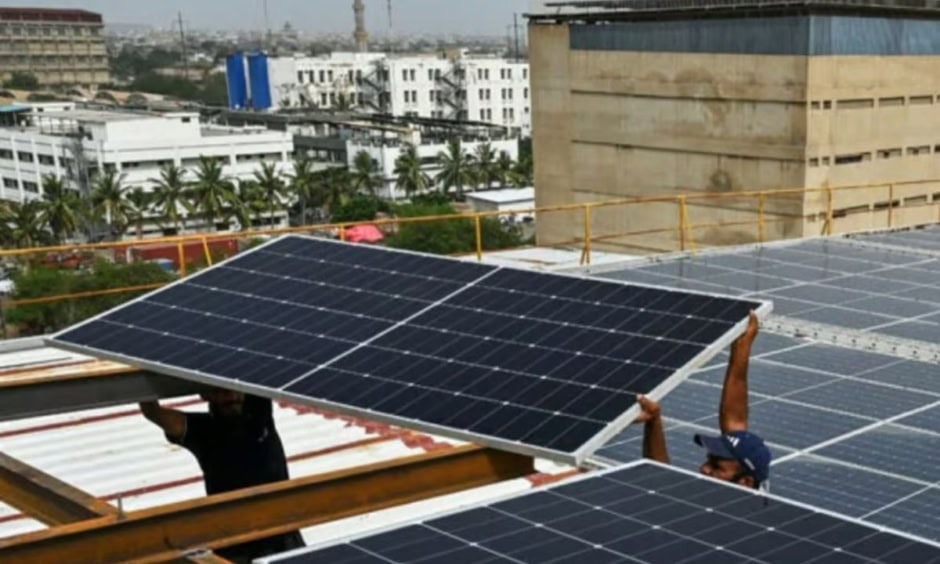
Federal Minister for Energy (Power Division) Sardar Awais Ahmed Khan Leghari said on Saturday that the rapid growth of rooftop solar installations is altering electricity demand patterns and creating fresh challenges for the national grid, pushing the government to accelerate battery storage solutions.
Speaking at the Battery Energy Storage Systems (BESS) Conference organised by the Pakistan Solar Association in Lahore, the minister said the rise in distributed solar generation has caused a sharp drop in daytime electricity demand alongside a heavy load on the grid during evening hours.
He said this shift in demand patterns is straining grid management, as surplus power generated during the day must be balanced against the surge in consumption after sunset.
Without sufficient storage capacity, he warned, the expanding solar footprint could weaken grid stability, add to system inefficiencies and prolong reliance on costly peaking power plants.
Leghari described Battery Energy Storage Systems as a key solution, allowing excess solar power generated during the day to be stored and dispatched during peak evening hours, which would improve grid flexibility and lower overall system costs.
The minister said the government has declared battery storage a strategic priority and formed a Federal Steering Committee tasked with drafting a comprehensive national BESS policy and speeding up its implementation.
He added that battery storage could also resolve long-standing power supply problems in remote and underserved areas such as Gilgit-Baltistan and Gwadar, while reinforcing the resilience of the transmission network.
On regulatory oversight, Leghari said rapid deployment of battery systems must be matched with strict safety standards, adding that only internationally certified batteries should be permitted in the country.
He said the Ministry of Energy has directed stakeholders to adopt International Electrotechnical Commission (IEC) standards, making certification mandatory for all battery modules.
The minister said the government is also preparing a separate manufacturing policy to promote local production of battery systems, draw foreign investment and enable technology transfer.
He said the policy is expected to build local supply chains, generate skilled employment and position Pakistan as a regional hub for battery manufacturing.
Leghari cautioned that the anticipated growth in electric vehicles would place additional strain on the distribution network unless backed by adequate storage infrastructure.
He outlined a government vision for an integrated energy system combining rooftop solar, battery storage, smart grids and electric vehicles to optimise energy use and reduce pressure on the grid.
He said Pakistan energy transition is entering a defining phase in which distributed generation and storage must develop together, and called for coordinated action among regulators, investors and industry stakeholders.
Leghari reaffirmed the government commitment to building a policy environment that supports innovation, investment and long-term sustainability in the power sector.