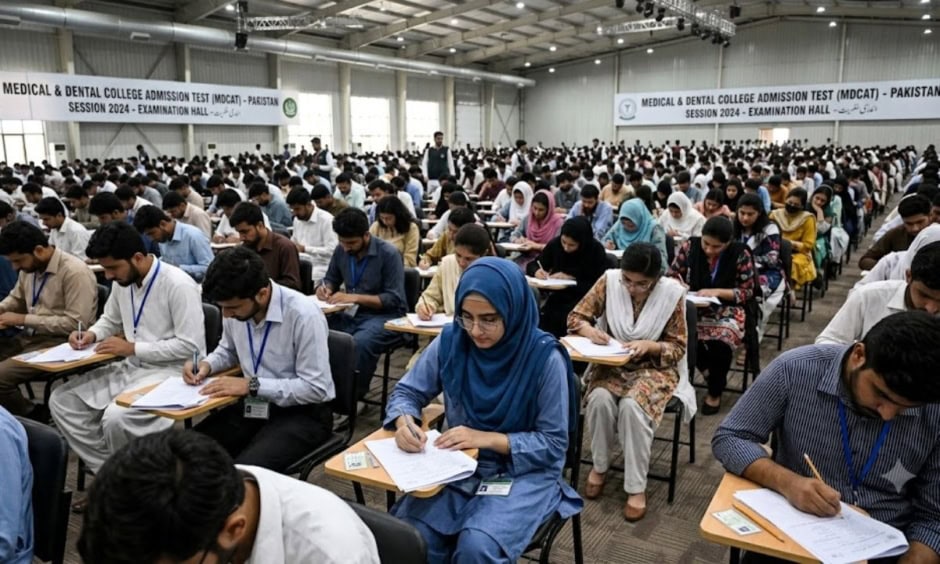
The number of candidates appearing in the Medical and Dental College Admission Test (MDCAT) in Khyber Pakhtunkhwa has fallen from 46,232 in 2022 to 38,000 in 2026.
The decline is attributed to the rising financial cost of medical education, the extended duration of undergraduate and postgraduate training, and growing demand for fields such as artificial intelligence, data science, biotechnology, and allied health sciences.
Khyber Medical University Vice-Chancellor Prof Ziaul Haq told Dawn that the latest MDCAT figures reflect a shift in how students view careers in healthcare, and should be treated as an opportunity to strengthen quality rather than simply increase enrolment numbers.
He said the downward trend does not indicate a decline in interest in healthcare but rather more informed career planning, greater awareness of diverse professional opportunities, and changing socioeconomic realities.
According to Prof Haq, students today weigh career options more comprehensively than in the past. Alongside traditional medical and dental education, many are exploring expanding fields such as artificial intelligence, data science, biotechnology, genomics and public health, which offer promising career pathways.
He identified several factors shaping students’ decisions, including the steep rise in the cost of MBBS and BDS programmes and the extended duration of undergraduate and postgraduate training.
He also cited evolving licensing and specialisation requirements, changing employment markets, and growing global demand for professionals with interdisciplinary skills.
Data on MDCAT applicants illustrate the changing aspirations of young people in KP over the past 15 years. The number of candidates rose from 13,464 in 2010 to 46,232 in 2022, reflecting increasing demand for medical education at the time, before falling to 38,000 in 2026.
Prof Haq noted that healthcare today extends well beyond the conventional roles of physicians and dentists.
He said modern health systems require multidisciplinary teams comprising nurses, public health experts, medical laboratory scientists, physiotherapists, pharmacists, nutritionists, psychologists, health informatics specialists, and biomedical researchers.
He said these professions play a vital role in delivering safe, effective and patient-centred healthcare.