Talking to Claude is about to get considerably smarter, since Anthropic has opened its voice mode to far more capable models. The company announced on Thursday that spoken conversations can now run on its Opus and Sonnet tiers, rather than only the lightweight Haiku model that has powered the feature since 2025. The goal is to make voice useful for real work instead of quick questions.
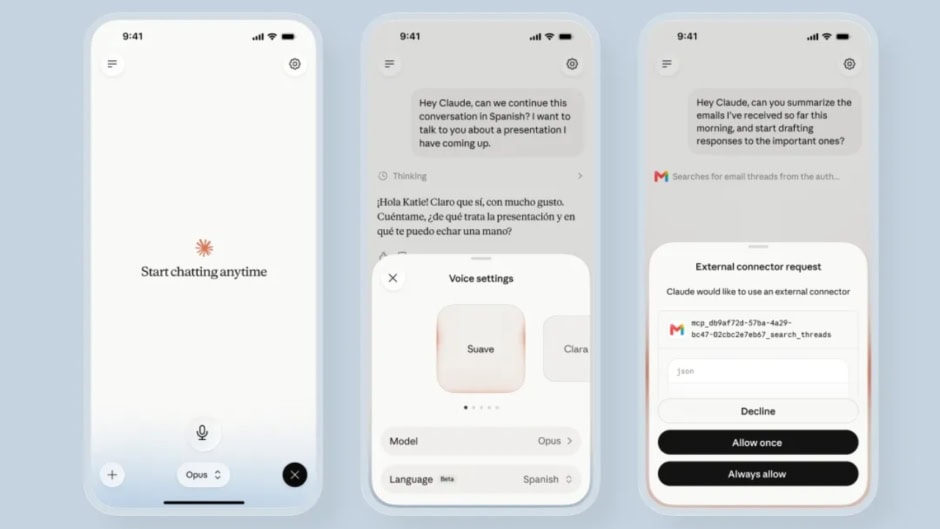
Voice mode now starts with whatever model you last picked in text chat, so a spoken session inherits that model’s intelligence automatically. You can also switch between Haiku, Sonnet, and Opus mid-conversation using a model picker. Putting that choice in the user’s hands, rather than defaulting everyone to the fastest option, is the real substance of the update.
The bigger leap is what voice can now do beyond talking, because now Claude’s voice mode can reach into connected apps like Gmail, Google Calendar, Slack, Canva, and Notion, turning spoken commands into actual actions. So you could ask Claude to summarize your inbox or update a document by speaking, which pushes voice from answering questions toward completing tasks.
Anthropic framed the upgrade around genuinely useful scenarios. The company suggested using it to talk through a client pitch, get feedback on your communication style, or brainstorm product research aloud. Those are longer, thinking-heavy conversations, exactly the kind the old Haiku-only mode handled poorly.
Free users stay restricted to the Haiku model and a single connected app, while Sonnet and Opus are reserved for paying subscribers. Multilingual input is included across ten languages, yet Claude still cannot detect a language switch on its own, so users must name the language before speaking it. Notably, the picker leaves out Claude Fable 5, Anthropic’s most capable widely available model, which stays out of voice for now.
OpenAI’s ChatGPT and Google’s Gemini both offered advanced voice features well ahead of Anthropic, so this upgrade closes a conspicuous gap. Because it routes existing models rather than requiring new audio infrastructure, the rollout did not wait on fresh technology. Anthropic also declined to detail the underlying voice stack it uses, leaving one part of the system unexplained.
For users everywhere, the appeal is hands-free access to a genuinely capable assistant. Whether you are driving, cooking, or thinking out loud, a voice mode backed by Opus rather than a stripped-down model is a meaningfully different tool.