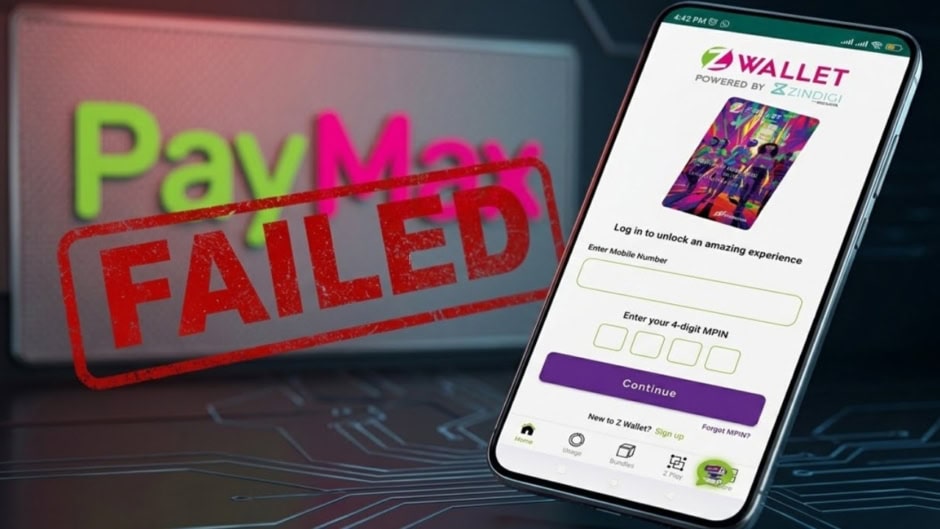
Zong is diping back into mobile fintech with their Z Wallet, a virtual wallet built directly into the My Zong App.
This collaboration dates back to March 2024, when Zong 4G and the fintech company executed a Banking-as-a-Service MoU. It was later broadened in August 2025 to handle government-to-person payments, creating M-Wallets specifically for welfare recipients. However, things took a turn unexpected.
About PayMax And Its Failure
In October 2023, Zong surrendered its Electronic Money Institution license and ceased TimePay (later changed to PayMax) operations. PayMax (as it was eventually called) was one of only four companies granted EMI licences, yet the “only commercially live EMI exited the market” less than a year after launching. The company never explained why. The SBP’s lowering of margins on debit card transactions, high regulatory overheads, skyrocketing inflation, and persistent depreciation of the Pakistani rupee compounded these difficulties.
Industry analysis suggests unit economics failed. Naturally, the licensed EMI model required capital adequacy ratios and compliance costs Zong could not sustain competing against entrenched players.
Now Zong has reentered digital payments, but through a different door entirely. Z Wallet is offered by CMPak with leading fintech Zindigi, a service of JS Bank Limited, with all banking services provided by JS Bank through Zindigi. Zong carries no payments licence, no capital requirements, and no direct regulatory exposure. This asset-light model eliminates the burden that killed PayMax.
When interests diverge between Zong and JS Bank, Zong cannot dictate product strategy. It controls a feature inside its own app, not the entire product roadmap.
In Contrast With Popular Fintech Apps
By contrast, Z Wallet completely bypasses the independent EMI route. While Zong acts as the interface, every financial transaction operates under JS Bank’s branchless banking framework. Consequently, Zong sheds all regulatory accountability, reserve mandates, and compliance exposure.
While Zong abandoned fintech, smaller competitors proved the market rewards specialization and focus. SadaPay was snapped up by Turkish fintech titan Papara for $50 million in 2024, offering seamless simplicity with its Mastercard-backed platform. SadaPay has built a massive footprint by completely eliminating the structural junk fees characteristic of traditional brick-and-mortar banking, issuing a completely free Teal debit card with zero annual maintenance. The zero-fee model attracted freelancers and young professionals seeking direct international payments without layered charges.
NayaPay, Pakistan’s first SBP-licensed EMI since 2021, flexes its $13 million-backed muscle as a feature-packed super-app focused on creating a seamless consumer-to-merchant network. NayaPay built its identity around blending social features with payments, offering bill splitting, group funds, in-app messaging and custom stickers alongside the core financial toolkit. This deliberate play for university students and young professionals succeeded where Zong’s broad approach failed. Both Nayapay and Sadapay own their licenses, control their products, and capture the relationship with customers.
JazzCash reported reaching 60 million registered customers by March 2026. Easypaisa surpassed 59 million registered users. It would be interesting to see how Zong plans to compete these numbers.
Z Wallet offers standard features: wallet-to-wallet transfers, QR payments, utility bills, and government payments. Every item on that list has been standard at JazzCash and Easypaisa for years.
While light-asset models dodge regulatory pitfalls, they cap growth potential. Jazz operates Mobilink Microfinance Bank, and Telenor previously ran Easypaisa Digital Bank, before the entity separated from the mobile network. Irrespective of the management, both fintech services could dictate their own product features and lending yields.
In contrast, Zong merely houses a wallet inside its application. High regulatory hurdles and compliance expenses hamper feature rollouts beyond basic transactions, while constrained global venture funding hampers smaller players.
Can Z Wallet Break Through?
Breaking through to an average Pakistani user demands overcoming three hurdles that plagued the PayMax venture.
First, it must construct an consortium network from the ground up to challenge deeply entrenched incumbents like Nayapay, Sadapay, JazzCash and Easypaisa.
Second, it needs to introduce unique services rather than merely copying existing market standards. Third, it has to ensure JS Bank remains committed if financial expectations diverge.
The company hasn’t disclosed user targets, investment amounts, or revenue splits.