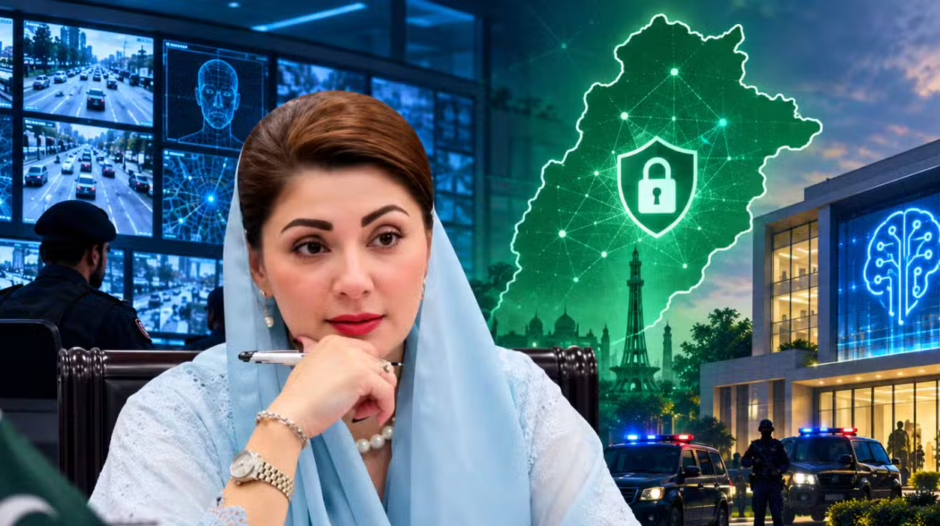
Punjab Chief Minister Maryam Nawaz Sharif has inaugurated the Provincial Intelligence Fusion and Threat Assessment Center (PIFTAC) and e-launched AI Hub Punjab, introducing artificial intelligence into the province’s security and threat-monitoring system.
Speaking at the inauguration ceremony on Saturday, Maryam Nawaz said Punjab had become the first province in Pakistan to establish an Artificial Intelligence Hub. She said the government had transformed the concept of AI-based security into a practical system within a short period.
According to the chief minister, the AI-enabled system will issue digital alerts to district coordination committees, allowing authorities to identify potential threats before they develop into major incidents.
She said PIFTAC would improve coordination among security agencies and help reduce response times against terrorism and other security threats, particularly those originating from the tri-border region and neighboring provinces.
Maryam Nawaz emphasized that preventing an incident before it occurs should be considered the ultimate measure of success.
She also said maintaining law and order was as important as development projects, noting that infrastructure and roads have limited value if citizens remain vulnerable to crime and violence.
The chief minister praised the Pakistan Army for its cooperation and appreciated Lahore Corps Commander Lieutenant General Fayyaz Hussain Shah.
She also congratulated Home Minister Khawaja Salman Rafique, Home Secretary Ahmad Javed Qazi, and other officials involved in establishing the AI Hub.
Maryam Nawaz said police, Special Branch, and other law-enforcement agencies were working as a unified system to protect citizens. Joint check posts in vulnerable areas have also been strengthened and equipped with bulletproof facilities, thermal cameras, and night-vision technology.
She said security conditions in riverine areas had improved considerably, with authorities restoring state control and reducing criminal activity.
Maryam Nawaz claimed that crime in Punjab had declined by as much as 70%, saying the government was increasingly focusing on preventing crime rather than responding after incidents had already occurred.
She said the government was also working to improve security infrastructure and response capabilities in areas vulnerable to terrorism and organized crime.
The chief minister also discussed the provincial government’s response to heavy rainfall. She said authorities were now removing accumulated rainwater more quickly despite weaknesses in existing sewerage and drainage infrastructure.
However, she acknowledged that completely rehabilitating Punjab’s sewerage and drainage systems would require substantial financial resources.
Maryam Nawaz said the Punjab government had adopted a zero-tolerance policy toward corruption, stating that cases would be pursued even when the amount involved was as little as Rs. 100.
A public helpline has been established for citizens to report corruption, while arrests will be made when sufficient evidence is available.
Written instructions have also been issued to senior police officials to identify and remove corrupt personnel from their departments.
The government has additionally provided body cameras to police officers to improve accountability and monitor conduct while on duty.
The chief minister said the government was also strengthening enforcement of road safety regulations, including helmet use, lane discipline, and zebra-crossing compliance.
She also defended the decision to allow Basant in Lahore after comprehensive safety measures were introduced. According to Maryam Nawaz, the festival concluded safely and no kites were seen in the sky after the official closing time.
Maryam Nawaz stressed the need for stronger protection mechanisms for women and children, particularly following disturbing cases of abuse.
She said protecting citizens’ lives and property remained the government’s responsibility and that public safety would continue to be a major priority.
The chief minister said the broader objective was to build a safer, technology-enabled, and better-governed Punjab, while continuing efforts to improve Pakistan’s international image.