
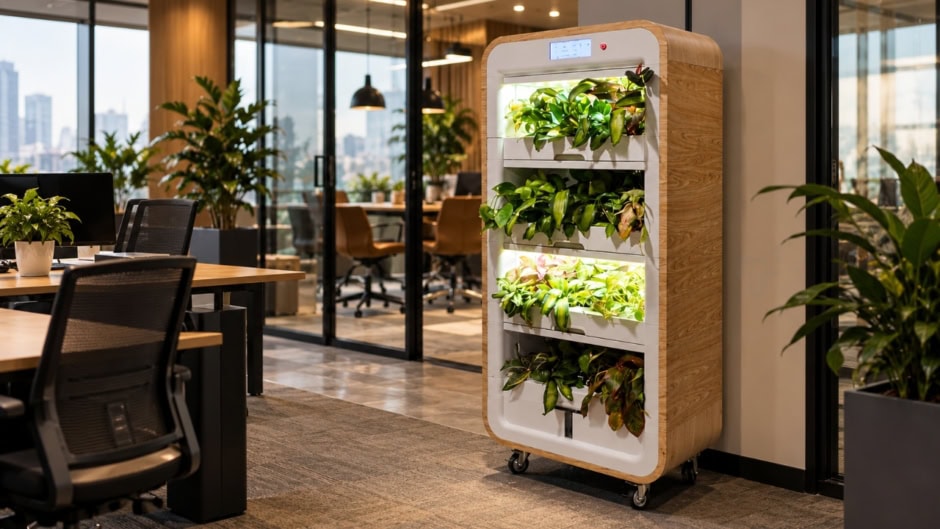
Singapore-based startup Greenairy builds smart plant towers that clean office air using plants and microbes. The company targets volatile organic compounds, or VOCs, that build up in air-conditioned workplaces.
Co-founders Tanvi Thombre and Lakshya Saraf started the company after a health scare in their university makerspace. They had unknowingly breathed toxic fumes from laser cutters, 3D printers, and soldering irons. As a result, Thombre’s best friend fainted and ended up in the hospital. That incident pushed both founders to study indoor air pollution.
As Thombre explained:
We began investigating indoor air pollution and realized it was an invisible but dangerous health risk — especially in schools, offices, hotels, salons, and any commercial buildings where air-conditioning prevents windows from being opened.
Moreover, the towers speed up the natural air-cleaning ability of plants. Of course, to quote Saraf, “a plant in a pot cleans air slowly”. However, Greenairy changes the conditions around plants to accelerate the process significantly. The system also needs no filter replacements and produces no harmful byproducts.
In addition, the microbial ecosystem inside the towers matures over time. Thombre says the system’s effectiveness increases as the microbes develop. Furthermore, office staff in pilot tests reportedly liked the towers’ natural aroma and atmosphere.
The company tested its towers across three offices in Singapore using RESET-certified air monitors. One office used Greenairy towers, another used a medical-grade ionizer, and the third used a HEPA air purifier. Notably, the Greenairy tower recorded the lowest VOC levels and removed VOCs the fastest. Thombre also reported a 50% reduction in both daily average and peak VOC concentrations during office hours.
Additionally, German certification body TÜV SÜD validated the results. The full findings will come out soon and remain available on request. Consequently, the company plans to start large-scale manufacturing once certifications wrap up.
Saraf currently handles fundraising from Berkeley, California, while Thombre leads testing in Singapore.
“If things go to plan, both of us will be in Singapore by the first half of 2027,” she said. “That’s when we expect to launch our first mass-produced towers and install them for our first customers” in Singapore.