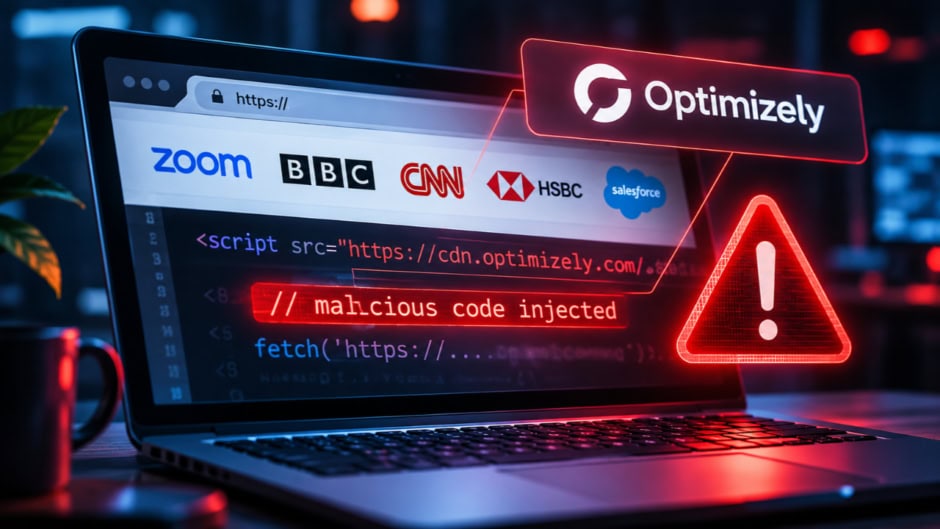
Reports have surfaced that attackers injected malware into 178 organizations through the Optimizely Web experimentation platform on Saturday, November 16.
The list of victims includes Zoom, BBC, CNN, Salesforce, GitLab, IKEA, HSBC, Equifax, Air France-KLM, Ledger, and Peacock. As a result, visitors to some of the most trafficked websites in the world received malicious code without anyone noticing for hours.
Security researcher Scott Helme of Report URI discovered and documented the attack.
Scott Helme of Report URI just exposed a supply chain attack that put malware on 178 major organisations’ websites today. Here’s what you need to know.
Helme first posted that his team was tracking a breach of a 3rd-party JS host hitting hundreds of high value websites, and called it staggering. That post passed 2.3M views.
The host is Optimizely, a website testing and A/B platform. Report URI found malicious JavaScript served through Optimizely Web to visitors of some of the world’s largest sites. The campaign is being called OPTIMJACK. One write-up says the attacker wrote the code into the Optimizely Web projects of these organisations on 16 November 2026. Another report says three smaller vendors also served the code.
Affected names include Zoom, BBC, CNN, HSBC, Salesforce, GitLab, KLM, Air France-KLM, IKEA, Equifax, Ledger, Peacock, Fox News, Bitly, IG Group, American Eagle and Hootsuite.
The malware looks aimed at crypto users. It works as a clipper. It swaps a crypto address you copied for the attacker’s address, and it rewrites addresses in the page’s outgoing requests. Researchers say it cannot take private keys. It also includes a card skimmer, and some reports mention iOS exploits. Report URI’s blog notes crypto theft, card skimming and iOS exploits among the payloads. One analyst noted the attacker addresses in the article show a low hit rate.
Helme said the clean up is done, and Report URI then published its full write-up with the list of affected sites. Troy Hunt, who worked on it with Helme, said most sites would have no idea their customers were being served malware, and asked where disclosure even begins.
Key numbers:
– 178 organisations affected per Report URI’s write-up
– 188 infected Optimizely scripts found
– 186 sites confirmed infected in Helme’s earlier count
– 16 November 2026, when the code was reportedly injected
– 2.3M views on Helme’s original postAnyone who visited an affected site while it was live and copied a crypto address should check their recent transfers.
— AGTP (@AGTPinsights) November 17, 2026
The malware arrived through a supply chain compromise. Optimizely Web works by loading a JavaScript snippet from its CDN onto customer websites. Each snippet contains the customer’s experiments and an optional field called Project JavaScript for custom code. The attacker wrote malicious code directly into this field across 188 snippets belonging to 178 organizations. Because the code shipped from Optimizely’s own trusted domain with its own certificate, every affected website loaded it without question.
The payload performed four functions simultaneously. First, it swapped cryptocurrency wallet addresses on the page with attacker-controlled wallets. It targeted BTC, ETH, Solana, TRON, Litecoin, Dogecoin, and other chains. Additionally, it intercepted clipboard operations and silently replaced even addresses copied from other sources. Second, it skimmed credit card numbers from form submissions using Luhn validation and sent them to an external server. Third, it stole cookies and captured screenshots of affected pages. Fourth, on iPhones and iPads running iOS 18.6 or earlier, it deployed the Coruna and DarkSword exploit kits through hidden iframes.
The attackers had already stolen approximately $7,040 in cryptocurrency by 7:25 PM UTC. Verified transactions hit their Bitcoin, Litecoin, TRON, and Ethereum wallets. The attackers swept funds to exchanges, including HitBTC, between 1:03 and 1:05 PM UTC. Moreover, the TRON wallet had shown activity since March 2026. That timeline indicates this group operated long before this campaign.
The scope of the breach spans nearly every sector. It hit 32 banking and finance organizations, 23 technology firms, 20 retailers, 12 streaming platforms, 10 news outlets, 9 airlines, and dozens more across healthcare, telecoms, insurance, and nonprofits. The attack also hit Optimizely’s own websites.
The attack timeline reveals a rapid and evolving operation. The first injection appeared on BBC’s snippet at 4:21 AM UTC. By 11:20 AM, the attacker modified Zoom’s snippet. At 1:43 PM, the attacker added the card skimmer. By late afternoon, iOS exploit kits joined the payload. Throughout the day, the attacker rebuilt the payload 26 times, adding features and new wallet addresses each time. However, cleanup began around 8:40 PM UTC. By 9:52 PM, only one snippet remained infected.
How the attacker gained write access to so many unrelated customer projects remains unknown. Report URI stated it reached out to Optimizely through multiple channels but received no response before publishing. Optimizely has not issued a public statement.
For anyone who visited an affected website on November 16, the immediate steps are clear. iPhone and iPad users should update to iOS 18.7.3 or later. Anyone who made a crypto transfer should verify the destination address. And anyone who entered card details on an affected site should monitor their statements closely.