The internet broke in six different ways in six days. And nobody knows if it is done breaking.
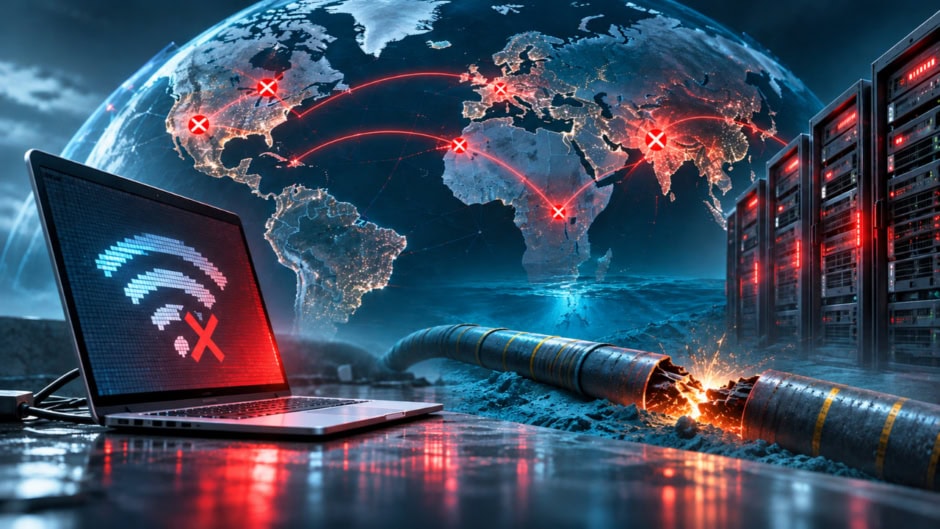
Between November 12 and November 18, a cascade of failures hit Microsoft, the US Federal Aviation Administration, three of America’s largest banks, Apple, the National Security Agency, and Pakistan’s submarine cable infrastructure. Each incident had a different cause. Together, they exposed a reality cybersecurity experts have warned about for years: the digital systems that run modern life are far more fragile than most people realize.
Microsoft started the chain on November 12 when a network capacity upgrade knocked Outlook, Teams, and Copilot offline for over 12 hours across 74 countries. The next day, an outdated telecom router at the FAA failed during maintenance, grounding every departing flight in the United States for more than four hours.
Meanwhile, the GTA VI preload added its own pressure. The game’s download size pushed console and PC users to pull massive files simultaneously, straining ISP bandwidth in regions already running at capacity. In August, the 26-minute Extended Look premiere on Netflix drew 1.8 million concurrent viewers and crashed both Netflix and Twitch within 20 minutes, logging over 3,100 outage reports on Downdetector. The game’s March 2026 online mode launch triggered what Rockstar classified as a “Severity 1” global outage after concurrent players exceeded 6 million. With the full launch arriving today, analysts have warned that server instability will likely persist for days.
On November 17, a software bug at JPMorgan Chase cascaded through the banking system, locking thousands of customers out of accounts at Chase, Wells Fargo, and Bank of America. That same day, a faulty internal update at Apple took down iCloud, the App Store, Apple Pay, and Apple Music. Also on November 17, the NSA’s classified internal network, known as NSA Net, went partially offline during what officials described as “scheduled routine maintenance.”
To make matters even worse, on the evening of November 18, the SEA-ME-WE 5 submarine cable developed a fault 11 kilometers off Pakistan’s coast, slowing internet speeds across the country.
Meanwhile, the threat landscape beyond outages grew even more alarming. On October 29, North Korean hackers stole $6.3 billion from Binance in roughly 20 minutes, executing the largest financial heist ever recorded. The FBI attributed the attack to TraderTraitor, Pyongyang’s elite hacking unit. In October, Iran’s Revolutionary Guard cyber unit Shahid Kaveh targeted refrigeration controllers at over 700 French supermarkets, causing food losses worth tens of millions of euros and sparking at least 15 fires. A second wave struck 115 stores across six European countries in November. On top of all that, security firm Calif used AI to uncover Java4Shell, a critical 12-year-old remote code execution flaw hiding in Java, the programming language that powers nearly every bank, hospital, and government system on Earth.
President Trump dismissed the outage wave from Manila. “Things like that happen,” he said. “It’s fine.” US Secretary of State Marco Rubio said there was “zero evidence” the incidents were connected. DHS Secretary Kristi Noem told Americans to “breathe.” Cybersecurity experts did not share that calm.
“Even when an outage isn’t caused by a cyberattack, these moments of operational distraction leave dangerous gaps open for threat actors,” said Cynthia Kaiser, former senior FBI cyber official and current senior vice president at Halcyon’s Ransomware Research Center.
She added that AI is now accelerating the discovery of legacy software flaws, forcing organizations to race against adversaries in a patch-or-perish cycle.
For individuals, experts offered five concrete steps to stay protected during this volatile stretch.
First, turn on automatic updates for every device. Dan Guido, CEO of cybersecurity firm Trail of Bits, said companies push security patches as soon as vulnerabilities surface. Delaying installation extends the window for attackers. Digital security expert Runa Sandvik of Granitt added that people should also check internet-connected home devices that rarely receive updates.
Second, use unique passwords and enable multi-factor authentication on every account. Emily Austin, principal security researcher at Censys, stressed that reusing passwords across websites multiplies the damage when one site gets breached.
Third, treat urgent security messages with suspicion. Nic Adams, CEO of cyberkinetics company 0rcus, warned that scammers flood inboxes whenever outage headlines dominate the news. Users should verify alerts by opening the company’s app directly or typing the website address themselves rather than clicking links.
Fourth, consider passkeys where available. Paul Benda, executive vice president of cybersecurity at the American Bankers Association, said passkeys are phishing-resistant digital keys that eliminate the need to type passwords into websites. He added that while bank systems remain well fortified, shopping on smaller or unfamiliar retail websites carries elevated risk during periods of active exploitation.
Fifth, patch organizational systems immediately. Dr. Daniel Gardham of the Surrey Centre for Cyber Security said AI makes finding vulnerabilities faster and easier, but fixing them across sprawling infrastructure remains far harder. The gap between discovery and patch deployment now determines whether a flaw becomes a headline or a breach.
For Pakistani users, the risks compound further. The SMW5 submarine cable fault forced PTA to reroute traffic through backup links with limited spare capacity. Slower connections increase timeouts, which can push users toward repeated login attempts and phishing pages disguised as error recovery screens. Users should avoid entering credentials on unfamiliar pages, wait for official ISP updates before troubleshooting, and reject any “speed booster” app downloads, which frequently carry malware.
Pakistan already spent much of 2026 dealing with VPN throttling and social media access restrictions. A submarine cable break on top of that leaves the country’s internet infrastructure stretched thinner than at any point this year.
The uncomfortable truth is simple: every system you depend on will go down again. The only variable is whether you prepared before it did.