NASA’s Voyager 1 became the first human-made object to reach one light-day from Earth on November 18, 2026. The spacecraft crossed the threshold at exactly 10:16:07 UTC, placing it 25.9 billion kilometers from home. At that distance, a radio signal traveling at the speed of light takes a full 24 hours to reach the probe and another 24 hours for the response to return. The milestone arrived nearly 50 years after Voyager 1 launched in September 1977.
One light-day equals approximately 16.1 billion miles or 173.14 astronomical units. For perspective, the Artemis II mission set the human distance record at 252,756 miles in April 2026. Voyager 1 now sits more than 63,000 times farther away than that. It travels at roughly 38,000 miles per hour, yet even at that speed, reaching one full light-year will take approximately 18,000 more years.
Despite its age, the spacecraft still sends back science data. Its cameras went offline years ago to conserve power, but instruments measuring magnetic fields and invisible phenomena remain active. NASA expects at least one science instrument to continue operating into the 2030s. However, the power supply from Voyager 1’s plutonium generators declines by roughly four watts each year. Engineers have already shut down heaters and redundant systems to extend the mission as long as possible.
Voyager 1 holds a list of firsts that no other spacecraft matches. It explored Jupiter in 1979 and Saturn in 1980, delivering close-up images of their moons and ring systems. In 1990, it captured the famous “Pale Blue Dot” photograph of Earth from 6 billion kilometers away. In August 2012, it became the first spacecraft to enter interstellar space, crossing beyond the Sun’s heliosphere into the region between stars.
Its twin, Voyager 2, follows a different trajectory and currently sits farther from interstellar space’s inner boundary. NASA projects Voyager 2 will reach one light-day from Earth around 2035. Whether either probe will still communicate by then remains uncertain.
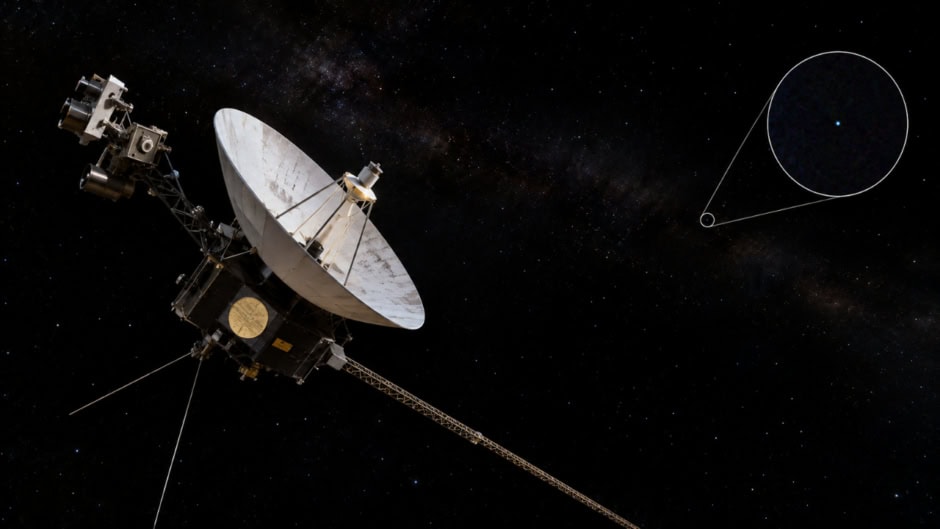
To mark the milestone, NASA organized a worldwide “Shine Bright” celebration. JPL scheduled a public discussion for November 19, and legendary space artist Don Davis revealed a new illustration showing what Voyager 1 looks like from one light-day away.
The milestone also puts cosmic distances into humbling context. Voyager 1 traveled for nearly half a century just to reach the edge of the solar system. The nearest star system, Alpha Centauri, sits 4.37 light-years away. At its current speed, Voyager 1 would need roughly 73,000 years to reach it. Every exoplanet astronomers have discovered lies even farther.
For all its distance, Voyager 1 carries something meant for anyone who finds it: the Golden Record, a 12-inch gold-plated disc containing sounds, images, and greetings from Earth in 55 languages. It remains the farthest message humanity has ever sent.