Anthropic has launched Claude Science, an AI workbench for scientists. The company describes it as its most significant push into the life sciences yet. It launched in beta on June 30 for paid Claude plans.
Scientific research often means juggling dozens of fragmented tools. Researchers move across databases, file formats, and separate applications. Claude Science aims to bring these into a single research environment. The company says scientists can run all stages of work there.
The app helps analyze literature and execute multi-step research. It produces detailed artifacts like figures and manuscripts. Users can refine them iteratively until ready for publication. It runs locally on macOS or Linux, or on a remote machine.
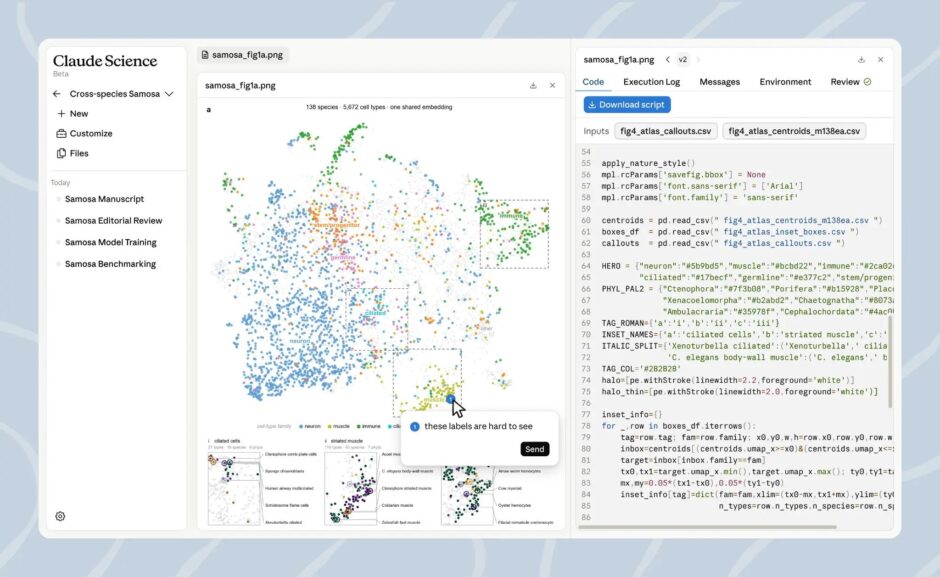
A key selling point is auditability, according to Anthropic. Every output carries a record of how it was made. That includes the exact code, environment, and full message history. The company says this makes results easier to validate and reproduce. Users interact with a coordinating agent backed by over 60 skills. These cover genomics, proteomics, structural biology, and cheminformatics. A separate reviewer agent checks citations and calculations. Anthropic says it flags and corrects errors as it goes.
The tool also manages computing resources on demand. It can scale an analysis from a single GPU to hundreds. Crucially, Anthropic says it runs on a lab’s own infrastructure. That means sensitive datasets never leave the systems they sit on.
Anthropic cited early beta users to illustrate the tool. A neuroscientist reportedly built a review pipeline reading thousands of papers. He said reviews that once took two years now move far faster. A UCSF epidemiologist said it cut certain analyses to a tenth of the time.
The app connects to NVIDIA’s BioNeMo toolkit and models too. Anthropic is also funding up to 50 AI for Science projects. Applications run through July 15.
You can access the new model here.