Large-scale battery installations are surging worldwide in 2026 as plummeting costs and rising energy demand accelerate the transition away from fossil fuels, transforming global power grids from Texas to Inner Mongolia.
Analysts project installations would jump approximately 33% this year, led by expansion in Europe, the Middle East, Africa, and Latin America. The momentum gained additional impetus from Middle East conflicts that lifted demand for alternatives to expensive fossil fuels, positioning 2026 as the year batteries become influential in the global energy system.
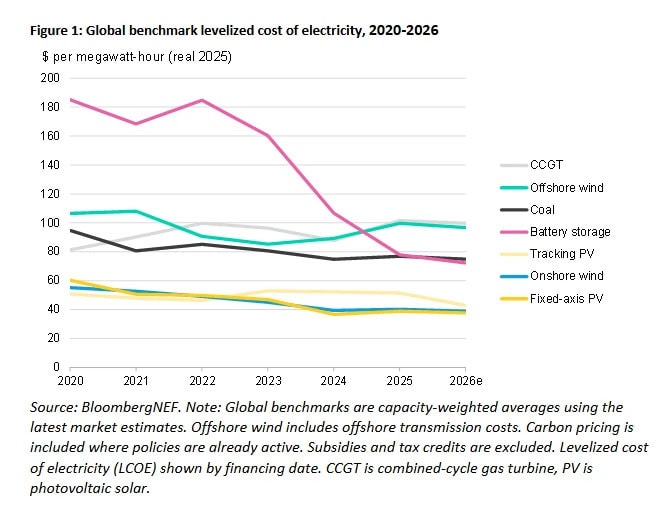
Battery storage costs fell more than 27% in 2025 to a record low of $78 per megawatt-hour for standalone four-hour battery projects, according to BloombergNEF. The benchmark levelized cost of electricity is expected to decline further to $58 per megawatt-hour by 2035, making grid-scale storage increasingly competitive with traditional power generation.
Australia offers a glimpse of how the boom is reshaping energy systems. Shortly after the massive Waratah Super Battery was partially switched on in New South Wales last year, batteries discharged more power onto the main grid during evening peak hours than gas-fired plants. The 850-megawatt facility, located at the former Munmorah coal-fired power station site, is expected to become fully operational in 2026.
The project would cost approximately 20% less to build now than when construction began four years ago, according to Nick Carter, chief executive officer of owner Akaysha Energy. Storage is also helping delay an expected gas crunch as domestic fields deplete, underscoring its role in Australia’s energy security.
In the United States, batteries are expected to account for more than 25% of the record generating capacity the country will add in 2026, according to the Energy Information Administration. The speed of construction has become an important factor, as data centers from Texas to Tennessee turn to solar paired with batteries because traditional power plants cannot be built quickly enough.
Near Memphis, Tennessee, Elon Musk’s artificial intelligence business xAI installed rows of Tesla Megapack batteries at its Colossus supercomputing facility to manage outages and surging electricity needs, illustrating how turbine shortages and grid bottlenecks are driving adoption.
“A lot of people still view the battery story as a clean energy technology,” said Jeff Monday, chief growth officer at storage provider Fluence Energy. “We’ve seen an evolution—battery tech is now seen as building grid resilience.”
At the center of the global energy storage boom is China’s role in producing hardware. Years of investment in electric vehicle supply chains have created a battery glut, driving prices down and flooding global markets with cheaper equipment. China now accounts for the vast majority of global manufacturing capacity and around 50% of existing grid-scale battery installations.
The pattern mirrors the solar industry’s post-2021 cycle, when surging demand triggered investment waves that led to oversupply, collapsing prices, and ultimately mass adoption, according to consultancy Trivium China. Battery prices are declining even as costs for most other clean energy technologies have risen.
A 2021 Chinese mandate requiring renewable projects to include energy storage, which has since been retired, accelerated domestic deployment. The resulting manufacturing overcapacity has benefited global markets through reduced equipment costs.
The rapid cost decline has made battery storage projects more appealing to investors. Average battery pack prices fell to $105 per kilowatt-hour at the end of 2025, down from approximately $1,000 per kilowatt-hour in 2010. The price drop is attributed to manufacturing overcapacity in China, increased competition, and an ongoing shift toward lower-cost lithium-iron phosphate technology.
However, the ongoing Middle East conflict could create competing pressures on battery prices. While disruptions to oil supply chains may accelerate demand for battery storage as countries seek energy independence from fossil fuels, the war could simultaneously strain global supply chains for critical battery materials. Lithium, cobalt, and other rare earth minerals required for battery production could face transportation bottlenecks or price volatility if shipping routes through strategic waterways become compromised. Still, China’s dominant position in battery manufacturing and its existing overcapacity may insulate the market from severe price shocks, potentially allowing the downward price trend to continue even amid geopolitical instability.
The trend is accelerating deployment of grid-scale storage systems designed to support renewable energy integration and prevent blackouts as strain on electrical grids increases. Home battery storage markets are also expanding, with California-based Lunar Energy securing more than $230 million in February to expand into new markets.