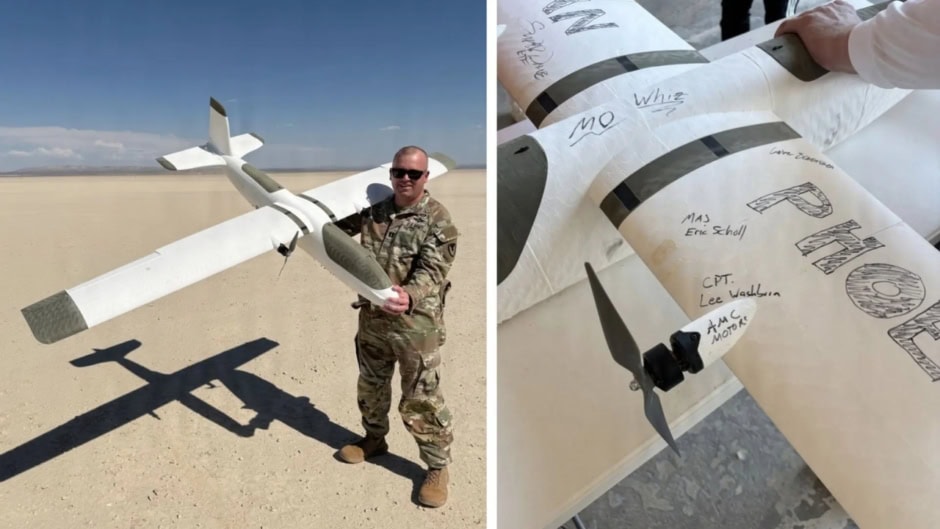
A battery-powered drone has shattered a world endurance record impressively. The small unmanned aircraft flew for more than eight hours straight. Notably, it achieved this feat in punishing desert heat conditions. Crucially, it relied on propulsion components assembled by the US Army.
The record-breaking demonstration took place at Edwards Air Force Base, California. It happened during the Game of Drones 26-2 event in July. There, two brushless direct current motors powered the small drone. Those motors were assembled at Tobyhanna Army Depot in Pennsylvania.
“This is a huge milestone for AMC and Tobyhanna, considering the fact that we just cut the ribbon on the new brushless motor line on June 30,” said Jon Strzelec, the AMC advanced manufacturing lead for small UAS.
The final flight time was genuinely remarkable for a battery drone. It stayed airborne for eight hours, 41 minutes, and 43 seconds. During that time, the aircraft flew roughly 300 miles total. Consequently, it surpassed the previous record by a full 50 minutes.
Perhaps most striking was how quickly the drone came together. Engineers designed it in under 10 minutes using adaptability software. They simply used computer prompts to generate the aircraft design. Within 24 hours of takeoff, the whole aircraft was fabricated.
The rapid production happened inside a mobile containerized factory. Workers used commercial 3D printers to build the frame quickly. They then integrated the Tobyhanna motors and a partner’s battery. Finally, a three-person team assembled everything entirely on-site.
The achievement reflects a deliberate strategic shift for the US Army. Specifically, it targets building manufacturing within its organic industrial base. By producing critical parts domestically, the Army reduces foreign dependencies. This matters greatly for securing military drone supply chains.
Officials framed the milestone as proof of that broader strategy. The new brushless motor line only opened on June 30. Therefore, the record came just weeks after that ribbon-cutting. Army representatives called it a huge milestone for the program.
The Army is now expanding this domestic production considerably. It produces drone frames at Rock Island Arsenal in Illinois. Additionally, it assembles batteries at Red River Army Depot in Texas. This spreads critical component manufacturing across multiple domestic sites.
“[It] was proof that industry and the government can work together in creative ways to produce exceptional results,” Strzelec said. “The event showcases exactly what the Army set out to do — provide opportunities for industry to partner with the Army and let the Army leverage the innovation and technical depth of industry.”
Ultimately, the event showcased close collaboration between government and industry. Officials said it proved both sides could produce exceptional results together. For the Army, it demonstrated real progress toward domestic drone dominance.