
Bitcoin has dropped 6.5 percent from its recent high above $82,000, with weakening demand, rising exchange inflows, and bearish technical signals increasing the risk of further downside in the near term.
Market analysts suggest that Bitcoin’s inability to hold above key support levels reflects fading buying momentum and growing investor caution.
Technical indicators have also weakened, with BTC falling below its 50-day and 100-day exponential moving averages, a move traders often view as a sign of deteriorating momentum. Analysts noted that the broader market environment has turned more risk-averse, reducing confidence in sustained upward moves.
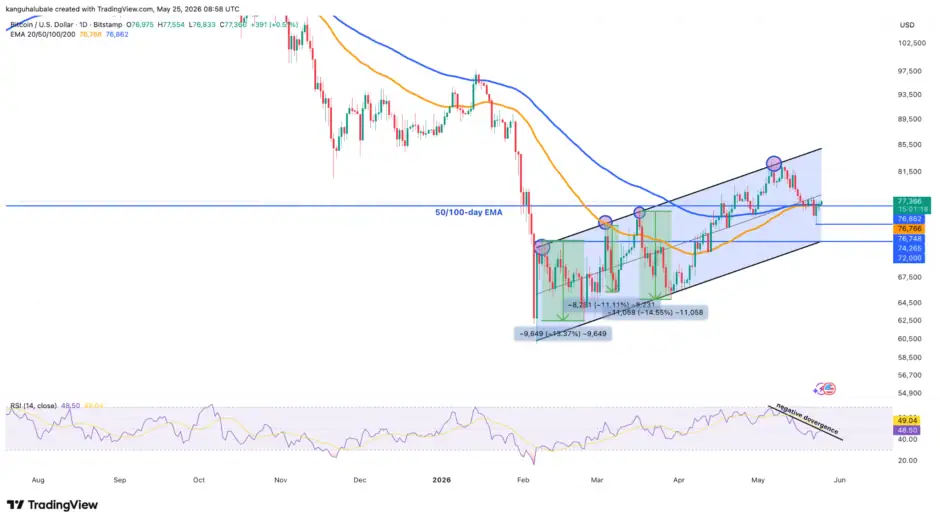
The rejection near the $82,000 level occurred around the upper boundary of an ascending channel that has guided price action since February. Previous rejections from similar levels resulted in declines of roughly 11 to 14 percent, creating expectations that Bitcoin could move toward the lower support zone near $72,000.
Momentum indicators have also softened, with the Relative Strength Index declining from near overbought levels earlier this month, suggesting increasing downward pressure.
Several analysts identified the $75,000–$76,000 area as a critical support region. A sustained break below this zone could expose BTC to further downside targets near $74,000, $71,400, and potentially lower if selling accelerates.
At the same time, on-chain and exchange data point to weakening demand conditions. Market observers noted that exchange inflows have increased sharply, particularly on Binance, where rising deposits are often interpreted as a signal of potential selling activity.
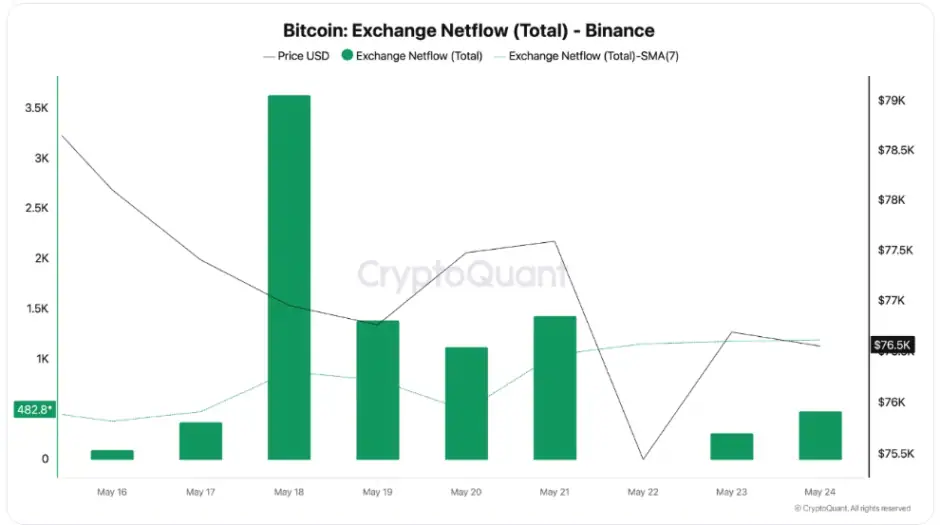
Data cited in market analysis also showed Bitcoin’s apparent demand falling to its weakest reading of 2026, suggesting that spot market buying has not yet recovered enough to absorb increasing sell pressure.
Analysts caution that unless demand improves in the coming weeks, Bitcoin may struggle to sustain a broader recovery and could remain vulnerable to additional volatility.