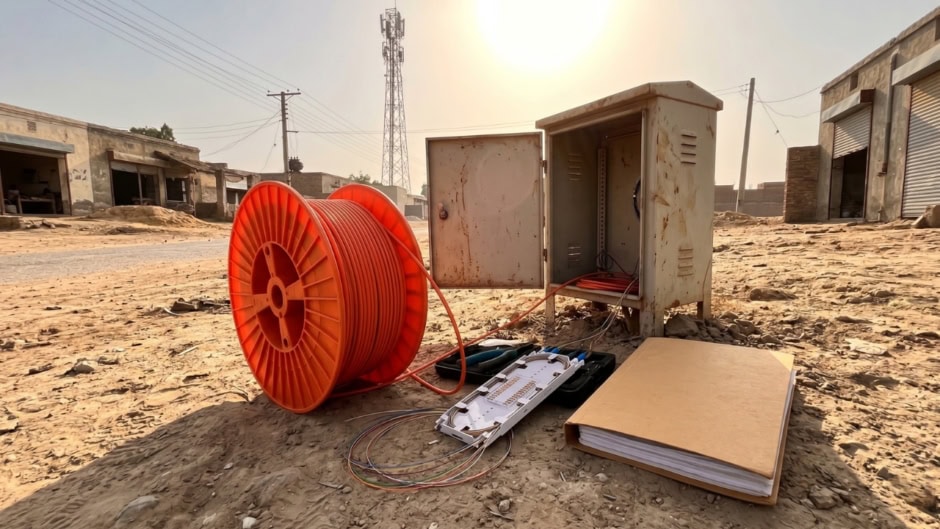
Pakistan continues to struggle with severe structural constraints across its digital sector. The World Bank reports that these bottlenecks severely limit broadband quality, service integration, and the adoption of advanced digital applications and the 5G transition in Pakistan.
Currently, mobile broadband dominates the country’s internet usage. However, fixed broadband remains massively underdeveloped. This infrastructure is critical for enterprise productivity, data-intensive applications, and high-quality service delivery. Consequently, Pakistan only has 2.6 million FTTH-based (Fiber to the Home) fixed broadband connections nationwide. Interestingly, Punjab hosts approximately half of these connections, accounting for about 1.3 million users.
The 5G Roadblock in Pakistan: Poor Fiberization
Meanwhile, the limited fiberization of mobile networks cripples overall performance. Pakistan currently operates approximately 58,000 mobile towers. Yet, the industry has fiberized only 17.9 percent of them. This massive shortfall heavily affects backhaul capacity. Furthermore, it degrades the quality and reliability of mobile internet services. Ultimately, this lack of fiberization restricts the effective use of current 4G networks and completely blocks the future transition to 5G.
Fixed broadband availability remains highly uneven across the country. Large national operators and smaller local providers serve urban areas with existing coverage. Conversely, rural areas lack fixed broadband entirely. They rely primarily on mobile connectivity supported by the Universal Service Fund. Additionally, a third category exists: urban locations with viable long-term demand but zero fixed broadband. These areas present a massive opportunity for private capital. However, regulatory inefficiencies and steep upfront deployment costs keep investors away.
Right-of-Way Red Tape
Fragmented Right-of-Way (RoW) practices act as a major deterrent to private investment in last-mile fiber deployment. Recently, federal and provincial governments introduced reforms, including selective RoW fee waivers. While this signals progress, last-mile connectivity in Punjab relies on local governments and private housing societies. These local bodies depend heavily on RoW fees to cover reinstatement, supervision, and administrative costs. Therefore, blanket fee waivers risk destroying local government capacity and financial sustainability.
To solve this, Punjab introduced a pragmatic approach. The province provides a time-bound reimbursement mechanism. Simultaneously, it streamlines approvals through a digital platform. This strategy addresses investor concerns without disrupting local fiscal operations.
Digital Payments & Pragmatic AI
Pakistan has successfully built key digital public infrastructure components, specifically digital identity and instant payments. For instance, the Raast payment system handles peer-to-peer and person-to-merchant transactions and sees significant uptake. However, person-to-government (P2G) and government-to-person (G2P) payments remain heavily fragmented. This fragmentation limits the effectiveness of digital public service delivery. Moreover, provincial governments struggle to integrate payments with service platforms, invoicing, and compliance systems.
Despite these national challenges, Punjab leads the country in digital governance. The province leverages its scale, institutional capacity, and existing digital platforms to drive reforms. Furthermore, Punjab employs a pragmatic strategy for artificial intelligence (AI) in the public sector. The province completely avoids building foundational large language models. These massive models require immense computing, data, and energy resources. Instead, Punjab focuses exclusively on inference-led, application-level AI solutions. Developers tailor these tools to local languages, service delivery workflows, and administrative processes. Consequently, this approach delivers immediate efficiency gains while strictly maintaining public sector data sovereignty.