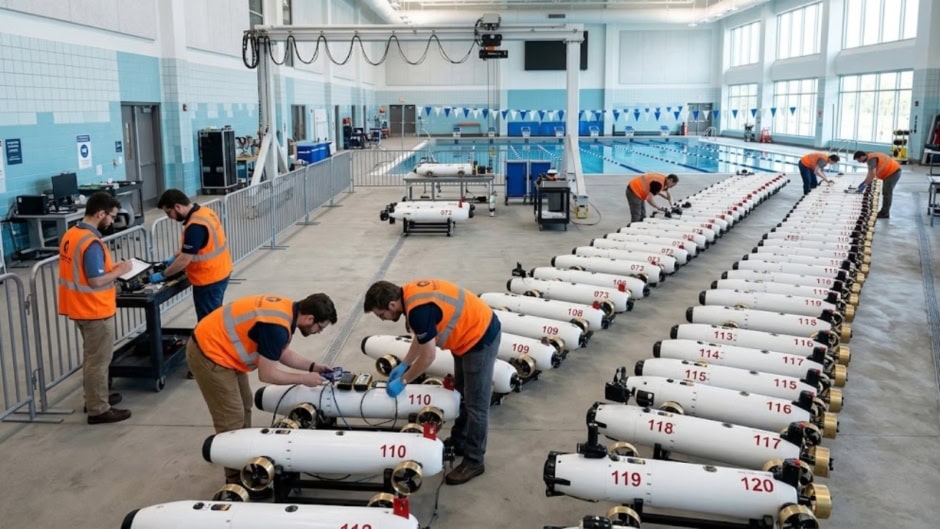
China set a new Guinness World Record for autonomous underwater vehicle swarms, when 116 TH-618 drones navigated a preset route without human input. The milestone demonstrates significant advances in swarm robotics and autonomous marine technology coordinated by Northwestern Polytechnical University and Xian Tianhe Maritime Technologies.
The drones spent 34 minutes navigating approximately 1,640 feet of water in coordinated formation. Officials from Guinness World Records certified the achievement after monitoring the demonstration. Each TH-618 measures roughly 24 inches long and 7.8 inches wide, weighing approximately 11.3 pounds. The compact design enabled deployment of the large swarm.
Individual drones featured camera-based navigation systems allowing them to interpret surroundings and adjust movement autonomously. Real-time data streams enabled each vehicle to maintain its assigned position within the formation. The system corrected paths when environmental disturbances pushed vehicles away from intended courses.
Coordinating multiple autonomous underwater vehicles presents engineering challenges exceeding single-drone operations. Radio signals behave differently underwater, creating persistent communication limitations. Northwestern Polytechnical University has spent over two decades developing underwater sensing technologies, acoustic communication systems, and visual perception capabilities.
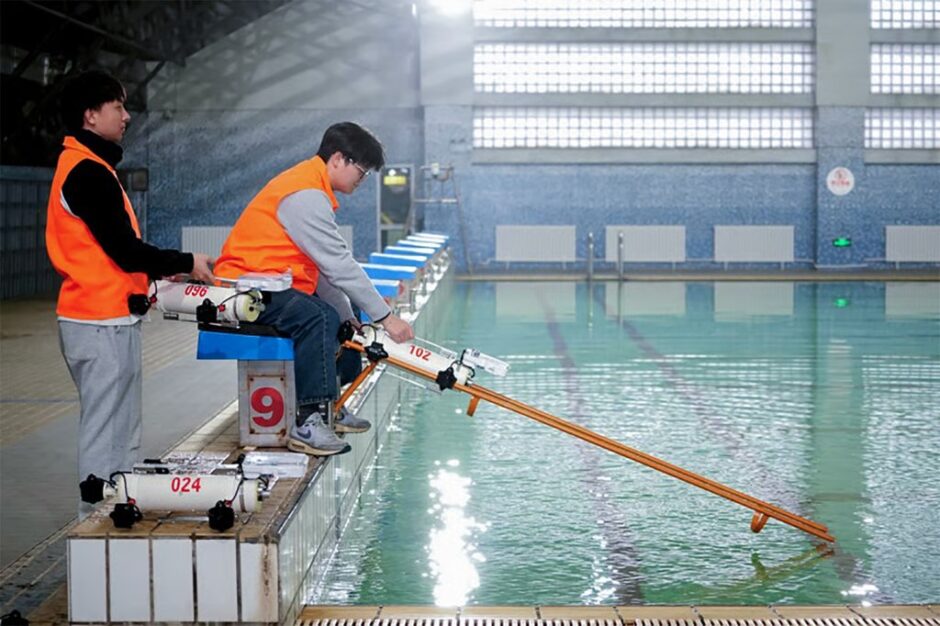
Maintaining formation awareness with limited underwater bandwidth represented a significant technical hurdle. Scaling beyond the record-setting swarm would require solving even more complex coordination problems across greater distances and stronger environmental disturbances.
Previous underwater drone records pale compared to China’s achievement. An European Union-funded project previously demonstrated a swarm containing 41 autonomous robots. China’s new record more than doubles that figure. The larger formation proved engineers could successfully scale autonomous underwater navigation beyond small groups.
Each TH-618 can travel up to 18.6 miles and remain operational for more than eight hours. Extended endurance enabled the 34-minute demonstration while maintaining formation control throughout the test duration.
Xian Tianhe Maritime Technologies identified potential civilian and industrial applications for autonomous underwater vehicles. Seabed surveys and oil and gas pipeline inspections represent immediate use cases. Complete autonomous seabed mapping requires coordinating multiple vehicles across large areas where human intervention proves impractical.
Military applications are also driving underwater drone development. Militaries increasingly explore uncrewed systems for operations across air, land and sea. Chinese researchers have examined military applications for coordinated underwater systems around contested regions. The technological milestone advances both civilian infrastructure inspection and strategic military capabilities.
The record demonstrates China’s growing capabilities in autonomous robotics and artificial intelligence. International competition in unmanned systems continues accelerating as countries recognize their strategic importance.