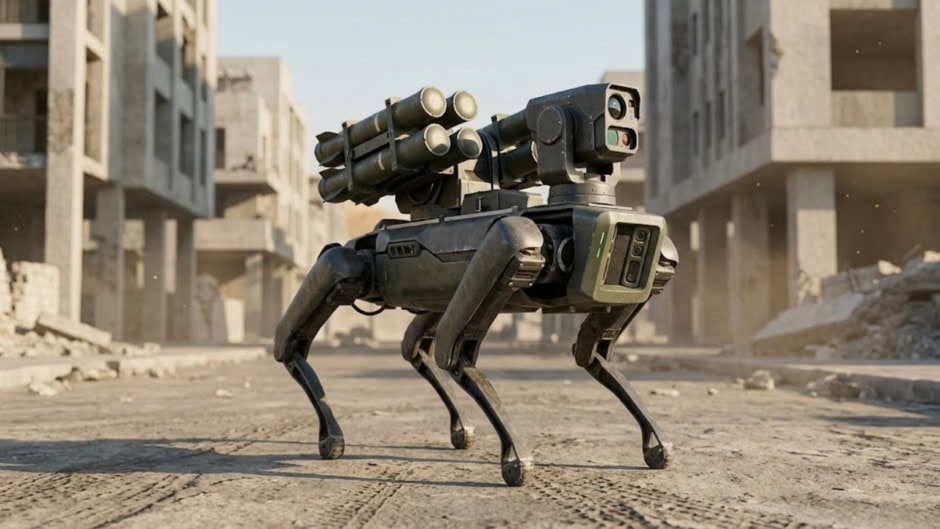
Earlier this year at the World Defense Show 2026 in Riyadh, China officially changed the battlefield. A Chinese state-linked defense manufacturer unveiled a production-ready quadruped combat robot. They call it the Robot Dog PF-070. Importantly, this robot dog carries four anti-tank guided missiles on its back. Furthermore, China actively positions this system for international sale. The armed robot dog is no longer a futuristic concept. It is a deployed reality.
Robot Dog PF-070: Lethal Precision & Urban Tactical Advantage
The PF-070 combines advanced sensors with a stealthy design. Specifically, the modular chassis remains low-profile, acoustically quiet, and highly agile across rough terrain. Additionally, the payload features four compact missile launchers set in a twin-pack configuration. China derived these missiles directly from its existing man-portable inventory. Consequently, the robot delivers an effective engagement range of two to four kilometers.
To ensure pinpoint accuracy, the system uses electro-optical targeting, thermal imaging, and a laser rangefinder. However, the machine does not fire autonomously. The design deliberately retains a human operator in the loop to authorize weapons release.
Tactically, this platform heavily disrupts urban warfare. Narrow city streets often make main battle tanks awkward and vulnerable. Meanwhile, traditional human anti-tank missile teams face severe exposure. Therefore, deploying a low-profile robot dog ahead of the infantry solves this problem. It drastically reduces thermal signatures and completely protects human crews.
A Global Proliferation Reaching Pakistan
China systematically developed this technology through its military-civil fusion strategy. Initially, the military tested commercial Unitree quadrupeds in various exercises. Now, China exports both the hardware and the operational tactics. For example, during the SCO’s “Interaction-2024” counter-terrorism exercise in Xinjiang, rifle-armed robot dogs operated alongside troops from all ten member states. Notably, this joint operation included military personnel from Pakistan. Exposure in these exercises serves as a direct pathway to eventual procurement for nations in China’s strategic orbit.
Moreover, armed quadrupeds currently represent a rapidly growing global phenomenon. Turkey’s Roketsan recently introduced the KOZ, a visually similar missile-armed robot dog, at IDEF 2025. Similarly, the United States tests platforms like Ghost Robotics’ Vision 60 primarily for counter-drone and reconnaissance missions. Furthermore, Russia and Ukraine actively deploy armed robot dogs in live combat zones.
Ultimately, the engineering phase of ground combat robotics is over. We currently stand in the deployment phase. Now, any reasonably funded state can deploy hundreds of networked, low-cost, missile-carrying platforms instead of a few crewed vehicles. Consequently, this technology completely alters traditional force employment, attrition calculus, and global deterrence. The hardware operates at machine speed; however, military doctrine and international law must urgently catch up.