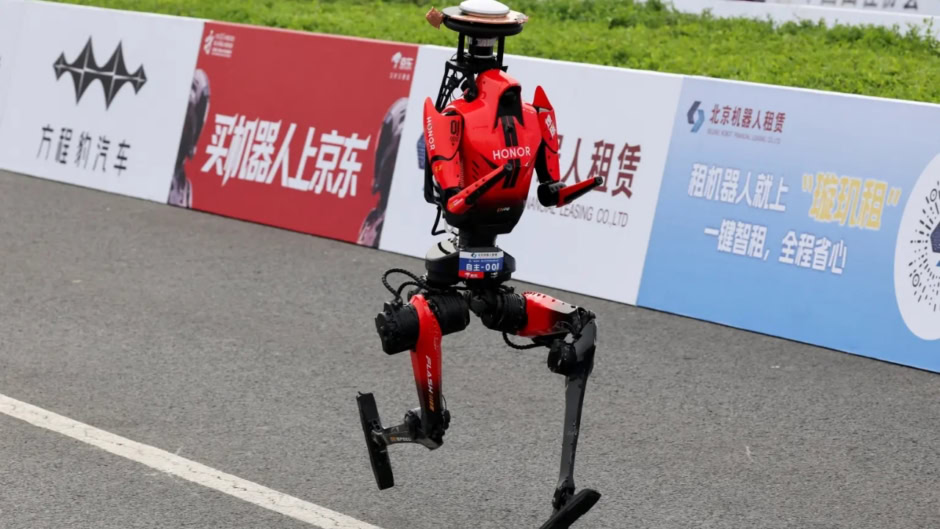
A humanoid robot developed by Chinese smartphone maker Honor shattered the half-marathon world record on Sunday in Beijing, completing the 21-kilometer race in 50 minutes and 26 seconds and beating the human record by nearly seven minutes.
The bright-red bipedal robot named Lightning finished the race at an average speed of approximately 25 kilometers per hour, surpassing Ugandan runner Jacob Kiplimo’s human world record of 57 minutes and 20 seconds set in Lisbon last month. The robot stood 169 centimeters tall and swung its short forearms for balance as it dashed toward the finish line.
The performance marked a dramatic improvement from last year’s inaugural event, when the winning robot required 2 hours, 40 minutes, and 42 seconds to complete the course. More than 100 robot teams participated in this year’s race alongside approximately 12,000 human runners, who competed in a parallel lane to avoid collisions.
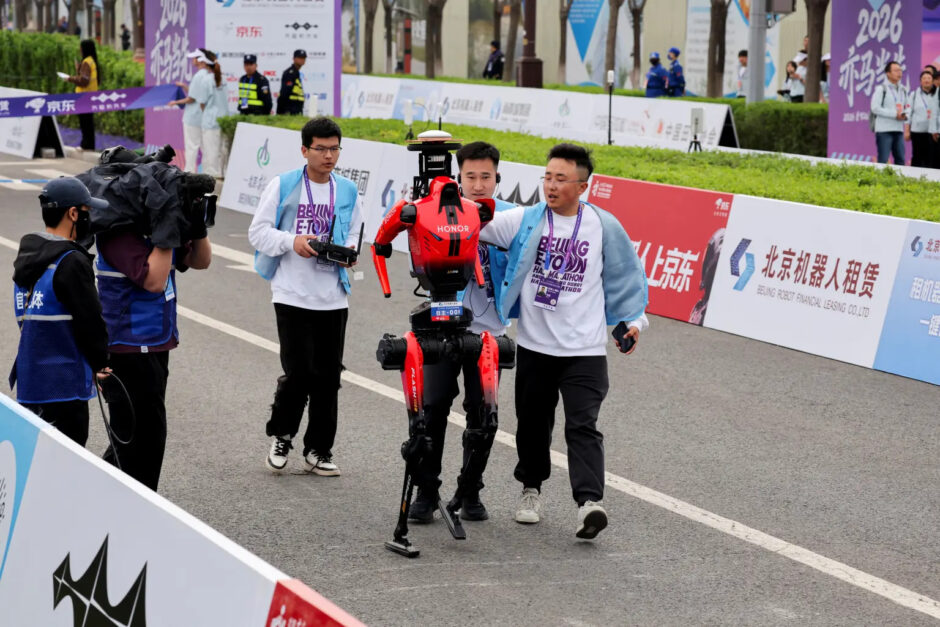
Honor engineers said the robot was developed over one year, fitted with legs 90 to 95 centimeters long to mimic elite human runners and liquid cooling technology adapted from smartphone manufacturing. The robot’s autonomous navigation and burst power proved key to winning the race, according to organizers.
Teams from Honor swept the top three podium positions, all posting times faster than the human world record and all using self-navigation systems. Approximately 40% of the robots navigated the course autonomously, while the remaining units were remotely controlled by teams of technicians who followed the course in golf carts.
The fastest human competitor, 29-year-old Zhao Haijie, completed the race in 1 hour, 7 minutes, and 47 seconds. Wang Qiaoxia won the women’s race, with both human winners requiring more than an hour to finish.
Despite the breakthrough, the race experienced technical difficulties. One robot fell flat at the start line, and Lightning itself crashed into a railing near the end of the race before recovering to cross the finish line.
Another robot flipped and face-planted approximately 200 feet from the starting line, then continued with its upper body held together with packing tape. Many robots required technician support throughout the course, with teams carrying stretchers and wheelchairs in case of mechanical failures.
The event represents a significant milestone in China’s push to dominate robotics and artificial intelligence development. Beijing’s 2026-2030 economic plan prioritizes speeding up development of humanoid robots and their applications across industrial and daily life sectors.
London-based technology research firm Omdia recently ranked three Chinese companies as the only first-tier vendors in its global assessment for shipment numbers of general-purpose embodied intelligent robots. AGIBOT, Unitree Robotics, and UBTech Robotics Corp. all shipped more than 1,000 units last year, with the first two companies shipping more than 5,000 units.
Spectators expressed mixed reactions to the technological demonstration. Sun Zhigang, who attended with his son, said the robots seemed to have stolen much of the spotlight from human runners.
“The robots’ speed far exceeds that of humans,” he stated. “This may signal the arrival of a new era.”
However, 25-year-old student Han Chenyu expressed concerns about workforce implications. “As someone who works for a living, I’m a little worried about it sometimes,” she told reporters. “I feel like technology is advancing so fast that it might start affecting people’s jobs.”
Experts noted that while the athletic capabilities are impressive, Chinese robotics firms still struggle to develop AI software enabling humanoids to match the efficiency of human factory workers. The skills displayed during the half-marathon do not directly translate to widespread commercialization in industrial settings, where manual dexterity, real-world perception, and capabilities beyond repetitive tasks remain crucial.
China showcased its humanoid robotics capabilities at the annual CCTV Spring Festival gala in February, where over a dozen Unitree humanoids performed sophisticated martial arts sequences with swords, poles, and nunchucks. Beijing also hosted the world’s first Humanoid Robot Games last year, featuring competitions in soccer, boxing, and martial arts.