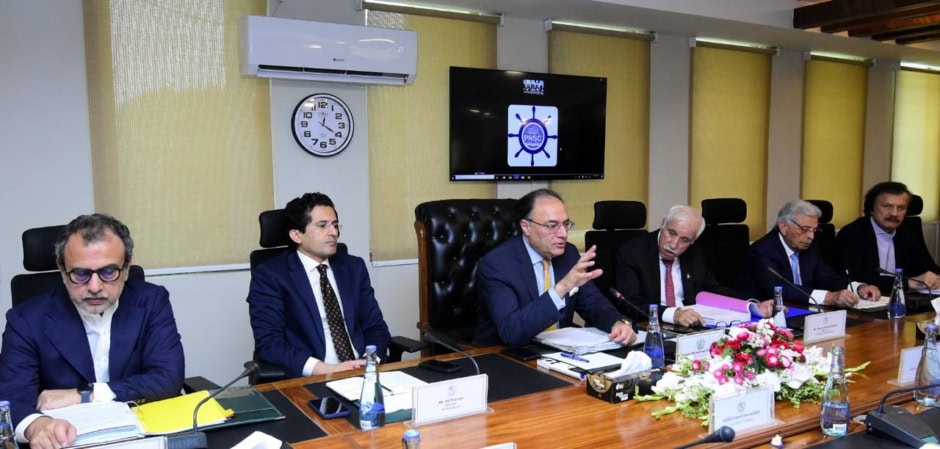
The Economic Coordination Committee (ECC) today, on Tuesday, approved several major funding allocations, including support for youth training, healthcare, refugee assistance, and food safety reforms during a meeting chaired by Finance Minister Muhammad Aurangzeb. The meeting took place at the Finance Division and focused on budget approvals and policy decisions for the fiscal year 2025-26.
Among the key approvals, the ECC cleared a Rs. 3,915.24 million Technical Supplementary Grant (TSG) proposed by the Ministry of Federal Education and Professional Training. The funding will support the Prime Minister’s Youth Skill Development Programme through the National Vocational and Technical Training Commission and help establish Danish schools in Azad Jammu & Kashmir, Gilgit-Baltistan, and Balochistan.
The committee also approved two separate summaries from the Ministry of Interior and Narcotics Control. These included Rs. 160 million for repair and maintenance work at the Prime Minister’s Office during FY 2025-26 and Rs. 480 million for operational expenses of the Frontier Corps KP (North) Hospital in Shakas, District Khyber.
Officials informed the committee that the maintenance duties of the Prime Minister’s Office were shifted to the Capital Development Authority after the closure of the Pakistan Public Works Department.
In addition, the ECC approved Rs. 1,500 million for the Prime Minister’s National Health Program under PSDP 2025-26. The programme, previously known as the Sehat Sahulat Programme, provides publicly funded health coverage to support access to medical services across the country.
The committee also raised the monthly subsistence allowance for Jammu and Kashmir refugees of 1989. The amount increased from Rs. 3,500 to Rs. 6,000 per person starting February 1, 2026. Moreover, the ECC approved Rs. 578.838 million through TSG to cover payments until June 30, 2026.
Meanwhile, the ECC approved Rs. 1 billion for outstanding liabilities under the Prime Minister Assistance Package after reviewing a summary from the Ministry of Railways. The committee also directed the Railways Division to review its pension liabilities. At the same time, the Establishment Division will examine the broader policy structure of the assistance package.
The ECC further approved another Rs. 1 billion allocation for the operational launch of the National Agri-Trade and Food Safety Authority. The authority will strengthen oversight of food safety, livestock, plant health, and agro-chemicals according to international trade standards.
In a major maritime sector decision, the committee granted in-principle approval for the restructuring of Pakistan National Shipping Corporation. The plan includes the sale of 30% shares and transfer of management control to the National Logistics Corporation. The ECC urged authorities to speed up the process to benefit from emerging maritime and transshipment opportunities.
The committee also approved the National Policy to Realize Pakistan’s Gemstone Potential 2026-2030. The policy aims to formalize the gemstone industry, improve mining practices, increase value-added exports, and support economic growth in Gilgit-Baltistan, Khyber Pakhtunkhwa, and Azad Jammu & Kashmir.
The meeting included several senior cabinet members, including Investment Minister Qaiser Ahmed Sheikh, Power Minister Awais Ahmed Khan Leghari, Petroleum Minister Ali Pervaiz Malik, and Food Security Minister Rana Tanveer Hussain, along with senior government officials.