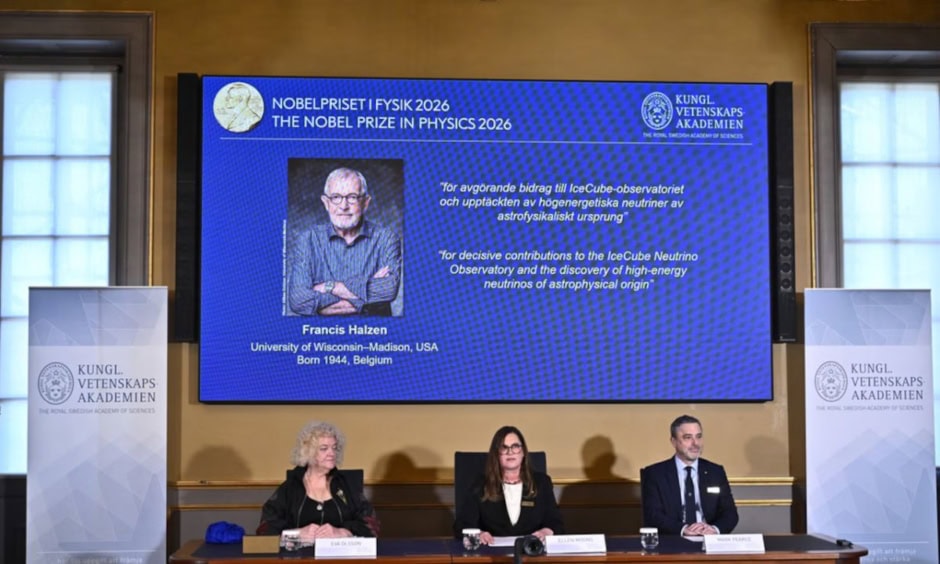
Francis Halzen, a Belgian-born physicist at the University of Wisconsin–Madison, has been awarded the Nobel Prize in physics for his work on a rare group of neutrinos, the Nobel Committee announced Tuesday. The committee said his research helps scientists understand how the universe evolved.
The committee credited the 82-Year-Old with a key role in building the IceCube Neutrino Observatory in Antarctica, which the University of Wisconsin–Madison operates.
Committee chair Mark Pearce said Halzen led an international team of researchers and engineers who produced “a fantastic instrument,” adding that his tenacity and scientific vision paved the way for a new kind of astronomy.
Halzen spoke to the committee by phone from Italy during a call broadcast at the announcement news conference. He said the news came as a great surprise. He added that although it had been predicted he would win, the announcement still felt strange.
Halzen said he is working on a proposal and hopes the prize will help secure its approval. The remark drew chuckles from the audience.
Neutrinos are tiny cosmic particles with a small mass. They are found everywhere, produced by stars such as the sun, with trillions passing through the human body every second. The Associated Press said its efforts to reach Halzen were not immediately successful.