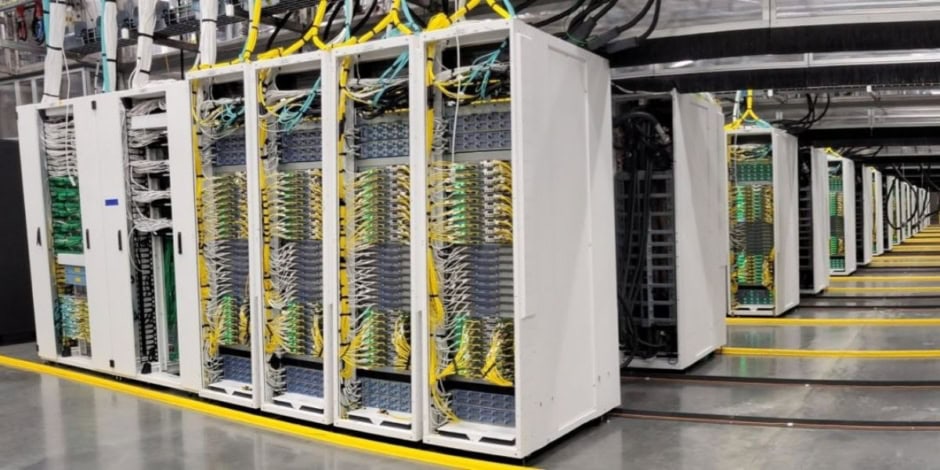
Microsoft will launch what it calls the world’s most powerful AI supercomputer, Fairwater, in early 2026. Located in Mount Pleasant, Wisconsin, the project aims to dramatically accelerate AI development worldwide. Engineers designed the new facility to deliver ten times the performance of today’s fastest supercomputers, putting Microsoft and its partners at the forefront of the AI arms race.
AI Supercomputer: A Computational Marvel
Spanning 315 acres and housing three buildings totaling 1.2 million square feet, the Fairwater campus is being purpose-built for the most intensive AI workloads. Its computing power comes from hundreds of thousands of NVIDIA GB200 (and future GB300) GPUs, all connected through a network with enough high-speed fiber optic cable to wrap around the planet multiple times. The flat network architecture, leveraging NVLink/NVSwitch, ensures near-zero latency, which will make training large-scale models like OpenAI’s GPT family significantly faster and more cost-effective.
Sustainability at Scale
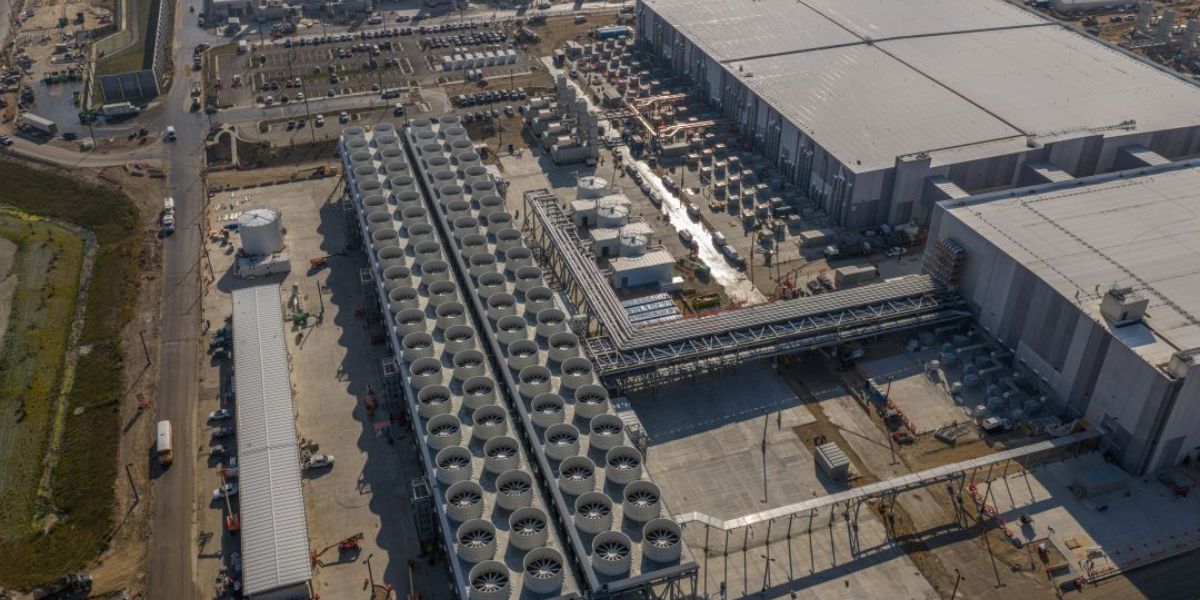
Despite its immense power consumption, Fairwater prioritizes sustainability. Its closed-loop liquid cooling system recirculates water and cools over 90% of its computing capacity without wasting resources.
The supercomputer design is so efficient that Microsoft claims the entire campus will use less water annually than a single golf course. Microsoft prepaid for local electrical infrastructure upgrades and funded a 250MW solar project to match its energy consumption with carbon-free sources. This approach ensures the project’s massive power needs don’t burden the local community.
Global Impact and the Geopolitics of AI Supercomputer
As AI becomes foundational to technology and science, having dedicated infrastructure of this magnitude can alleviate cloud bottlenecks and enable researchers and developers worldwide to tackle larger, more complex models. The project is a key component of Microsoft’s strategy to maintain a competitive edge over rivals like Google, Amazon, and Meta. Analysts also view these massive infrastructure investments as a form of “computational nationalism,” securing critical AI resources domestically in an era of geopolitical tensions and trade restrictions.
For developing nations, including Pakistan, the rise of such super-compute hubs holds the promise of faster, more reliable, and potentially more affordable access to advanced AI resources. However, access must be democratized to ensure these benefits are widely shared.
With construction well underway, the first phase of Fairwater is expected to be operational in early 2026. As part of its community investment, Microsoft is already implementing workforce training programs, including its Datacenter Academy, to prepare local talent for the technical jobs the facility will create. In addition to Fairwater, Microsoft is also vesting their interest in making UK’s largest AI supercomputer as well.