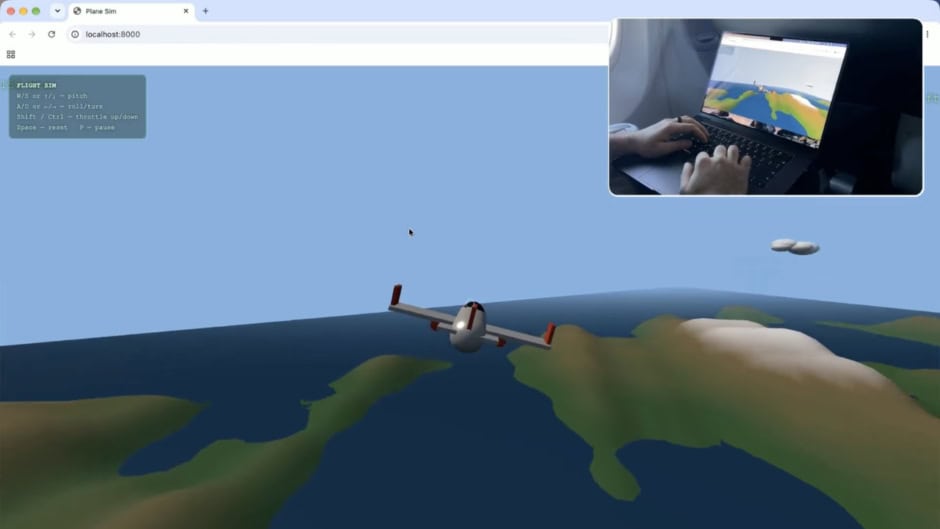
Thinking Machines Lab has released Inkling 2 Mini, an open-weights AI model small enough to run on a laptop. The company, founded by former OpenAI CTO Mira Murati, says the model leads every open-weights model under 100 billion parameters on coding benchmarks. It also built a playable flight simulator offline on a MacBook Pro in airplane mode.
The model’s key innovation is looping. Instead of processing each token through its layers once, Inkling 2 Mini runs its middle layers three times per token. That approach lets it reason more deeply without writing out longer chains of thought.
“Looping allows the model to reason longer without writing its reasoning down,” Thinking Machines wrote in its announcement.
Under the hood, Inkling 2 Mini uses a mixture-of-experts architecture. It holds 26.4 billion parameters in total but only activates 3.4 billion per token. With the three loops factored in, that figure reaches 5.4 billion weight activations per token. Its 24 layers sit in four blocks of six. The first and last blocks run once, while the two middle blocks run three times each. The entire model fits in roughly 20GB of memory.
The lab trained most weights in NVIDIA’s 4-bit NVFP4 format. As a result, there is no quality loss from post-training conversion. During training, the team also cut two-thirds of the model’s experts. They then retrained it on one trillion tokens from a larger internal Inkling model.
On benchmarks, the results are strong. Inkling 2 Mini scored 48.2% on DeepSWE v1.1 and 77.9% on a hard set of SWE-bench Pro tasks. By comparison, Alibaba’s Qwen3.8-27B scored 42.2% and 73.8% on the same tests. Independent benchmarking firm Artificial Analysis rated Inkling 2 Mini at 20 on its Intelligence Index. That matches Qwen3.8-27B with roughly five times fewer active parameters.
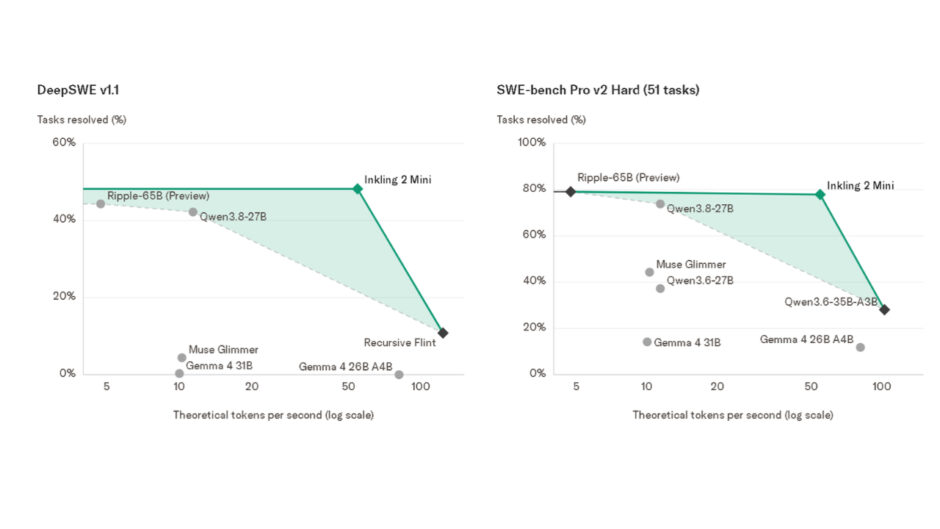
The cost difference is equally notable. Artificial Analysis found each task cost $0.59 and took nine minutes with Inkling 2 Mini. The same task cost $3.53 and took 38.2 minutes with Qwen3.8-27B. That makes Inkling 2 Mini about six times cheaper and four times faster per task. However, it uses about 38% more output tokens for the same score. For context, OpenAI’s GPT-6 Luna scored 28 on the same index at $0.15 per task.
The model does have limits. Thinking Machines acknowledged that Inkling 2 Mini is not the strongest small model for multi-turn chat. It also struggles with instructions containing many constraints. In those scenarios, Qwen3.8-27B performs better. Additionally, it trails larger models on hard reasoning tests. Looping does not help it store more facts.
Looping also raises a safety question. AI labs monitor models partly by reading their written reasoning chains. Because a looped model does more thinking internally, monitors cannot see all of its reasoning. Thinking Machines addressed this directly by releasing a research model that loops between one and five times. In its tests, reasoning at five loops produced less than half the text of one loop. However, the lab said it found no meaningful reduction in how well monitors could read the model’s thinking at this scale.
As per Thinking Machines:
Efficient intelligence makes Inkling 2 Mini a great choice for inference where speed is paramount, or for running on local hardware. At launch we support Inkling 2 Mini running on any Mac system (MacBook, Mac Mini) with at least 32GB RAM via Ollama. With native NVFP4 training and inference precision, Inkling 2 Mini runs efficiently on NVIDIA’s DGX Spark desktop AI computer. Quantized GGUF versions are available via Unsloth and llama.cpp for local inference.
Inkling 2 Mini runs on Macs with at least 32GB of memory through Ollama. The weights sit on Hugging Face under an Apache 2.0 license. The model supports a context window of one million tokens.