Instagram is developing a new AI-powered tool that generates smooth transitions between still photos posted in Stories, turning what is currently a flat slideshow into something that looks and feels more like a video.
The feature, labelled “AI Transition” in the app’s interface, was first uncovered by reverse engineer Alessandro Paluzzi and has since been confirmed by multiple sources tracking Instagram’s development pipeline. In the current Stories experience, uploading multiple photos produces a simple slide-to-slide sequence where each image appears abruptly after the last. The new tool sits alongside the existing “Separate” mode and appears to use generative AI to fill the visual gap between two images, generating new pixels that morph one photo smoothly into the next. The technique is similar to frame interpolation, a method already used in video production to create fluid motion between static frames.
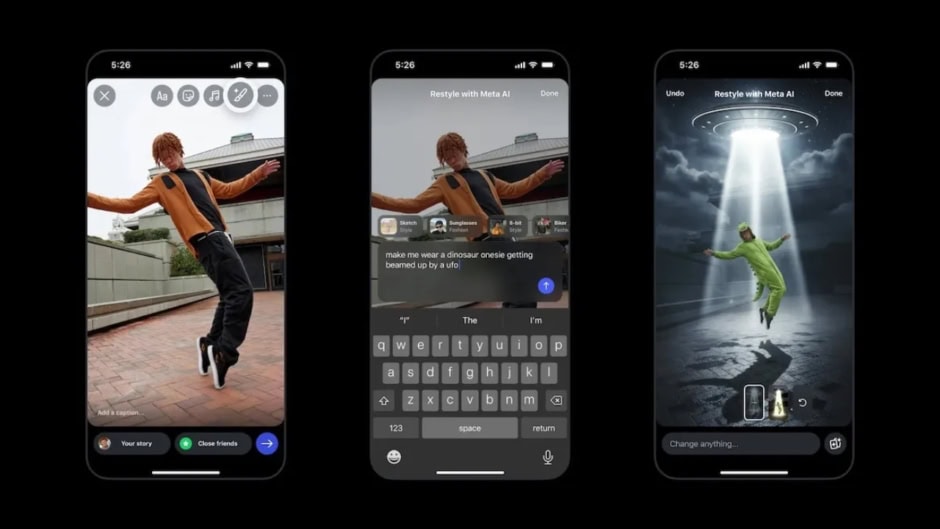
The feature arrives against the backdrop of a much broader AI integration campaign across Instagram. Over the past year, Meta has steadily layered AI tools into the Stories creation process. In October 2025, it brought its “Restyle” editing suite directly into Stories, allowing users to enter text prompts to add, remove, or change elements in photos and videos without leaving the app.
Users can ask the AI to change a hair colour, add a crown to someone’s head, insert a sunset background, or apply preset effects that alter outfits and image styles. These tools had previously been confined to the Meta AI chatbot but are now accessible natively through the Stories composer via a paintbrush icon.
Meta has also been expanding its standalone Edits app with features that blur the line between photo and video creation. Recent updates include freeze frames for enhancing transitions, AI-powered auto-tagging that identifies people in video clips, fade transition refinements, clip-to-overlay conversion, audio ducking, and a teleprompter for recording. The Edits app has become Meta’s answer to CapCut and other third-party editing tools, and Adam Mosseri, Instagram’s head, recently clarified that using external editors does not hurt reach, though retaining third-party watermarks might.
The AI Transition feature fits a clear strategic pattern. Instagram’s algorithm already heavily favours video content, particularly Reels, for discovery and recommendation. But a massive portion of Stories content is still photo-based. By making it possible to turn a handful of still images into something that mimics video, Instagram gives creators a way to produce more engaging Stories without needing to shoot or edit actual footage. It also keeps creation inside Instagram’s own toolset rather than sending users to competing apps.
As Instagram head Mosseri himself has acknowledged, AI is rapidly making polished content cheap and easy to produce, which means the content that stands out may increasingly be raw, imperfect, and unmistakably human. Instagram is simultaneously building tools that make everything look more polished while signaling that authenticity is what will matter most. How those two impulses coexist as AI features expand will be one of the defining questions for the platform in 2026.
According to Instagram’s Help Center, “AI Transition” will now be appearing for some users as an option within the image gallery in Instagram Stories. Users will then select two or more images to generate a transition, which can then be posted as a Story.
The feature has not yet been publicly released. Instagram is still developing it internally, and no official launch date has been announced.