
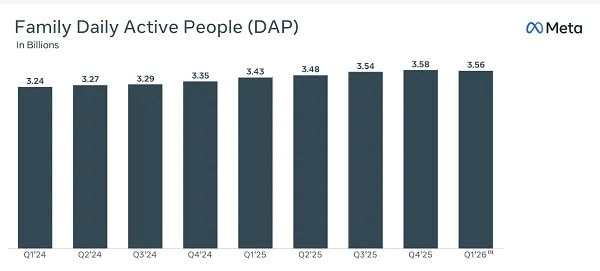
Meta Platforms recorded its first-ever decline in daily active users across its family of apps dropping to 3.56 billion in the first quarter of 2026 from 3.58 billion in Q4 2025. It marks a significant milestone for the social media giant despite launching new platforms including Threads and the Meta AI app according to the company’s Q1 2026 performance update published April 29, 2026.
The slight decrease represents a 4% year-over-year increase compared to Q1 2025 but a quarter-over-quarter drop that Meta attributed to internet disruptions in Iran during January 2026 protests, Russia’s WhatsApp access restrictions, and potential user losses in Australia due to new teen social media regulations.
The daily active user decline occurred despite Meta’s expanding app portfolio that includes Facebook, Instagram, WhatsApp, Messenger, Threads and Meta AI, demonstrating that new product launches could not offset user losses in restricted markets.
Meta still maintains that more than one-third of the world’s 8 billion population uses its apps every day with 3.56 billion daily active people, positioning the company as a dominant global connective platform however the first-ever usage decrease signals potential headwinds in user engagement growth that has historically driven advertising revenue expansion.
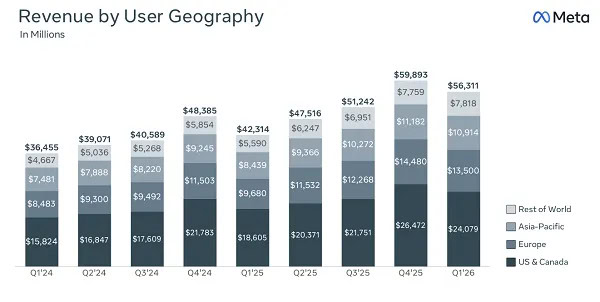
Meta reported Q1 2026 revenue of $56.31 billion representing a 33% year-over-year increase from $42.3 billion in Q1 2025, marking the fastest quarterly growth since 2021 driven by a 19% increase in ad impressions across its platform family and a 12% rise in average ad prices. Net income jumped 61% to $26.8 billion or $10.44 per share from $16.6 billion a year earlier, however the profit surge included an $8.03 billion income tax benefit related to the Trump administration’s One Big Beautiful Bill Act tax treatment of capitalized research and development expenses, meaning diluted earnings per share would have been $3.13 lower without the tax adjustment.
The company’s total costs and expenses reached $33.44 billion in Q1 2026 representing a 35% year-over-year increase reflecting Meta’s massive artificial intelligence infrastructure investments and operational expansion. Meta raised its 2026 capital expenditure guidance to $125-145 billion from the previous range of $115-135 billion citing higher component pricing for AI hardware and additional data center costs to support future capacity requirements, triggering a 5% stock price decline in after-hours trading as investors expressed concerns about escalating AI spending without clear monetization strategies.
Meta announced plans to lay off approximately 8,000 employees representing 10% of its workforce in May 2026 while closing 6,000 open roles as part of efficiency improvements designed to offset massive AI investments, bringing total headcount to approximately 70,000 from 77,986 as of March 31, 2026. The job cuts target operational optimization as CEO Mark Zuckerberg continues the company’s strategic pivot toward artificial intelligence following a June 2025 talent overhaul that included a $14.3 billion investment in Scale AI and hiring of CEO Alexandr Wang to lead Meta’s AI initiatives.
Meta slightly reduced losses in its Reality Labs division which has accumulated $73 billion in cumulative losses over five years through 2025, however the Metaverse-focused unit received job cuts as part of broader restructuring efforts. The company’s overall headcount rose 1% year-over-year likely fueled by AI staffing additions offset by Reality Labs reductions, demonstrating resource reallocation from virtual reality initiatives toward artificial intelligence infrastructure and capabilities.
The European Commission preliminarily found Meta’s Instagram and Facebook in breach of the Digital Services Act for failing to adequately identify, assess and mitigate risks of minors under 13 years old accessing their services. Meta stated it continues monitoring active legal and regulatory matters including headwinds in the European Union and United States that could significantly impact business and financial results, noting continued scrutiny on youth-related issues with additional trials scheduled in 2026 that may ultimately result in material losses following two trial defeats in March 2026 involving allegations the company misled consumers about product harms.
Meta reported ranking improvements on Instagram in Q1 drove a 10% lift in Reels time spent viewing. Meanwhile, Facebook total video watch time increased more than 8% globally representing the largest quarter-over-quarter gain in four years, demonstrating engagement growth within existing user bases despite overall daily active user decline. Average revenue per person came in at $15.66 beating analyst estimates of $15.26 though down from $16.56 in Q4 2025, while Meta guided Q2 2026 revenue to $58-61 billion roughly in line with Wall Street expectations.
CEO Mark Zuckerberg stated the company had a milestone quarter with strong momentum across apps and the release of its first model from Meta Superintelligence Labs, claiming Meta is on track to deliver personal superintelligence to billions of people. The strategic focus on artificial intelligence aims to reshape Meta’s revenue structure beyond advertising dependence, however analysts note the company’s AI investments need to demonstrate monetization pathways as user growth challenges emerge alongside rising operational costs and regulatory pressures across key markets.
Meta’s total costs and expenses were $33.44 billion in Q1, an increase of 35% year-over-year.