Meta released Muse Code in beta on August 5, entering the AI coding agent race dominated by Anthropic’s Claude Code and OpenAI’s Codex. The terminal-based tool handles complex software engineering tasks across large repositories. It plans changes, writes code, and validates results.
Muse Code runs on Muse Spark 1.2, a coding-focused model update co-trained specifically with the agent. Alexandr Wang, head of Meta Superintelligence Labs, leads the project. The tool installs with a single terminal command on macOS or Linux. When facing large tasks, it launches parallel sub-agents that work simultaneously in isolated worktrees. The developer’s primary working copy stays untouched throughout.
The architecture introduces features absent from competitors. Muse Code maintains a local append-only event log. If it crashes 20 hours into a long-running task, it resumes exactly where it stopped. It also runs persistent background agents that build context over time rather than starting fresh with every session. Built-in “skills” include /plan for approval-gated planning, /grill for stress-testing that plan, and /goal for driving toward task completion.
The pricing strategy is the most aggressive move in the launch. Standard tier runs $1.25 per million input tokens and $4.25 per million output tokens. The contributor tier drops that to $0.10 input and $0.20 output. That is 12.5 times cheaper on input and 21 times cheaper on output.
Developers on the contributor tier grant Meta permission to train future models on their prompts and code completions. Zuckerberg is steering new users toward this tier directly. The contributor tier also carries tighter rate limits: 60 requests per minute versus 3,000 on standard.
A coding agent reads your entire codebase, which might be a deal breaker for some. On the contributor tier, that means your source code, internal APIs, comments, and test fixtures all become Meta training material. For open-source projects, the pricing is nearly free. For proprietary codebases, it is a licensing decision disguised as a discount.
Meta’s internal adoption strategy is equally aggressive. An internal memo reported by The Information reveals Meta is requiring thousands of engineers to use MetaCode, the internal version, weekly. Engineers must submit at least one code change per week using the tool. When it makes mistakes, employees correct them. Those corrections train a future model known internally as Watermelon. MetaCode already has roughly 7,000 weekly active users. Employee feedback has generated over 800 fixes that improved performance on the DeepSWE benchmark.
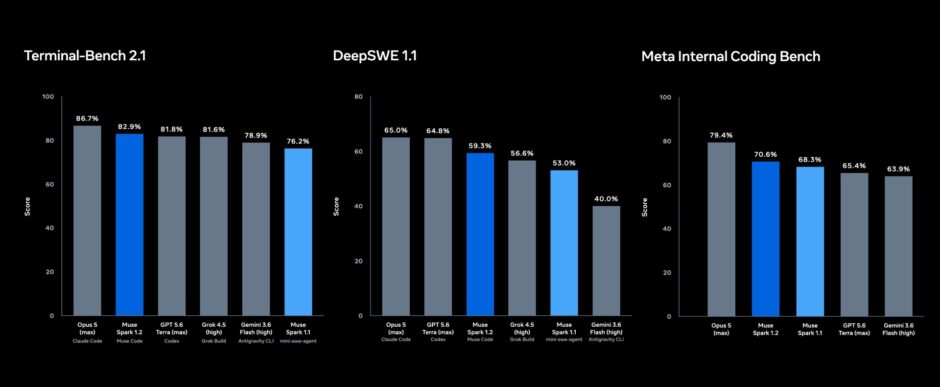
Meta’s own published charts place Claude Opus 5 first on all three coding benchmarks it released, including Meta’s internal test. Muse Spark 1.2 scored 70.6% where Claude scored 79.4%. Meta is not claiming superiority. It is competing on price and architecture while openly acknowledging the capability gap.
The launch also conspicuously omits any mention of open source. This is striking from the company that spent three years positioning itself as the standard-bearer of open AI through the Llama model family. Muse Code is closed-source. Whether Meta eventually opens the weights remains unclear.
Meta also offers zero data retention options for enterprise customers who need compliance guarantees. That positions Muse Code as a viable option for regulated industries unwilling to share code with any vendor.
The competitive landscape now features four major terminal coding agents: Claude Code, OpenAI Codex, Google’s Antigravity CLI, and Muse Code. Meta arrives last but with the cheapest entry point and a unique crash-recovery architecture. At the end of the day, it will inevitably be the pricing which would define the supreme coding agents among the competition.