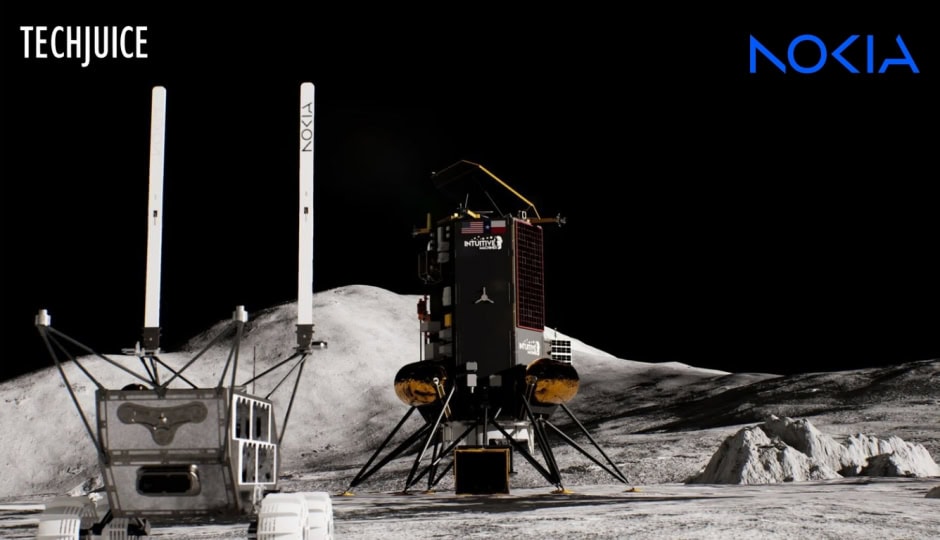
In a groundbreaking step toward advancing lunar communications, Nokia is set to deploy the first-ever 4G cellular network on the Moon. This initiative, part of NASA’s Tipping Point program, is being developed by Nokia Bell Labs and will be integrated into Intuitive Machines’ IM-2 mission, scheduled for launch later this month from NASA’s Kennedy Space Center.
Space agencies have primarily employed direct sight radio signalling to communicate on the Moon, but these systems have limited range and slow data speeds. Thierry Klein, President of Nokia Bell Labs Solutions Research, warned that these standard point-to-point radio communications are insufficient for NASA’s Artemis program to sustain human presence on the Moon through the 2030s.
By implementing 4G technology, lunar operations will receive increased data processing capabilities and diffused coverage, allowing for operation with several devices and improving operational sustainability.
How It Works?
Nokia’s lunar network is built around an integrated LTE base station design, EPC features, and LTE User Equipment components that are backed by RF antennas and run high-reliability software for operations and maintenance. The base station is the major component housed inside the lander, and the user equipment communicates with the rover installed on lunar ground.
During the IM-2 mission, the tiny network-in-a-box technology allows for uninterrupted communication between the lander, rover, and hopper. The device was designed to withstand lunar environmental conditions, however the severe temperatures of nocturnal lunar circumstances will deactivate it after a few days.
Nokia has intentions to broaden this network in anticipation of the upcoming Artemis missions and to integrate the technology into astronaut spacesuits. Some researchers in radio astronomy, such as Chris De Pree from the National Radio Astronomy Observatory (NRAO), are concerned about the cell signal frequencies utilised by LTE.
Nokia was granted initial authorisation to operate the IM-2 mission, according to Harvey Liszt of NRAO. However, in order to maintain operations, comprehensive spectrum clearance must be obtained.
The mission is a significant accomplishment in the field of space exploration, as it establishes protocols for the execution of sustainable and advanced lunar operations. By bringing terrestrial communication technology to the Moon, Nokia is playing a crucial role in laying the foundation for future lunar habitats and, ultimately, deep space exploration.