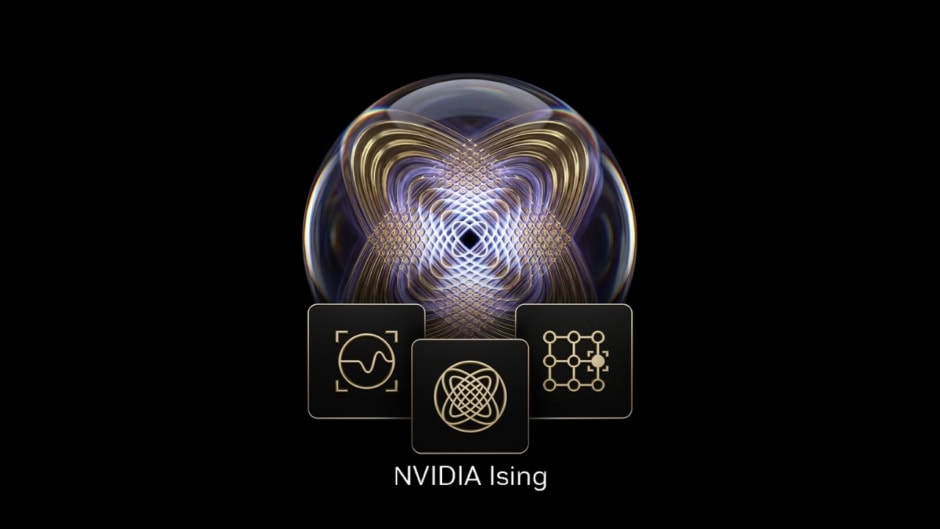
NVIDIA has released what it describes as the world’s first family of open source AI models designed specifically for quantum computing.
Called “NVIDIA Ising”, the model family targets two of the most critical barriers to useful quantum computing: processor calibration and error correction.
If there is one thing that is certain is that quantum computers are notoriously fragile. Their qubits lose coherence quickly, and even small errors accumulate fast enough to make large-scale computation unreliable. Calibrating a quantum processor and correcting errors in real time currently requires enormous time and manual effort, slowing progress significantly. Ising addresses both problems through dedicated AI models.
The Ising family has two components. Ising Calibration is a vision language model that interprets measurements from quantum processors and enables AI agents to automate continuous calibration. The process currently takes days in many labs, but NVIDIA says Ising Calibration reduces that to hours.
Ising Decoding is a 3D convolutional neural network available in two variants, one optimized for speed and one for accuracy, designed to handle real-time decoding during quantum error correction. NVIDIA says it outperforms pyMatching, the current open source standard, by up to 2.5x in speed and 3x in accuracy.
NVIDIA founder and CEO Jensen Huang framed the launch in broad terms.
“AI is essential to making quantum computing practical,” he said. “With Ising, AI becomes the control plane — the operating system of quantum machines — transforming fragile qubits to scalable and reliable quantum-GPU systems.”
The adoption list for Ising at launch is substantial. Ising Calibration is already in use by institutions including Fermi National Accelerator Laboratory, Harvard’s John A. Paulson School of Engineering and Applied Sciences, Lawrence Berkeley National Laboratory’s Advanced Quantum Testbed, IQM Quantum Computers, and the UK National Physical Laboratory.
On the other hand, Ising Decoding is being deployed by Cornell University, Sandia National Laboratories, UC Santa Barbara, and the University of Chicago, among others.
Ising integrates with NVIDIA’s existing quantum software platform and hardware interconnect, and runs locally on researchers’ systems to protect proprietary data.
The quantum computing market is projected to surpass $11 billion by 2030, with progress on error correction and scalability considered essential to reaching that figure.