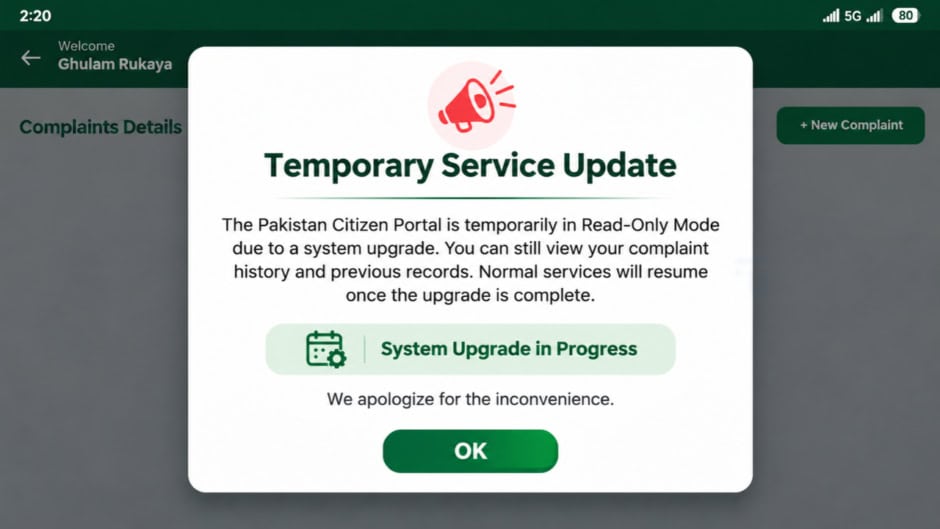
Pakistan’s Citizen Portal has blocked new complaint submissions for nearly a week. The government’s flagship grievance platform switched to read-only mode around November 4. Users can still view their complaint history and previous records. However, they cannot file fresh complaints through the mobile application. No restoration date has been announced.
The notice inside the app offers no timeline whatsoever. It reads that the portal is “temporarily in Read-Only Mode due to a system upgrade.” Also, it adds that normal services will resume once the upgrade finishes. Beyond that, the notice contains no expected completion date, no progress update, and no information about alternative channels for filing complaints. For a platform that connects millions of citizens to thousands of government offices, that silence raises obvious questions.
The numbers behind the portal underscore the scale of the disruption. Previously published official figures put registered users at approximately 4.76 million. Total complaints received stood at about 6.66 million, with around 6.55 million recorded as resolved.
On Google Play, the Android app has crossed five million downloads. Meanwhile, information presented to the National Assembly showed that 6,285 government departments and 11,223 officials were linked to the system. That network reportedly spanned federal and provincial institutions, Azad Jammu and Kashmir, Gilgit-Baltistan, and 86 Pakistani diplomatic missions abroad.
Launched in October 2018 during Imran Khan’s tenure as prime minister, the portal gave citizens a direct route to register grievances about police, revenue, municipal services, utilities, and other public bodies. For many users, it replaced the need to physically visit government offices and navigate bureaucratic barriers. Over time, it became one of the more visible examples of digital governance in Pakistan.
The read-only restriction creates several unanswered questions. For instance, can officials still process existing complaints while the public-facing app stays locked? Are deadlines for pending complaints or appeals affected by the downtime? What alternative channel can a citizen use to file an urgent new grievance during the upgrade? Additionally, will users receive advance notice before normal services resume?
The government has not clarified any of these points publicly.
It also remains unclear whether registered users received individual notifications before the restriction went live. The Ministry of Information reportedly circulated an announcement on November 4. However, the app notice itself does not indicate that users received emails, SMS alerts, or any other direct communication beforehand.
This is not the first time the portal has faced access problems. Reports of technical issues also surfaced in 2025. Those earlier disruptions raised similar concerns about service continuity and the platform’s resilience under routine maintenance.
System upgrades are routine and often necessary for security and performance. That part is not controversial. However, a nationwide public grievance mechanism also requires clear communication, practical alternatives during downtime, and transparent restoration timelines. Taking the platform offline without any of those safeguards risks undermining public confidence in a system specifically designed to improve government accountability.
For now, millions of registered users have no way to submit new complaints. They have no date for when that ability returns. And they have no alternative platform to turn to in the meantime.