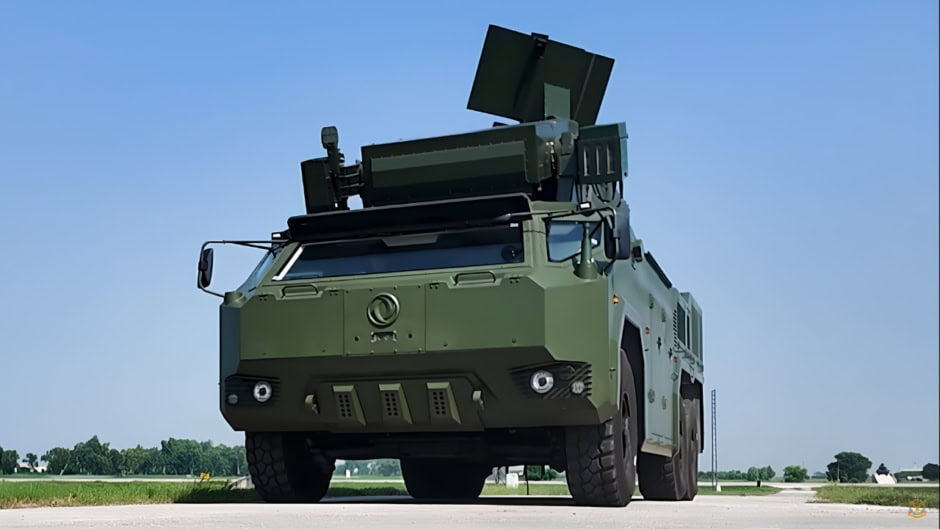
The Pakistan Air Force (PAF) just quietly showcased a massive upgrade to its military arsenal. Just after midnight, the PAF released a promotional music video on its YouTube channel titled “Fizaon K Pasbaan” (Guardians of the Skies). Around the 28-second mark, a new 6×6 wheeled air defense vehicle briefly rolled across the screen. Interestingly, Pakistan did not officially name the system, nor did it disclose contract details, unit quantities, or delivery dates. However, viewers quickly noted its resemblance to China’s HQ-17A. By Monday evening, Chinese state media and military accounts officially confirmed the system as the Chinese HQ-17AE export variant.
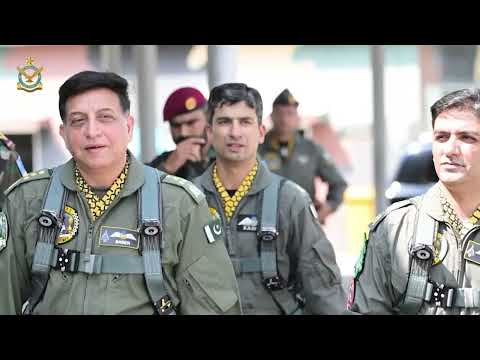
Furthermore, the video served as the first confirmation that Pakistan has acquired Turkish ASELSAN systems, specifically the KORKUT 35 mm and ŞAHİN 40 mm. Consequently, this highlights a strategic shift for Pakistan. The country is diversifying its short-range defense suppliers away from an exclusive reliance on China. This move further cements an August 2026 joint defense agreement between Pakistan, Saudi Arabia, and Türkiye.
Pakistan acquired these systems to address a severe short-to-medium range air defense gap. This vulnerability was brutally exposed last year during the May 2025 India-Pakistan war. During the conflict, India forced Pakistan to counter massive drone swarms. India utilized over 600 drones in a single wave to map and saturate Pakistani defenses.
Therefore, Pakistan needed a cost-effective, multi-layered point-defense shield to neutralize swarms before they could reach critical assets.
Chinese HQ-17AE Specifications & Capabilities
The HQ-17AE is manufactured by the China Aerospace Science and Industry Corporation (CASIC), specifically its Second Academy in Beijing. Historically, the HQ-17 is a reverse-engineered copy of the Russian Tor-M1. China originally purchased Tor-M1s in the late 1990s. Later, they resorted to reverse engineering the system after Russia refused to grant a domestic production license in 2000.
Today, the system is mounted on a roughly 30-tonne Dongfeng chassis. It boasts an 800 km road range and a transit speed of 90 km/h. Crucially, it can conduct combat operations, including searching, tracking, launching, and guiding missiles, while moving at a constant speed of up to 25 km/h.
The vehicle is equipped with a PESA search radar, which has a 45 km detection range and can survey 48 targets while tracking 24. Additionally, it uses an AESA guidance radar. The system uses a vertical cold-launch mechanism. A mechanical catapult ejects the 165 kg interceptor missile at 25 m/s (90 km/h) before the rocket motor ignites. Guidance is radio-commanded all the way to interception. Therefore, the vehicle must survive and maintain radar tracking until the missile’s proximity fuze detonates the 15 kg fragmentation warhead.
According to the manufacturer, the system achieves a single-shot kill probability of over 0.85 against aircraft and over 0.80 against missiles.
Here is a brief breakdown of HQ-17AE engagement envelopes:
| Target Type | Slant Range Envelope | Altitude Ceiling Envelope |
| Non-Stealth Aircraft | 1.5 km – 15 km | 10 m – 8 km |
| Stealth Aircraft | 1.5 km – 9 km | 10 m – 6 km |
| Missiles | 1.5 km – 8 km | 10 m – 5 km |
A standard battery relies on a heavy support footprint. It consists of one command vehicle, four combat vehicles, and 16 missile modules. Each combat vehicle holds two four-round vertical packs, meaning a four-vehicle battery provides 32 ready-to-fire missiles. Reloading is handled by a Shaanxi SX2306 crane-equipped vehicle, which lifts four missiles per cycle.
A Three-Tiered Point-Defense Shield
The HQ-17AE operates with a minimum engagement range of 1.5 km. This creates an inner blind spot that must be filled by gun-based systems. Consequently, the HQ-17AE does not extend Pakistan’s maximum defensive reach. Instead, it provides a high-density interception layer before targets reach the terminal zones.
Pakistan’s newly compressed point-defense shield now operates in three distinct tiers:
- Outer Missile Layer (1.5 km – 15 km): The Chinese HQ-17AE intercepts threats that successfully bypass fighters and longer-range SAMs (such as the HQ-9BE, HQ-16FE, or LY-80).
- Middle Gun Layer (~4 km): The Turkish ASELSAN KORKUT takes over. These vehicles fire twin 35 mm cannons at a blistering 1,100 rounds per minute. They utilize programmable ATOM (tungsten fragment) and I-ABM (anti-UAV pellet) airburst ammunition.
- Inner Gun Layer (~700 m): The Turkish ASELSAN ŞAHİN 40 mm system provides the final line of defense against penetrating drones.
The Chinese PR Takeover & Capability Disputes
Despite the impressive hardware, controversies remain regarding the system’s actual performance. Chinese state media and CASIC brochures claim a single HQ-17AE can simultaneously guide four missiles against four separate targets. However, independent defense analysts heavily dispute this claim. They assess that the system likely maxes out at two simultaneous engagements, which is identical to the Russian Tor-M1 it was cloned from.
Furthermore, analysts point out the stark contrast in unveiling optics. In 2024, Serbia formally and proudly announced their HQ-17AE acquisition via their Prime Minister. Conversely, Pakistan hid the system in a split-second video frame. Ultimately, Islamabad stayed silent while Beijing stepped in to manage the global public relations announcement.