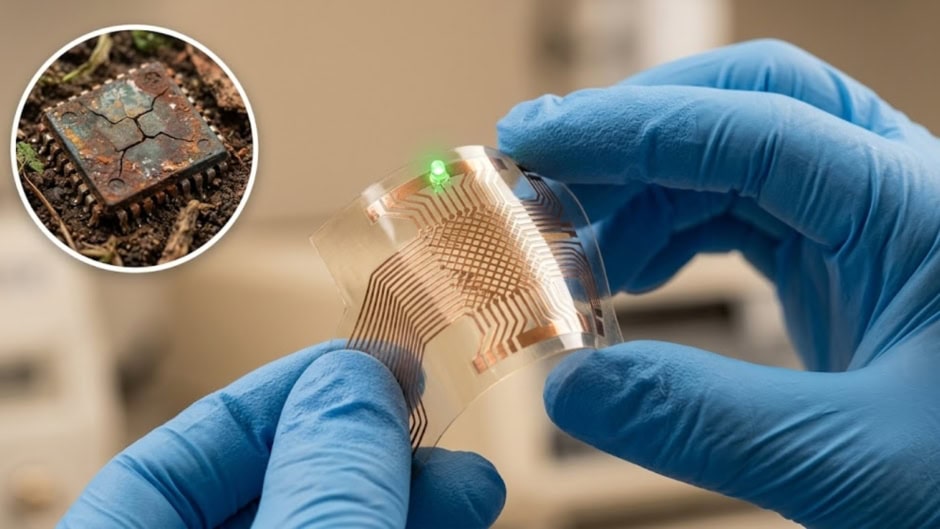
Researchers have developed a stretchable battery that runs on air moisture. It draws water from the surrounding air to generate electricity. That removes the need for conventional liquid electrolytes entirely. The work comes from Rice University and North Carolina State University.
The moisture-activated battery uses simple, safe components. It pairs a magnesium anode with a silver chloride cathode. A cellulose membrane infused with lithium chloride salts sits between them. The membrane absorbs air moisture, dissolving the salts into an electrolyte.
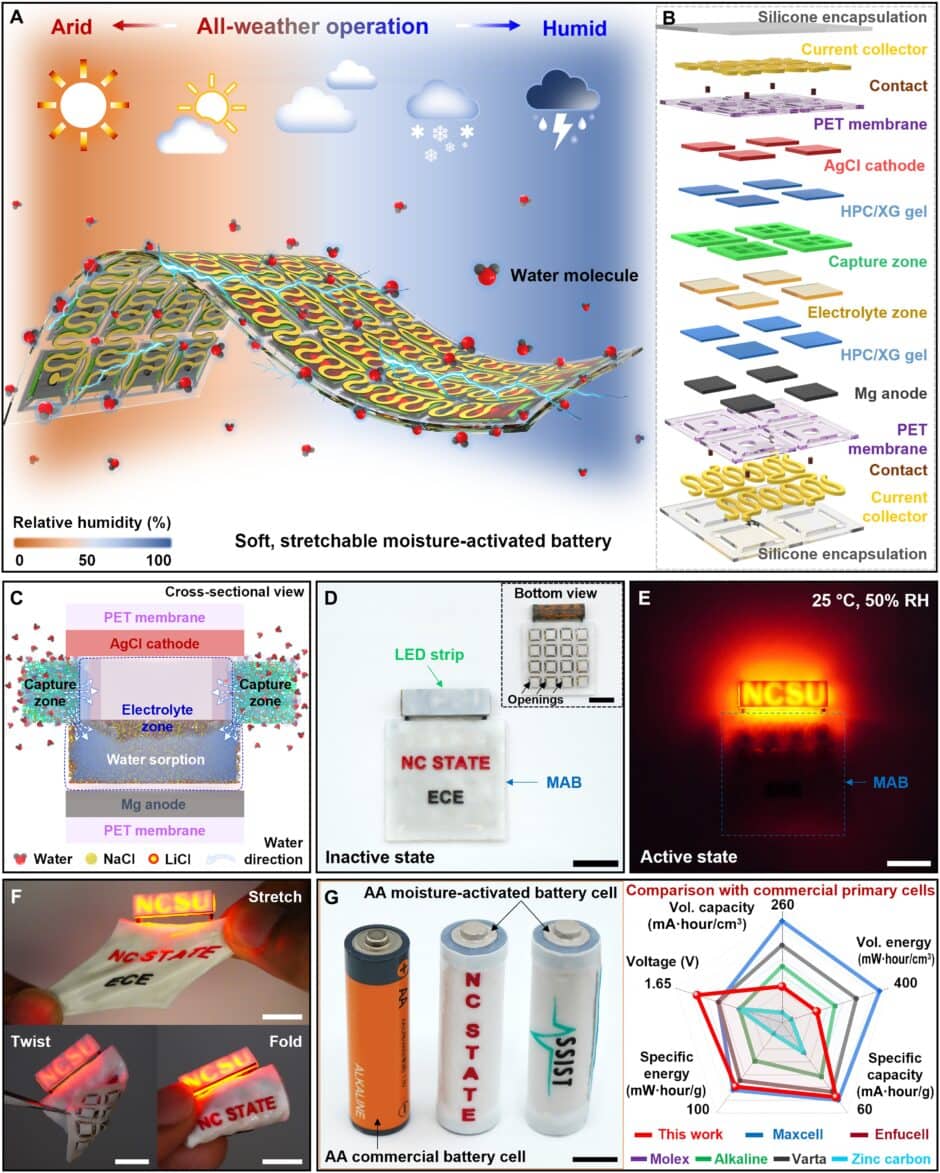
The design offers several practical advantages. It stays inactive while sealed inside its packaging. That gives it a long shelf life before first use. It also avoids the toxic, flammable electrolytes in standard batteries.
The battery draws inspiration from an unusual source. Its overlapping, scale-like structure mimics a pangolin’s armor. That layout minimizes empty space created during stretching. It helps preserve energy density while bending, twisting, or expanding.
Researchers proved the battery works in real devices. It powered a wireless Bluetooth oximeter for up to 30 hours. That performance matches conventional batteries in similar devices. It suits wearables, tiny robots, and remote sensors.
The most striking feature is a built-in kill switch. The team added a moisture-triggered self-destruct mechanism. It stores a dry mix of aluminum and iodine powder in a sealed compartment. Tampering breaches that compartment and lets moisture reach the chemicals.
The resulting reaction generates intense heat. It can engulf the device in flames and destroy its electronics. In one test, a wireless gas sensor was destroyed within three minutes. That included its embedded computer chips.
The researchers see broad potential for the technology. The battery is lightweight, biocompatible, and biodegradable. They frame it as a possible alternative to lithium-ion cells.
The study appeared in the journal Science Advances.