Scientists have discovered a new way to control quantum light sources by twisting atomically thin layers of hexagonal boron nitride, a breakthrough that could help bring quantum technologies closer to practical use. Researchers from the University of Technology Sydney found that rotating and restacking layers of the material can significantly alter the color and wavelength of light emitted by quantum emitters embedded within it.
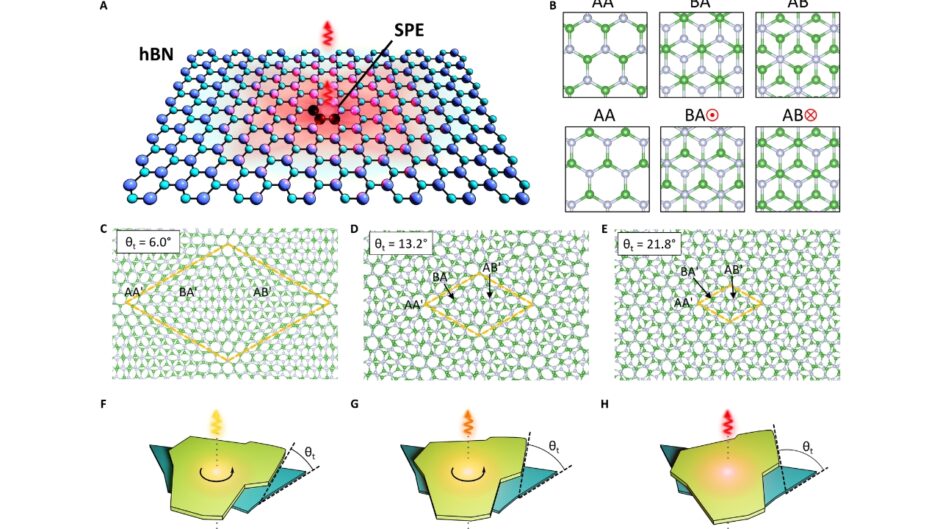
Quantum emitters are tiny light sources capable of producing single photons, making them essential building blocks for future quantum computers, secure communication networks, and highly sensitive sensors. While scientists have long been able to detect and study these emitters, controlling them precisely has remained a major challenge. The research team’s approach offers a new way to tune these light sources by exploiting hBN’s unique layered structure, a material that can be repeatedly separated, twisted, and reassembled.
Lead author Dr. Angus Gale said the findings give researchers a practical new tool for manipulating quantum emitters. “You can measure these quantum emitters and see that they exist, but it’s hard to make them work in practice. This gives us a lever to get closer to that, a step towards the realisation of quantum technologies,” Gale said. In experiments, the team produced a significant shift in emitted light simply by changing the twist angle between layers, repeatedly picking up, twisting, and restacking the material while continuing to modify its optical properties.
“We’re leveraging the fact that this material is layered. We can pick it up, stack it, twist it, and use that twist to modify the emitters. You can’t really do that with traditional materials like diamond or silicon carbide,” Gale explained, comparing hBN to slices of cheese rather than a solid block. “With a block of cheese, you can’t really get to the flavour in the middle. But with slices, you can peel away layers, put them back together and change how they interact.”
Professor Igor Aharonovich added that twisting layered materials this way can produce entirely new physical behaviors. “You can take two layers that don’t do much on their own, put them together at a specific angle, and suddenly you have a completely different system,” he said.
The amount of tuning achieved exceeded what researchers typically observe in many other quantum emitter platforms, offering a larger degree of optical control than conventional methods allow. The team believes the approach could eventually contribute to advances in quantum computing, quantum communication, and quantum sensing technologies used across healthcare, cybersecurity, and navigation. The study was published in Advanced Materials.