Apple launched a new research study and a dedicated iPhone app to explore how people interact with AI-powered health tools. The Apple Health AI Study App contains a generative AI chatbot that answers health questions using peer-reviewed medical citations. It also pulls data directly from the user’s Apple Health profile to personalize responses.
The study accepts up to 200,000 eligible US residents aged 21 or older.
Apple built the app in collaboration with OpenEvidence, a clinical AI platform trained on peer-reviewed medical research and clinical guidelines. According to Apple’s announcement, the study aims to understand what drives user trust in health AI, how well responses match clinical standards, and whether the tools change everyday health decisions.
Here’s the app’s description on the App Store:
Help Apple build better health AI products.
Join the Apple Health Al Usage Study and help us explore how Al can support you in understanding your health. When you join the study, you’ll get access to a custom app built on technology from OpenEvidence, an Al platform trained on peer-reviewed medical research and clinical guidelines. Ask the app all your health questions and get answers personalized to you based on Apple Health data you choose to share.
Any time you have a health question, ask the app. You can use it to:
• Understand symptoms or conditions
• Put your personal Health data in context
• Prepare for a medical visit
• Build a personalized exercise or meal planQuestions you ask support research that can help Apple make health Al smarter for everyone.
Neither the app nor the research study provides medical advice, diagnosis, or treatment. Consult a medical professional to address health concerns or verify information.
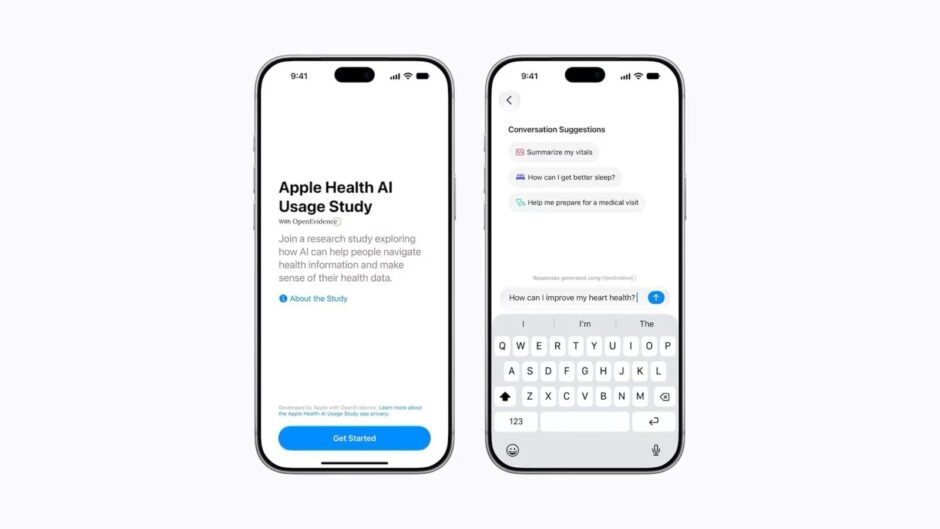
The app covers a broad range of health use cases. Users can ask about symptoms and conditions, put their personal health data in context, prepare questions for a doctor’s visit, or build personalized exercise and meal plans. The AI generates answers based on both the user’s Apple Health data and peer-reviewed sources. Where necessary, it links directly to the clinical citations behind each response.
However, Apple made one thing clear upfront. The app does not provide medical advice, diagnosis, or treatment. The company told users to consult a medical professional for any health concerns.
Participation requires an iPhone 15 Pro or newer running iOS 26 or later. That hardware requirement limits the pool to users with relatively recent devices. It also suggests the app relies on on-device AI processing capabilities available only in newer chips.
“At Apple, we believe responsible innovation starts with scientific rigor and clinical grounding. Health is deeply personal, and conducting a dedicated research study is the most thoughtful way to understand how people engage with, comprehend, and evaluate health AI in everyday life,” said Sumbul Desai, M.D., Apple’s vice president of Health and Fitness. “Insights from this study will help advance the broader scientific conversation and ensure that as technology evolves, we continue building trusted tools that genuinely support people wherever they are on their health journey.”
This study represents Apple’s most direct move into AI-powered health tools. The company already dominates health tracking through the Apple Watch and the Health app. Adding a conversational AI layer on top of that data creates a foundation for future health features baked into iOS itself.
The timing aligns with broader industry trends. Google, Amazon, and Microsoft have all invested heavily in health AI products over the past year. By framing its entry as a research study rather than a product launch, Apple gathers real-world usage data while managing liability and user expectations. The insights will shape how Apple designs health AI experiences across its ecosystem going forward.
For now, the study and app remain US-only. Apple has not announced plans to expand the research to other markets.