
VGO Tel seized market leadership in Pakistan’s locally assembled phone segment during the first seven months of 2026. The brand recorded 2.14 million locally assembled units, surpassing longtime leader Infinix at 1.88 million units and signaling major competitive dynamics reshaping Pakistan’s domestic handset manufacturing landscape.
The shift represents dramatic reversal from 2025 performance. Infinix commanded market leadership throughout 2025 with 3.65 million units, narrowly ahead of VGO Tel’s 3.57 million. VGO Tel’s January-July 2026 surge demonstrates aggressive market-building strategy resonating with Pakistani consumers seeking locally assembled alternatives.
Itel maintained third position at 1.57 million units during the period, followed by Tecno at 1.06 million. Samsung recorded 0.94 million units while Vivo posted 0.90 million. Nokia rounded out major competitors at 0.88 million assembled units.
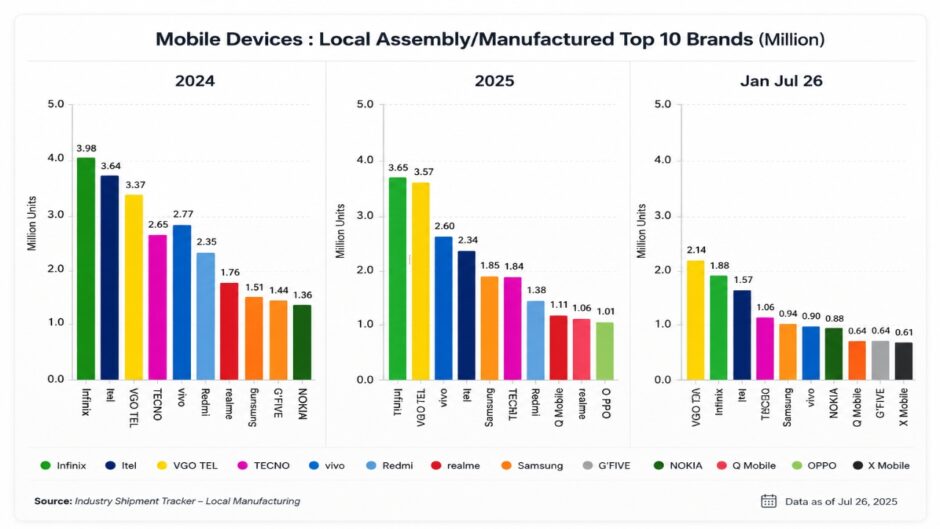
The competitive shifts extend deeper into 2024 data. Infinix led 2024 assembly with 3.98 million units, followed by Itel at 3.64 million and Vivo at 3.37 million. Three years of data reveals sustained volatility among assembly leaders as consumer preferences shift and manufacturers adjust production strategies.
These figures underscore Pakistan’s growing domestic manufacturing commitment. Local assembly reduces import dependence while generating employment across production, logistics, and distribution sectors. Government initiatives incentivizing assembly operations encouraged major handset brands establishing manufacturing facilities across Pakistan.
VGO Tel’s competitive gains likely reflect strategic pricing, improved availability, and successful distribution channel development. The brand’s momentum suggests consumer confidence in locally assembled devices meeting quality expectations at competitive price points.
Competition among manufacturers maintains downward price pressure benefiting consumers. Increased assembly capacity demonstrates Pakistan’s evolving role within global handset supply chains, reducing reliance on finished product imports while building technical expertise domestically.