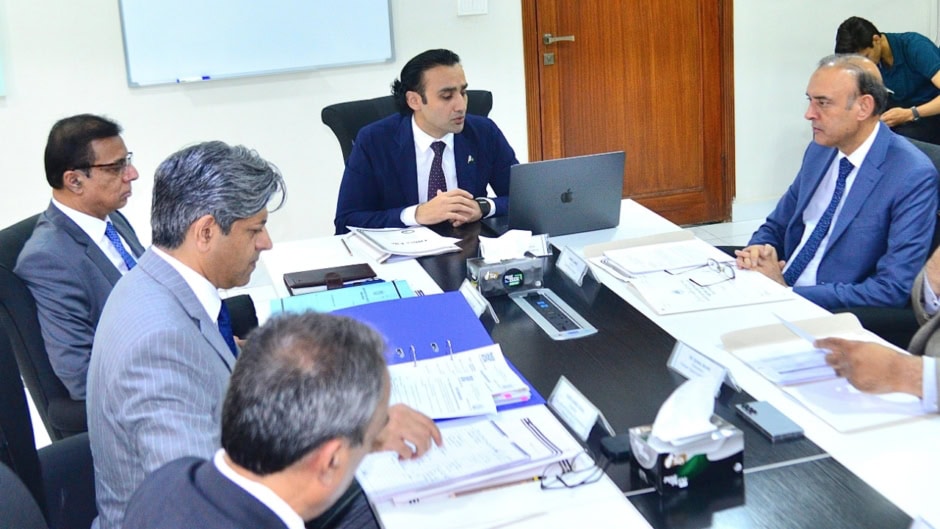
Seventy companies have applied to operate legally in Pakistan’s virtual asset market, PVARA Chairman Bilal Bin Saqib told TechJuice during a briefing with the authority’s team in Islamabad.
Eighteen months ago the sector had no legal existence here at all. Now it has a queue.
The count follows a hard deadline. Under Section 70 of the Virtual Assets Act, 2026, every firm already offering virtual asset services in or from Pakistan had until 5 September to file for a No Objection Certificate. File, or stop. Seventy filed.
Among them are some of the largest names in global crypto. Binance and HTX took NOCs from PVARA in December 2025 and are moving through the licensing pipeline now, alongside a mix of international platforms and Pakistani startups filing for the first time. The authority has been careful about what that certificate means: a first step under supervised entry, not a blanket approval. The licence comes later.
Bilal shared that the parliament passed the Act in March. Licensing opened within six months. For a regulatory build in Pakistan, that is fast enough to be worth remarking on.
The authority’s ambition is not limited to policing exchanges. PVARA team framed the licensing regime as a way to pull established global operators into the country while giving local businesses a legitimate route into an industry most of them have been running at the edges of.
The AI argument
Asked what any of this means for freelancers and founders, Saqib turned to AI.
“Everything is being redefined, especially digital assets and AI.”
His argument runs like this. As AI systems start generating real economic value, they will need to move money themselves, and they will not do it through correspondent banking. That opens a category Pakistan could build for rather than adopt late — agentic payment workflows, engineered here, sold to users and businesses anywhere.
Asked by TechJuice CEO Talal Ch how quickly this moves from paperwork to a functioning market, Saqib was blunt about the pace inside the authority.
“Myself and the PVARA team are operating at full capacity to make this happen and place Pakistan in the top slots of new-age financial technology. This is the first time Pakistan is leading sectoral innovation on a whole other level.”
Pakistan has spent two decades importing financial technology built elsewhere and adapting it late. The pitch here is the reverse of that, and its audience is the country’s developer and freelancer base: large, young, English-speaking, already invoicing Western clients, and asking a fair question about how it gets paid in 2030.
The remittance prize
The team also laid out the fiscal case. Pakistan received a record $38.3 billion in remittances in FY25, up 27 percent, and the State Bank has since revised its FY26 projection up to $42 billion. Shave one percentage point off the cost of moving that money and roughly $400 million a year stays with Pakistani families instead of the payment chain.
That figure matters more now than it did a year ago. The old incentive schemes that kept Pakistan’s corridor among the world’s cheapest cost the exchequer Rs206 billion in FY25, and the State Bank wound up the Telegraphic Transfer incentive for banks in July. The subsidy that bought cheap remittances is gone. Something structurally cheaper has to replace it or the price goes up.
PVARA has been laying groundwork. It signed an MoU with SC Financial Technologies in January to explore stablecoin-based cross-border payments. In April, the State Bank cleared banks to open accounts for licensed VASPs — without which a regulated corridor has nowhere to put the money it moves.
Shariah, written into the statute
The longer play is Islamic digital finance. The Virtual Assets Act mandates a Shariah Advisory Committee inside PVARA, and licensed firms offering Shariah-compliant products must follow its rulings. Few countries have written that requirement into a dedicated virtual assets statute. Whether a standing statutory body answers the permissibility question faster, or more credibly, than scholars ruling case by case is untested — but in a market where religious permissibility drives household behaviour, the question is not a footnote.
The demand signal is there. Global sukuk issuance hit a record of roughly $300 billion in 2025, with outstanding sukuk crossing $1 trillion, and Fitch counts Pakistan among the core markets alongside the GCC, Malaysia, Indonesia and Türkiye. At home, the government raised over Rs2 trillion through sukuk last year, the biggest annual haul since Islamic bonds arrived in 2008. Almost none of that market has been built for digital distribution.
Pakistan already ranks third worldwide on the Chainalysis 2025 crypto adoption index, with an estimated 40 million users transacting almost entirely outside formal channels.
Seventy applications, forty million users. That gap is the story, and it does not close at the filing stage.