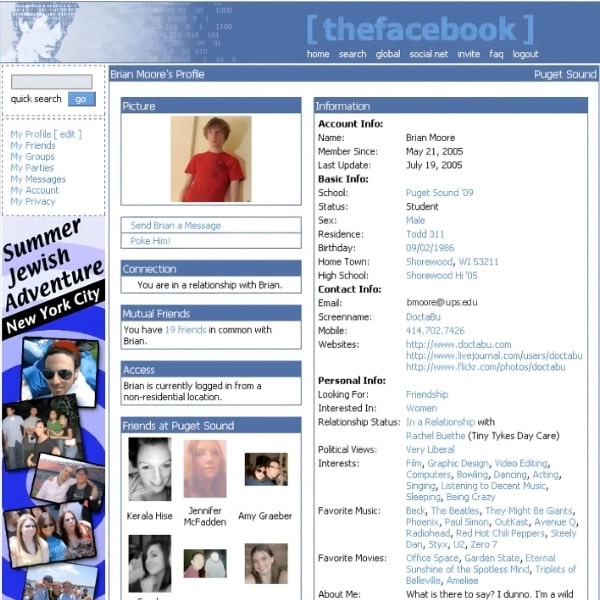
Today is February 4, 2026. Exactly twenty-two years ago, a Harvard sophomore named Mark Zuckerberg launched a site called “TheFacebook“. It initially started as just a simple directory for college students. But today it has grown into a global empire. Facebook changed the way we talk, the way we shop, and the way we see the world.
The journey wasn’t as easy as it sounds. Facebook’s history is marked with massive protests, billion-dollar fines, and existential threats. Yet, Meta stands today as a dominant force in Artificial Intelligence (AI) and social connection. Here’s a breakdown of how the “Social Graph” evolved from a small dorm-room project into a trillion-dollar architect of the future.
The Foundation of Facebook: Engineering Identity & Scarcity (2004-2011)
In 2004, the internet was a messy place. Sites like MySpace allowed users to build chaotic profiles with clashing colours and auto-playing music. But Facebook chose a totally different path. It offered a clean, blue-and-white aesthetic that focused on real identity. Initially, you needed a Harvard email to join. This exclusivity created intense demand.
Though everything changed in 2006 when Zuckerberg opened the platform to the general public. He also launched the “News Feed” in the same year. At first… users hated it. They called it “stalker-esque” and organised massive protest groups. However, the data told a different story. Engagement soared because users could finally see what their friends were doing in real-time.
By 2009, the “Like” button arrived. It clearly wasn’t just a button… it was a data goldmine. It allowed Facebook to finally understand exactly what its users preferred at a level never seen before. Consequently, advertisers started coming to the site in flocks. They moved away from broad demographics and toward precise behavioural targeting.
The Facebook Empire Era: “Copy, Acquire, or Kill” (2012-2021)
As the 2010s began, mobile phones became the primary way people accessed the web. Facebook struggled at first because its desktop ads didn’t fit small screens. To survive, Zuckerberg pivoted the company toward a “mobile-first” strategy. He also began a ruthless campaign to protect his “social moat”.
In 2012, Facebook bought Instagram for $1 billion. Many critics thought the price was insane for a company with thirteen employees. They were wrong. Instagram became the home of visual culture and reached over 2 billion users. Two years later, Facebook spent $19 billion on WhatsApp to secure the global messaging market.
When companies refused to sell, Facebook copied them. In 2016, Instagram launched “Stories” to crush Snapchat. This “copy, acquire, or kill” strategy ensured that no competitor could steal the limelight for long. Meanwhile, the company launched the Facebook Pixel in 2015. This tool tracked users across the entire web. It turned Facebook into a surveillance-based advertising powerhouse that generated billions.
The Turbulence: Scandals, Crashes & Pivots (2018-2023)
The “move fast and break things” era eventually caught up with the company. In 2018, the Cambridge Analytica scandal broke. It revealed that data from 87 million users had been harvested without consent for political targeting. The backlash was global. Governments held hearings, and the FTC eventually levied a record-breaking $5 billion fine.
Further trouble arrived in 2021 when Apple released its App Tracking Transparency (ATT) feature. This allowed users to opt out of tracking, costing Meta roughly $10 billion in revenue in a single year. Feeling the pressure, Zuckerberg rebranded the company to “Meta” in October 2021. He bet the future on the “metaverse”, an immersive virtual world.
However, the transition was painful. In February 2022, Meta’s stock plummeted 26% in a single day. It was the biggest one-day value drop in history. To fix the ship, Zuckerberg declared 2023 the “Year of Efficiency”. He cut over 21,000 jobs and flattened the management structure. This lean approach worked, and investor confidence returned.
The Now: AI Dominance & Legal Victories (2024-2026)
As Facebook celebrates its 22nd birthday today, the company looks very different. The metaverse vision hasn’t vanished, but AI is now the star. Meta’s Llama models have become the industry standard for open-source AI. By releasing powerful AI “weights” for free, Meta has undercut competitors like OpenAI and Google.
Moreover, Meta recently won a massive legal battle. On November 18, 2025, U.S. District Judge James Boasberg ruled that Meta does not hold a monopoly in the personal social networking market, dealing a significant blow to the Federal Trade Commission’s (FTC) antitrust case. The court found that the FTC failed to prove anticompetitive behaviour regarding the acquisitions of Instagram and WhatsApp, noting that intense competition from platforms like TikTok and YouTube meant Meta lacked monopoly power.
Today, shockingly, Facebook is still the most-used app in the world, with over 3 billion monthly users. It has evolved from a simple collegiate directory into a sophisticated AI company. The demographics have obviously aged, but Meta’s ability to adapt remains its greatest strength. Twenty-two years later, the “Social Graph” is more complex than ever, and Mark Zuckerberg is still at the helm, moving fast and, finally, building with stable infrastructure.