
Meta has begun notifying advertisers that it will introduce location-based surcharges on ads delivered in certain jurisdictions from 1 July 2026, passing on the cost of digital services taxes (DST) that the company has previously absorbed itself. The fees, which range from 2% to 5% depending on the country where an ad is shown, will be added on top of whatever advertisers spend on their campaigns after delivery. These are beginning from European Union and Turkey in the first phase.
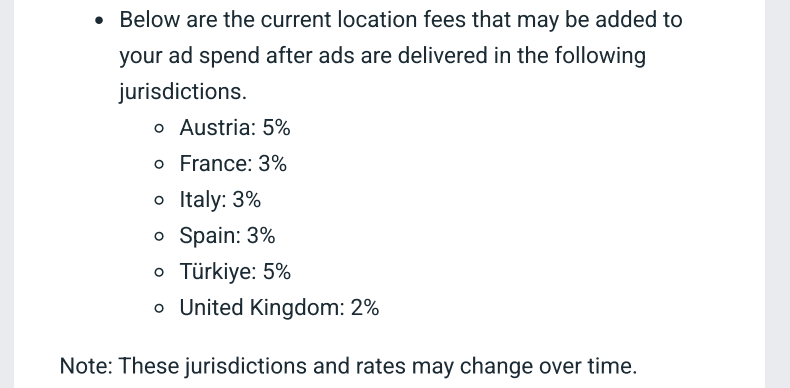
The charges are calculated on where an ad is actually seen, not where the advertiser’s business is based. An advertiser in Pakistan or the United States running a campaign targeting European audiences will be subject to the same fees as a European business doing the same. The rates as currently announced are: Austria at 5%, Turkey at 5%, France at 3%, Italy at 3%, Spain at 3%, and the United Kingdom at 2%.
Using Meta’s own example from the notification email: a $100 campaign delivered to an Italian audience becomes $103 after the location fee is applied, with any applicable VAT then calculated on top of that combined total. The fees will be itemised on invoices by jurisdiction, for example listed as “Italy digital services,” so advertisers can see exactly what they are paying and where.
Crucially, Meta will not count location fees against campaign budgets. The charge is applied after delivery, meaning advertisers cannot simply reduce their budget to account for the surcharge. The full budgeted ad spend will be consumed, and the fee will appear as a separate line item on top.
The fees apply to all ad formats including image and video, and also cover WhatsApp click-to-message campaigns and WhatsApp marketing messages that are invoiced alongside regular ads. They do not apply to other WhatsApp paid messaging products.
In its notification to advertisers, Meta said the regulatory landscape around digital services taxes has been evolving, and that it has until now covered those costs itself.
“These updates reflect Meta’s continued commitment to adapting to regulatory developments,” the company said, adding that other major platforms have implemented similar charges and that the move is consistent with industry norms.
Digital services taxes have been a persistent point of friction between large US technology platforms and European governments for years. Countries including France, the UK, Austria, Spain, and Italy have each introduced their own DST frameworks, typically levying a percentage charge on revenues that tech giants earn from digital advertising and marketplace services within their borders. The rates Meta is now passing on to advertisers broadly mirror the DST rates those governments impose at the national level.
Meta’s email advises advertisers to review which of their ad accounts are affected, and to share the notification with finance, procurement, media, and marketing teams so that budget planning can be adjusted before July. Businesses running significant campaigns targeting European audiences will need to factor the additional charge into their cost-per-acquisition calculations, as campaigns that were previously profitable may require revised bids or budget increases to maintain the same return.
For advertisers whose audiences are concentrated in Austria or Turkey, the 5% surcharge is the most significant. A business spending $10,000 per month reaching Turkish consumers, for instance, will see an additional $500 added to its bill from July onwards.
Meta said advertisers with questions can contact Meta Pro support or their dedicated Meta sales representative