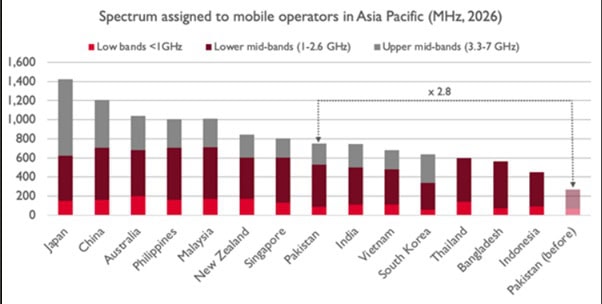
Following the 5G spectrum auction, Pakistan has been put ahead of India and next to Singapore, as per GSMA report.
The recent multiband spectrum auction in Pakistan has captured the attention of industry stakeholders and observers alike, marking a significant turning point in the country’s telecommunications landscape. The auction, completed in early March 2026, saw the country’s three mobile operators, Jazz, Ufone and Zong, acquire a total of 480 MHz across four core mobile bands (700 MHz, 2.3 GHz, 2.6 GHz and 3.5 GHz) for $510 million (PKR 142 billion).
The result represents a major boost to the overall spectrum supply for mobile services, expanding the total supply by 2.8 times to over 750 MHz. Prior to the auction, only around 270 MHz was available, among the lowest in APAC and globally. With each operator acquiring more than 100 MHz of mid-band spectrum, this sets the foundation for 5G deployment in the world’s fifth most populous nation.
Previous auctions in Pakistan have often resulted in unsold spectrum due to high reserve prices and limited interest, for example, in 2014 (850 MHz, 1800 MHz) and in 2021 (1800 MHz, 2.1 GHz), and this has contributed to slower 4G rollout and adoption. The country has also been affected by high inflation rates, currency depreciation, and rising energy costs, all of which negatively impacted consumer spending and increased operating costs for the telecom industry over the last decade.
This time, however, the Ministry of Information Technology and Telecommunication (MoITT) and the Pakistan Telecommunication Authority (PTA) demonstrated strategic foresight and pragmatism in the auction planning process, recognising the importance of making spectrum accessible and affordable in order to support investment in national digital infrastructure.
First, spectrum was made available across multiple bands and reserve prices were kept at reasonable levels (below market prices from recent auctions such as Bangladesh and Vietnam) to encourage participation.
Second, a decision was also made to denominate auction payments in local currency PKR based on exchange rate at time of auction, instead of USD as in previous auctions. This is in line with international practices and promotes more certainty for operators, avoiding the risk of currency fluctuations in financial markets.
Third, the auction included a combination of coverage and quality of service obligations to be met over four phases over the next decade. These comprised deployment of new 4G and 5G sites in specified locations and minimum downlink and uplink speeds. These obligations reflect a growing trend globally towards assignment approaches that provide certainty and incentives for investment in expanding mobile connectivity. Governments are increasingly prioritising investment and long-term socioeconomic benefits over short-term income from licence fees or auction proceeds.
Pakistan is just at the start of the 5G journey, and there are still challenges ahead as it strives towards its vision of Digital Pakistan. These include further fiscal reforms on telecoms sector taxation to align with digital development goals, improving affordability of mobile devices and connectivity, accelerating adoption and digital transformation across all segments of society.