An international research team has achieved a record-breaking result in photonic chip engineering, trapping light on a chip for more than one million cycles before it fades. The breakthrough, published in Nature Materials, solves a fabrication problem that has blocked the use of van der Waals materials as structural building blocks in photonic devices for years.
Van der Waals materials have long attracted scientific interest because of their exceptional optical and electronic properties. Their surfaces are atomically smooth and free of imperfections that would otherwise scatter light and reduce chip performance. However, standard fabrication tools are simply too aggressive for these delicate substances. Conventional methods such as focused ion beam lithography damage the crystal lattice, distorting the precise structures needed to trap and guide light efficiently.
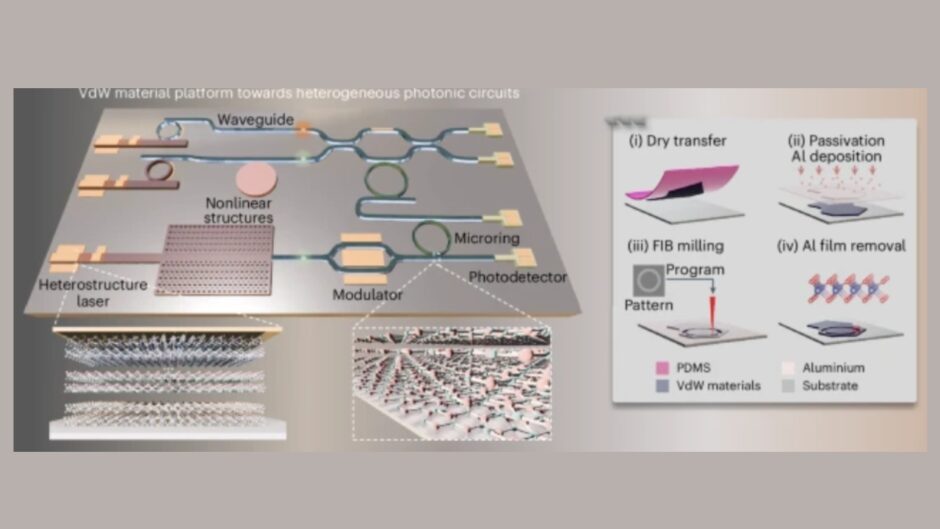
“Yet, despite their enormous potential, using vdW materials as structural building blocks has remained a major challenge,” said Xiaoqi Cui, one of the lead authors of the research paper. “This aluminium layer works like a microscopic suit of armour,” added Andreas Liapis, another research member. “It absorbs the destructive impact of the ion beam.”
The research team explained how they solved this with a simple but effective approach. Before shaping the material, they coated it with a thin aluminum layer that absorbs the impact of harsh fabrication tools, acting as a protective shield. This allowed researchers to carve tiny circular disk structures called microdisks with the precision and smoothness the material requires, without degrading its properties.
The microdisks allow light to circulate inside them with minimal loss. The devices achieved quality factors above 1,000,000, meaning only around one part per million of the light escapes per cycle. This performance surpasses previous van der Waals resonant systems by three orders of magnitude. Because light stays confined so effectively, it interacts far more strongly with the material itself, dramatically amplifying nonlinear optical effects. In testing, researchers observed a 10,000-fold increase in second harmonic generation efficiency, a process that converts light from one frequency to another.
The advance moves van der Waals materials from being passive coatings layered onto conventional silicon-based chips to becoming active structural components in their own right. The researchers say this opens new possibilities for reconfigurable photonic circuits, quantum light sources, and highly sensitive optical sensors built directly onto chips, all without relying on traditional silicon platforms.
You can read the research paper here.