Anthropic released Claude Opus 4.8 on May 28, 2026, upgrading its flagship model with improvements across coding, reasoning, and agentic tasks. The model is available everywhere today at the same price as its predecessor, Opus 4.7.
What Is New in Opus 4.8 Itself
The headline improvement is honesty. Anthropic says Opus 4.8 is more likely to flag uncertainties and less likely to make unsupported claims than earlier models. The company reports the model is around four times less likely than Opus 4.7 to let flaws in its own code pass unremarked. This directly targets a common AI weakness, where models confidently claim progress despite thin evidence.
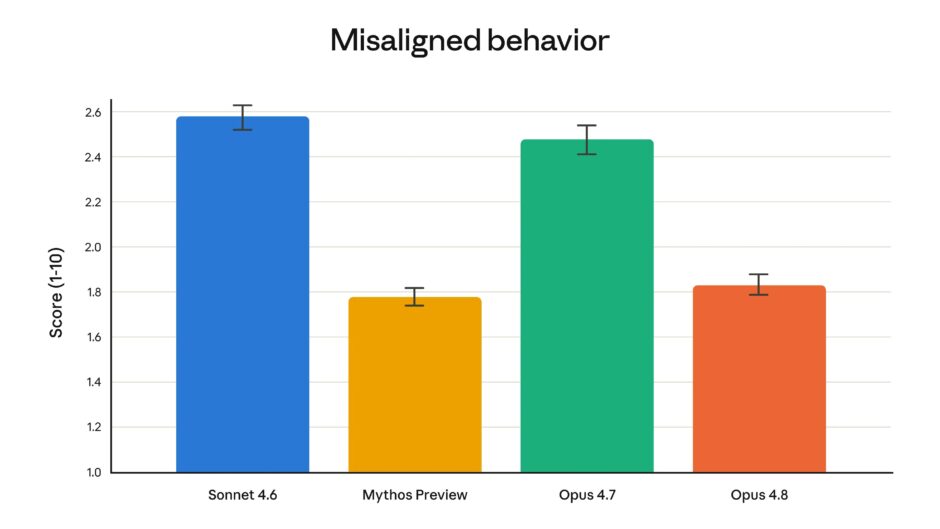
Opus 4.8 also shows sharper judgment in agentic work. Early testers found it asks better questions, catches its own mistakes, and pushes back when a plan is unsound. On Anthropic’s alignment assessment, the model reached new highs on prosocial traits like supporting user autonomy. Its rates of misaligned behavior fell substantially below Opus 4.7, approaching the company’s best-aligned model, Claude Mythos Preview.
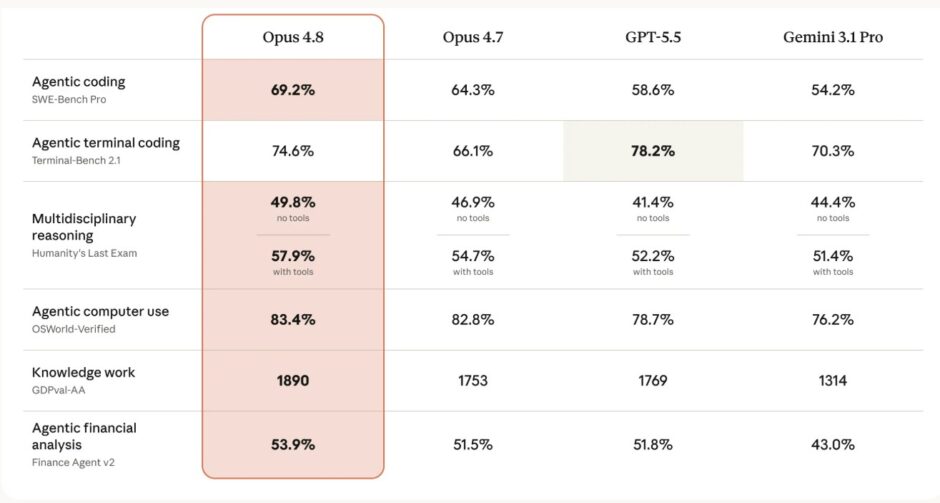
Benchmark gains span the board. Testers reported Opus 4.8 as the strongest computer-use and browser-agent model yet, scoring 84% on Online-Mind2Web. It also set new records on legal and financial benchmarks, becoming the first model to break 10% on one legal all-pass standard. Tool calling is more efficient, using fewer steps to reach the same result.
Three New Features Launching Alongside the Model
First, effort control is now live on claude.ai and Cowork. A new control beside the model selector lets users decide how hard Claude works on a response. Higher settings produce deeper thinking and better answers, while lower settings respond faster and consume rate limits more slowly. This control is available on all plans. Opus 4.8 defaults to high effort, with “extra” and “max” options for harder tasks.
Second, dynamic workflows arrive in Claude Code as a research preview. This feature lets Claude plan large tasks, run hundreds of parallel subagents in a single session, and verify its outputs before reporting back. Claude can now handle codebase-scale migrations across hundreds of thousands of lines of code from start to merge. The feature is available on Enterprise, Team, and Max plans.
Third, the Messages API now accepts system entries inside the messages array. Developers can update Claude’s instructions mid-task without breaking the prompt cache. This allows live updates to permissions, token budgets, or environment context while an agent runs.
Fast mode for Opus 4.8 runs at 2.5 times the speed and is now three times cheaper than it was for previous models. The company shared:
As always, we ran a detailed alignment assessment on the model before release. In terms of positive traits, our Alignment team concluded that Opus 4.8 “reaches new highs on our measures of prosocial traits like supporting user autonomy and acting in the user’s best interest.” The assessment also showed Opus 4.8 to have rates of misaligned behavior (such as deception or cooperation with misuse) that are substantially lower than Opus 4.7, and similar to our best-aligned model, Claude Mythos Preview.
Pricing and What Comes Next
Pricing stays unchanged at $5 per million input tokens and $25 per million output tokens. Fast mode costs $10 per million input tokens and $50 per million output tokens. Developers can access the model via the API using the string claude-opus-4-8.
Anthropic also confirmed bigger plans ahead. The company is developing cheaper models with Opus-level capabilities, plus a new class of model more intelligent than Opus. As part of Project Glasswing, a small group of organizations already uses Claude Mythos Preview for cybersecurity work. Anthropic expects to bring Mythos-class models to all customers in the coming weeks, once stronger cyber safeguards are in place.