Global app releases surged 60% year-over-year in the first quarter of 2026, with AI-powered coding tools potentially driving a new wave of creators without traditional technical skills to build mobile applications.
According to analysis from market intelligence provider Appfigures, worldwide app releases across Apple’s App Store and Google Play increased 60% in Q1 2026 compared to the same period last year. The iOS App Store alone saw an even sharper 80% increase. In April 2026, total app releases jumped 104% across both stores and 89% on iOS compared to the previous year.
The findings challenge predictions that AI chatbots and agents would drive users away from apps entirely. Instead, the data suggests AI may be making app creation more accessible to people with ideas but without coding expertise, potentially sparking a rebirth of the app ecosystem.
Apple Senior Vice President of Worldwide Marketing Greg Joswiak recently quipped that rumors of the App Store’s death in the AI age “may have been greatly exaggerated.” His comments reference concerns from industry figures like Nothing CEO Carl Pei, who has focused on building smartphones for an AI-first era where apps could become obsolete.
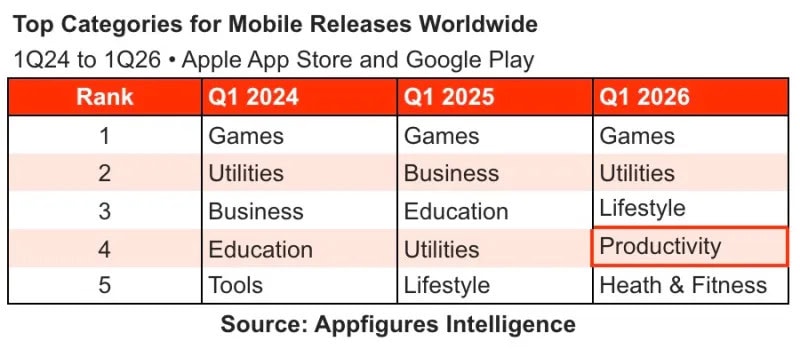
Certain app categories are experiencing disproportionate growth. Mobile games continue accounting for most new releases worldwide as of Q1 2026, consistent with prior years. However, productivity apps have moved into the top five categories this year, while utilities jumped to the number two slot. Lifestyle apps climbed from fifth place last year to third, with health and fitness applications rounding out the top five.
The working hypothesis among analysts is that AI-powered development tools like Claude Code and Replit are behind the surge. The industry may be reaching a tipping point in AI usability where people can leverage these tools to build desired mobile apps more quickly or create their first apps without traditional programming knowledge.
The explosion of new app submissions could be contributing to recent high-profile App Store review failures. This week, Apple removed rewards app Freecash from the App Store for rules violations after allowing it to climb into the top five for several months. The company also failed to catch a malicious cryptocurrency app, a clone of Ledger Live, that drained $9.5 million in crypto from victims’ accounts.
Despite these incidents, Apple maintains significant app review infrastructure. The company’s most recent 2024 analysis showed it removed or rejected more than 17,000 apps for bait-and-switch violations, rejected over 320,000 submissions found to be spam or misleading, and took action to prevent more than 37,000 potentially fraudulent apps from reaching users.
Industry observers including technology commentator John Gruber have long argued the App Store needs a dedicated team to monitor scammy or fraudulent apps gaining popularity or generating high revenue. If AI-assisted development is indeed driving the surge, this need will intensify as more applications flood the marketplace.
The trend contradicts earlier predictions about computing platforms potentially eclipsing smartphones. The New York Times reported last year on the potential for smart glasses, ambient computing devices, or reimagined smartwatches with AI features to replace traditional smartphones. OpenAI is even developing an AI hardware device with former Apple designer Jony Ive.
However, current data indicates AI may be expanding rather than contracting the app ecosystem by democratizing development. The shift could represent a fundamental change in who creates mobile software, moving beyond professional developers to include creators, entrepreneurs, and individuals with specific use cases but limited coding experience.
The productivity and utilities categories seeing significant growth align with the hypothesis that non-technical users are building apps to solve personal or niche problems. These categories typically include tools for specific workflows, automation, or task management that individuals might create for themselves or small communities.
As the app development landscape evolves, questions remain about quality control, security implications, and whether platforms like the App Store can scale review processes to handle the influx while maintaining safety standards. The tension between accessibility and oversight will likely define the next phase of mobile app ecosystems.