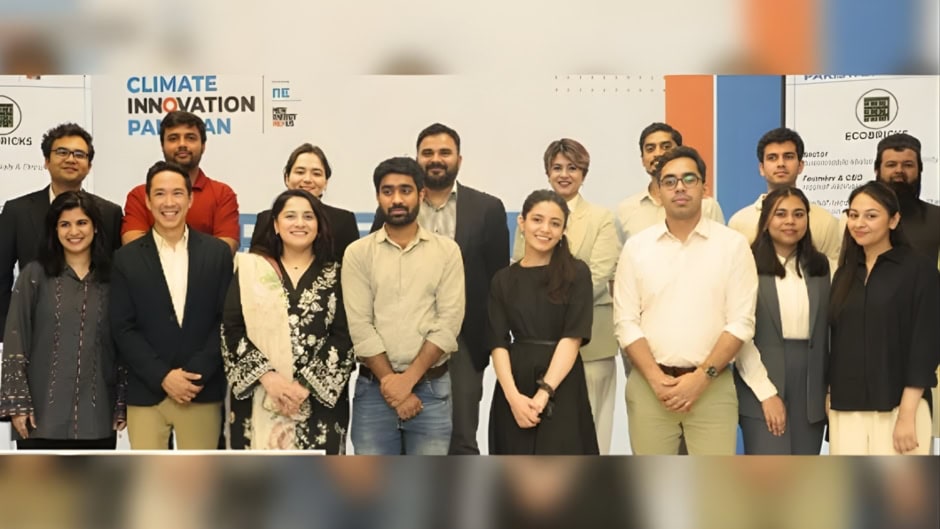
Eleven climate and clean energy startups have graduated from the inaugural cohort of Climate Innovation Pakistan (CLIP), a joint national platform by Renewables First and New Energy Nexus, as the country accelerates efforts to build homegrown solutions for its deepening energy crisis.
The 12-week incubator program provides capacity building, tailored mentorship, investor access, and regulatory guidance to climate-focused ventures. Unlike traditional entrepreneurship programs, CLIP takes a market-first approach, pushing startups to prove whether their solutions work in Pakistan technically, financially, and at scale.
The inaugural cohort was showcased at CLIP Demo Day, where eleven startups presented solutions built for Pakistan’s climate realities. Over the 12-week journey, founders moved through validation, pilot testing, business model refinement, and investor readiness, translating early-stage ideas into investable ventures.
Climate Change Secretary Aisha Moriani, who served as guest of honor, praised the creativity on display, noting that the startups incubated at CLIP reflect the kind of innovation the ministry is looking to support as it pushes for climate resilience and a clean energy transition. She emphasized that with Pakistan facing a deepening energy crisis, such initiatives are essential to unlocking scalable, homegrown solutions in the climate-tech space.
The cohort spans energy, mobility, water systems, agriculture, and climate intelligence sectors. In clean mobility, PakPlug is building an “Airbnb for EV charging,” enabling private charger owners to monetize unused infrastructure. Founder Roha Rehan, an Electrical Engineering graduate from Lahore University of Management Sciences, aims to make electric vehicle charging accessible and community-driven across Pakistan.
In climate intelligence, Nimbus Labs is deploying AI-powered forecasting tools for climate-sensitive sectors. The startup addresses Pakistan’s severe gaps in weather monitoring and forecasting by using AI and IoT-driven weather stations and machine learning models powered by low-cost sensor networks to deliver hyper-local precipitation nowcasts and medium-range forecasts.
Pani Express is rethinking urban water delivery through smart logistics, addressing water scarcity challenges in Pakistani cities through improved distribution systems. Meanwhile, Recycle Bin, founded by Adeela Ali, secured a Rs 3 million investment during the program, demonstrating investor confidence in the cohort’s viability.
EPO focuses on closed-loop farming systems using renewable energy and recycled water to produce consistent, high-quality crops while reducing water and energy consumption. The solution offers resilience in water-stressed regions where agricultural productivity faces threats from water scarcity and rising energy costs.
Moiz Bhatti, an environmental advocate and founder of National Incubation Center Islamabad, co-leads EPO with a team of environmental scientists focusing on AI-driven solutions.
MycieBlue produces compostable, lightweight materials using mycelium grown from organic waste, offering low-carbon solutions for packaging and future construction applications. The startup addresses growing plastic pollution while providing sustainable alternatives that are often costly or hard to access in developing markets.
Algaverse develops bio-fertilizers offering a climate-resilient, lower-cost alternative aligned with global soil restoration goals, helping farmers improve yields while reducing synthetic fertilizer use. Founder Nayab Raza, a PhD candidate in Environmental Biology at the University of Manchester, aims to provide farmers with sustainable, low-emission alternatives that improve soil health and reduce dependence on chemicals that degrade soil, raise input costs, and worsen emissions.
The event highlighted a broader shift in Pakistan’s energy landscape, driven by increased solar adoption, emerging electric mobility solutions, and rising climate awareness. However, speakers noted a key gap: while the transition is gathering pace, the innovation pipeline required to sustain it remains at an early stage.
Other startups in the cohort are moving toward pilot projects, partnerships, and early-stage commercialization, indicating growing traction in Pakistan’s climate technology sector. The program represents part of New Energy Nexus’s global mission supporting more than 10,000 clean energy entrepreneurs worldwide.
tanley Ng, Global Partnerships Director of New Energy Nexus, noted that Pakistan is the world’s fifth most populous nation with its largest industries in high carbon-emitting sectors, creating immense opportunity to ignite development of groundbreaking climate tech innovations. The CLIP Incubator aims to help founders scale solutions, build resilient businesses, and contribute to a cleaner, more inclusive economy.
The graduation comes as Pakistan positions itself for a historic climate and clean energy moment, with the government and private sector increasingly recognizing the need to support locally developed climate solutions. The success of the inaugural cohort will likely influence future climate innovation initiatives across the country.