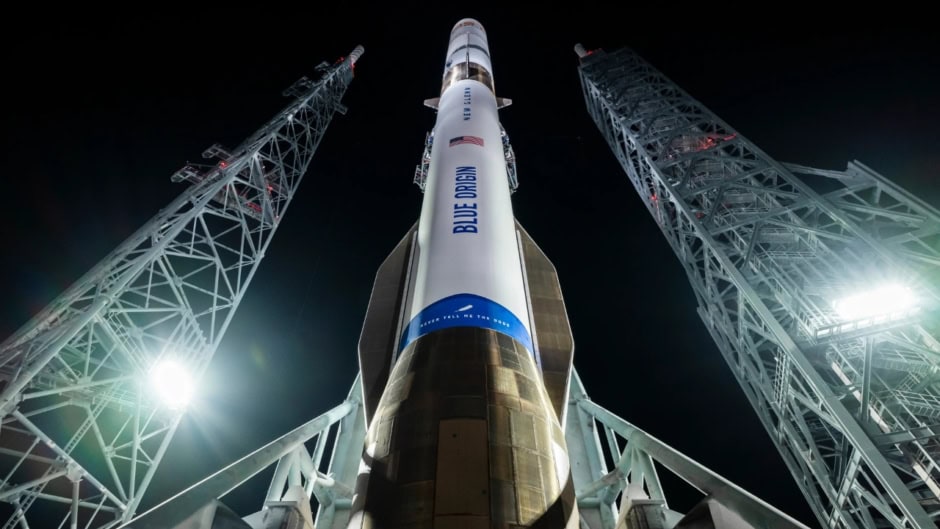
Yesterday, Blue Origin achieved a historic reusability milestone but critically failed its primary mission. Jeff Bezos’ space company successfully reused a New Glenn rocket for the very first time. However, the mission ultimately failed to deliver its customer payload to the correct destination.
A Costly Orbit Error
The New Glenn rocket carried AST SpaceMobile’s BlueBird 7 communications satellite. The mega-rocket lifted off at 7:35 AM local time from Cape Canaveral, Florida. Roughly two hours after launch, Blue Origin announced a severe error. The rocket’s upper stage placed the satellite into an “off-nominal”, lower-than-planned orbit.
Consequently, the satellite cannot sustain operations. The hardware successfully separated and powered on, but it is now useless. It must be de-orbited and left to burn up in Earth’s atmosphere.
Fortunately, an insurance policy covers the entire cost of the lost satellite. Furthermore, AST SpaceMobile expects to finish building successive BlueBird satellites in approximately one month. The company still plans to launch 45 more satellites by the end of 2026 using multiple launch providers.
Reusability Success of New Glenn Amidst Failure
Despite the complete payload loss, the initial launch sequence showcased a major technical achievement. Roughly 10 minutes after liftoff, the first-stage booster landed flawlessly on an ocean drone ship. Specifically, Blue Origin reused the exact same booster from New Glenn’s second mission in November 2025.
Jeff Bezos quickly shared drone footage of the successful landing on X. Subsequently, rival Elon Musk offered his congratulations on the social media platform.
— Jeff Bezos (@JeffBezos) April 19, 2026
Future Implications for Blue Origin
This incident represents the first major failure for the New Glenn program. The company spent over a decade developing the rocket before its initial debut in January 2025. By comparison, SpaceX spent years flying test versions of Starship with dummy payloads to work out early kinks. Blue Origin instead chose to launch commercial payloads early in the testing process.
Now, this upper-stage failure could threaten Blue Origin’s broader ambitions. NASA and the Trump administration are currently pressuring the company to put landers on the moon by the end of President Donald Trump’s second term.
Interestingly, Blue Origin recently finished testing its first uncrewed lunar lander. The company originally considered launching this lander on yesterday’s mission. Ultimately, they decided to launch the commercial AST SpaceMobile satellite instead. Blue Origin has not released any further information regarding the upper-stage failure.